
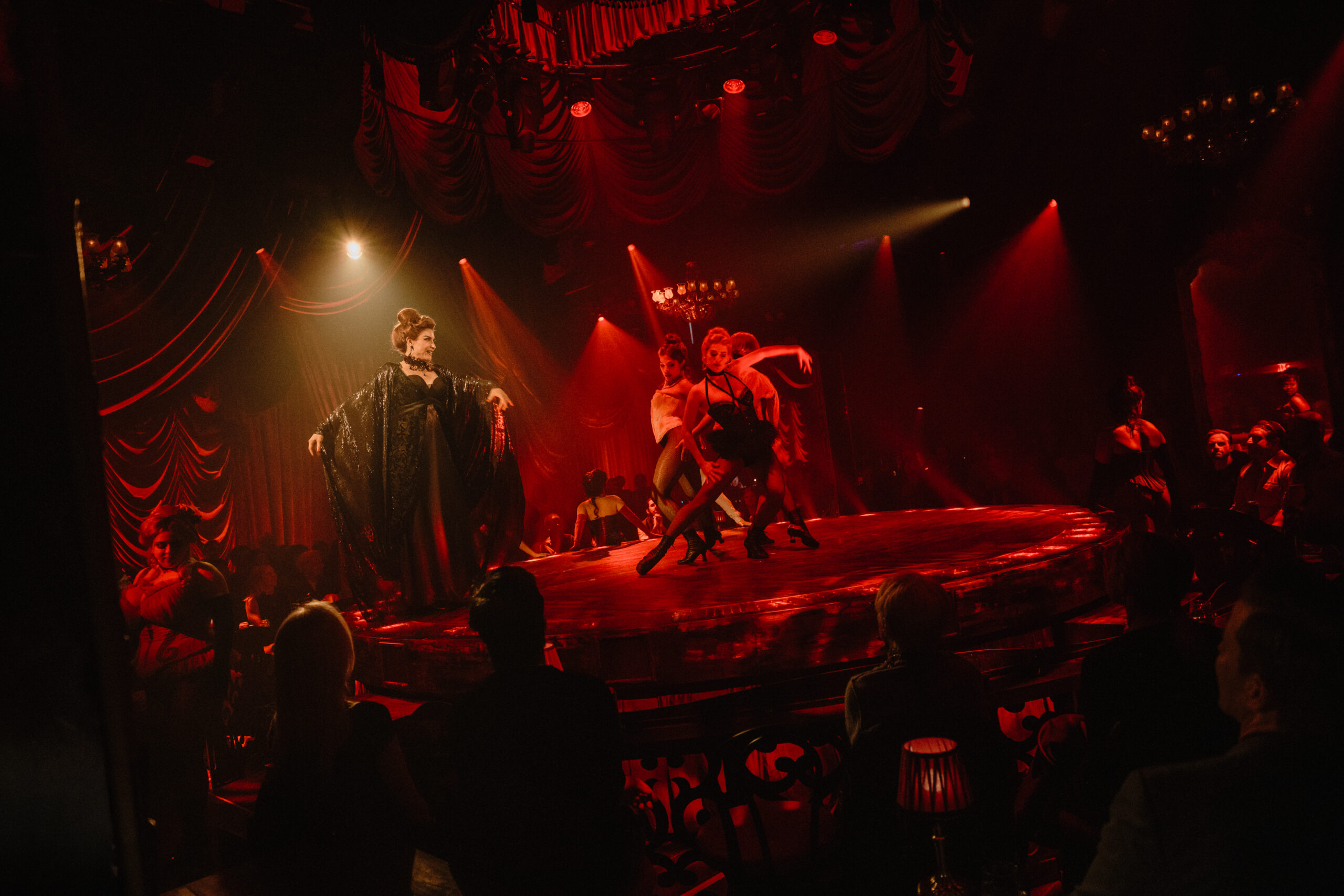
Jenny Powers and the ensemble in Memoirs of Amorous Gentlemen. Photo: Andy Henderson
Memoirs of Amorous Gentlemen, based on the manga by Moyoco Anno, bills itself the first American musical adaptation of a manga series, though there are plenty of others on the London stage. The possibilities of manga/manhwa seem endless as a source for content, with visual style baked right in, but this show’s creators—book writer Leah Nanako Winkler, composer/lyricist Duncan Sheik, and director/choreographer Rob Ashford—haven’t quite cracked the code on the adaptation, on turning something that’s episodic and designed to be read in private by women into something that’s a public event for a general audience.
The show looks great, with a lush aesthetic for the characters (costumes by Catherine Zuber and wigs/hair by Tom Watson) that translates Moyoco’s art onto real bodies, in a style that’s one part period flair (Paris, turn of the twentieth century), one part camp, one part edge, one part down-at-the-heels glam. (“If Moulin Rouge is first class,” says the script, “the Night Egg is coach.”) The Culture Club space, designed by Scott Pask, brings that louche nightclub ambience, with little glowing ruby lamps (lighting by Brian Tovar) dotting the audience seated at cafe tables and with a brass-frame bed that descends from the flies. Rob Ashford directs and choreographs effectively in the round, using the periphery of the stage and the mirrored platforms that frame it to create more locations for movement.
But for a show so enmeshed in the dark and complex underbelly of human desire, its characters are oddly flat, with motivations that are one-dimensional (or completely opaque). We might know what the men want in bed, but we get very simple psychology about what that says about them, or even simpler philosophy about the lessons to be learned from their perversions–but even that is more than we learn about the women. One is lovesick, one is queer, one is losing her grip on reality, and that’s about it.
Part of this comes from a fuzziness in the point of view of Leah Nanako Winkler’s book. Colette (Sophia Anne Caruso), our central character, is a Parisian prostitute who turns tricks to support herself and her lover, aspiring painter (and thorough cad) Leon (Corey Jeacoma). She’s approached by Sakae (Marc delaCruz), a Japanese failed novelist, with a proposition: Write down what you see around you. He’ll pay for her observations at the Night Egg in hopes of finding a book in them. So, sometimes the show we are watching is the raw material of Colette’s life—the clients and their outre desires; the day-to-day routine of the girls at the club; Colette’s own yearning for the unredeemable Leon. Sometimes the show seems to be the story Colette is spinning, the “better version” she imagines to replace the least satisfying features of her existence. But sometimes we leave Colette’s perspective entirely to follow Leon into his betrayal of Colette with Nana (Nkeki Obi-Melekwe), a higher-class courtesan. (And if there’s little justification for why Colette continues to give Leon the time of day, let alone support him, at least they have a shared past to fall back on. I have no idea why Nana puts up with him for more than 90 seconds.)
If the book has too many perspectives, Duncan Sheik’s music, so full of edge and confusion in Spring Awakening, doesn’t have any: neither the grit and the grind of the women’s lives or the funk and thrill of the men’s. There’s either plaintive prettiness or anodyne peppiness to most of the Individual songs. Many of them are pretty, but none of them feel like they’re rooted in time, place, or character, and the lyrics are often painfully expository.
Caruso and delaCruz do their best to create grounded characters in Colette and Sakae, but the broader, weirder portrayals are more successful here: Elsa Keefe as the bubbly and slightly delusional Carmen. Obi-Melekwe’s imperious Nana, who’s happy to shade into villainess when that’s convenient. Starr’s Ulysse, utterly matter-of-fact as he switches from talking to barking.
While Memoirs gets pretty explicit in its staging of oral sex, threesomes, and very specific fantasy scenarios (intimacy coordinator Erica Mansfield feels deeply necessary here), the actual eroticism gets trapped in that same perspective conundrum: Colette is honest with Sakae that the satisfaction she gets from pleasing her clients isn’t sexual, so the show can’t go too far down the road of perverted pleasure fest. But we are meant to find some sort of honesty and satisfaction in the men’s needs getting met: Henry (Michael Everett), who wants to be a bird; Willy (Caleb Marshall), who likes to dress in women’s clothing and get his body shaved; Emile (Austin Lesch), a voyeur with a clown fetish; and Ulysse (Michael Starr), a dog living in the body of a man. They’re all liberated by the Night Egg. The women are just living lives of slightly more lucrative drudgery than they would in a sewing factory.
Still, if the sex isn’t particularly sexy, at least it’s not particularly sleazy or exploitative either, and it’s blessedly lacking in sentimentality. There are no Pretty Woman scenarios here; Winkler and Sheik are clear-eyed about whose desires are being met and the limited choices available to the women meeting them. Memoirs of Amorous Gentlemen’s most unrealistic fantasy, in the end, may be Colette’s ultimate success as a writer.