
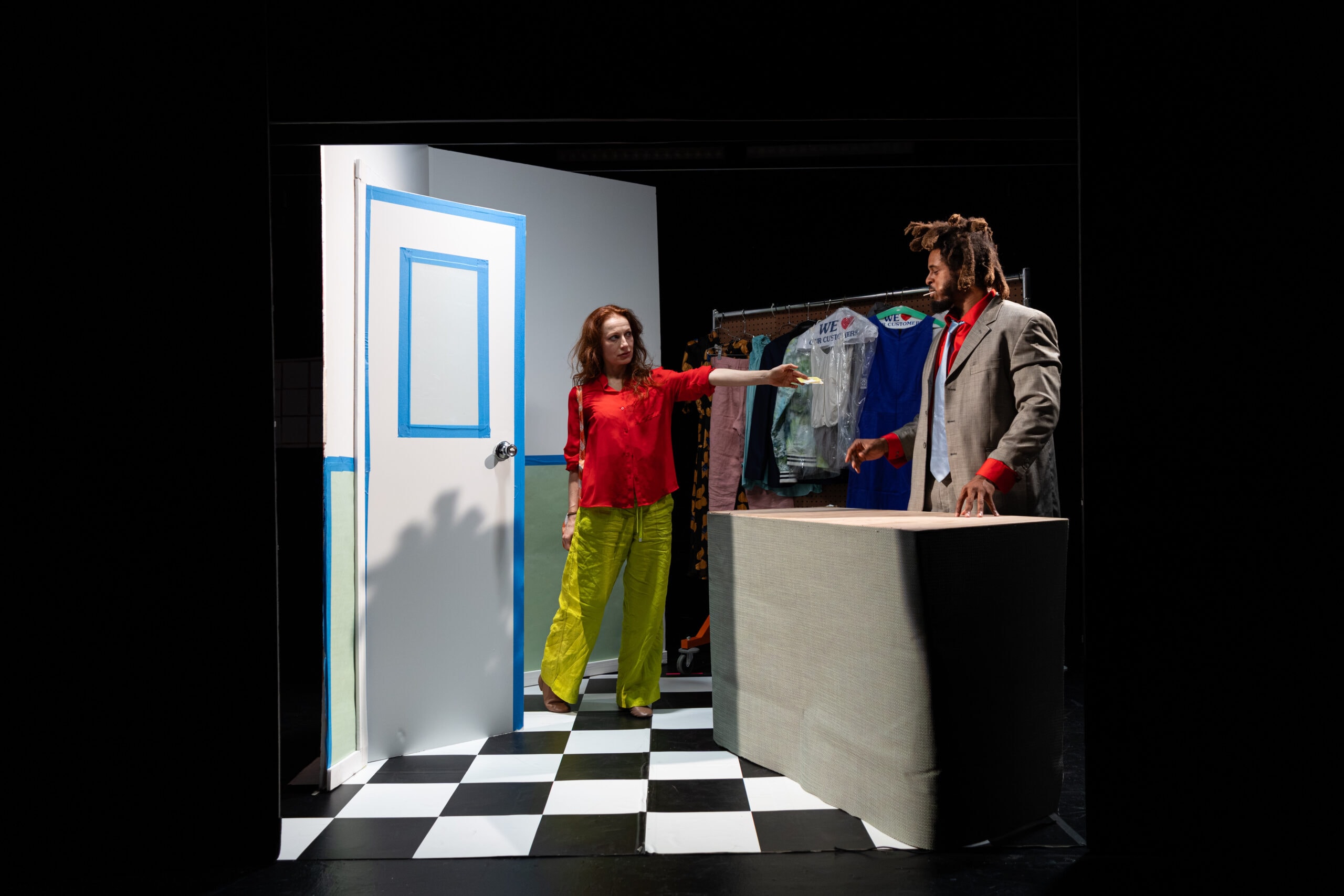
Tatyana Kot and Essence Lotus in The Kick Inside. Photo: Jose Miranda
One could argue that “too much” (or, more precisely, “intriguing element repeated often enough that it becomes entirely too much”) is a key component of the aesthetic of legendary avant-garde theater-maker Richard Foreman. It makes sense, then, that there is a Richard Foreman scene embedded like a downtown-theater Easter egg in the center of The Kick Inside, a surrealist “exquisite corpse” of a dreamscape. Crafted by one director (Nicolás Noreña), thirteen New York writers (twelve of the scenes were created for this piece; the one by Foreman, for obvious reasons, was not), an international ensemble of eight actors, three designers, and a live Foley artist, The Kick Inside is an intentional onslaught of too much, channeled straight at the backbrain and the subconscious, with the audience left to hold it all in our heads and puzzle out how the scenes and characters fit together. Most of it is linguistically opaque–sometimes intriguingly and provocatively so, often self-importantly or carelessly so. Certain scenes are intentionally visually obscured in ways that at their best cleverly use apertures and frames created by Normandy Sherwood’s set to force unusual perspective and at their worst feel like intentional frustration of the audience’s desire to see the work. (From a purely technical perspective, a lot of things that take place at floor level are invisible to much of the audience even when they’re not meant to be.)
In other words, director Noreña throws an awful lot of spaghetti at the wall: the philosophy of Gurdjieff, sentient bedrooms, witches, angels, dogs that are and are not dogs, locksmiths, mystical libraries, and outer space, to name just a few elements. Some of it indeed sticks, leaving individual images and scenes standing out on grounds of visual cleverness, linguistic wordplay, or conceptual intrigue, but the thing as a whole remains very far on the side of random assemblage rather than integrated theater piece. I confess I don’t understand the connection to the Kate Bush album that gives the piece its title (although that song does play over the first scene). Sherwood’s set is an ever-unfolding puzzle box of walls and floors and cartoonish doors that sometimes recalls an even more skewed Pee-Wee’s Playhouse and its most disorienting literally hangs the characters in mid-air. And the live Foley work of Marija Kovačević adds vivid freshness to Robin Margolis’s sound design.
For me, the scenes that work best are the ones where the performers are actually engaging with one another, where there’s something to the scene on its own that works, whether it connects meaningfully to the whole or not: Jess Barbagallo’s “The Apartment,” where our quasi-protagonist Alenka (Tatyana Kot) has to mediate a dispute between a strange possibly alien man who has appeared in her room (Timothy Scott) and the consciousness of the room itself (Alenka Kraigher); the invocation of the consciousness of a room reminded of me of Crumble, one of my favorite Sheila Callaghan plays. John Jesurun’s “The Bus Stop,” a riff on Waiting for Godot involving a possibly dying alien and a dog who is also a man (Felix Teich). And Nazareth Hassan’s “The Locksmith,” where Hassan is clearly having so much fun with the characters’ malapropically mangled proverbs (as a performer, Essence Lotus brings particular relish to this task) that the murky philosophical underpinnings can get hand-waved away. (It is an amusing oddity about seeing this show the day after The Curious Case of Benjamin Button that a penchant for a misstated aphorism is possibly the only conceivable link between the shows.)
As an experience to just wash over you and let the moments that strike you strike you, The Kick Inside has its pleasures. As a thing whose pieces cohere into a larger whole, it has its frustrations. Your overall enthusiasm for it may depend on which of those things you appreciate more.
Personally, as much as I enjoy being freed to wander the surreal and the experimental, I also like to feel like the intentionality behind the connections. I know that the purpose of the exquisite corpse exercise is the opposite of intentionality–it’s leveraging the vectors of chance into art. But I still feel like there is more shaping that could have been done here once the dice had been rolled.