
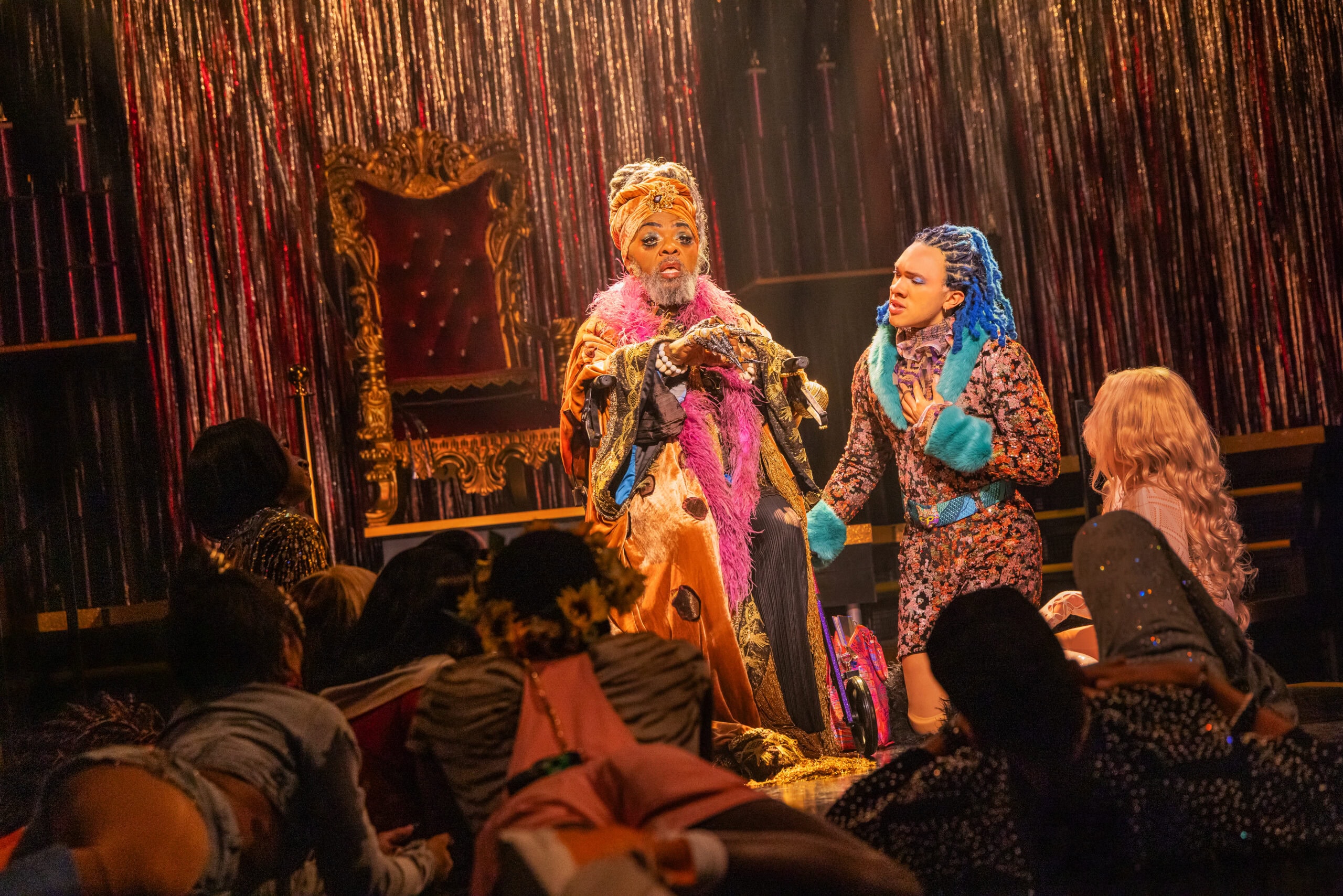
Junior LaBeija and Bryson Battle in Cats: The Jellicle Ball. Photo: Matthew Murphy and Evan Zimmerman for MurphyMade
It is easy, as a full-fledged theater critic with a penchant for non-realist dramaturgy and complicated modern dance and a general aversion to excessive whimsy, to forget the uncomplicated joy I took in Broadway musicals when I was a nerdy little drama kid. Which is to say, child me wholeheartedly adored Cats (second only to perhaps A Chorus Line, which I saw way too young, and that’s a story for another time). And despite my adult impatience with the last twenty-plus years of Andrew Lloyd Webber, despite my adult understanding that actually it kinda helps if a musical has a plot and some characters, well, it turns out I still know every goddamn note and lyric from the original score of Cats. But I would never have been dragged back to see it purely on nostalgia, and both its junkyard whimsy aesthetic and its loose revue structure sorely needed a refresh.
Giving Cats a plot was always going to be a tall order, but the inspiration that the creators of Cats: The Jellicle Ball (directors Zhailon Livingston and Bill Rauch along with choreographers Omari Wiles and Arturo Lyons, who originated the show last summer at PAC) have had is to place all of the spectacle and nonsense of OG Cats into a container that rewards every dose of extra that can be thrown at it, and also adds an underlying logic to its one-unrelated-musical-number-after-another progression. That container is, of course, drag ballroom culture, with each musical number restaged as a “battle” between two of the “kittens” and a whisker more of a plot added into Act 2.
Cats: The Jellicle Ball can’t get away from the inescapable silliness of a virtually plot-free musical inspired by a book of children’s poetry by T.S. Eliot. The underlying material remains intentionally nonsensical and full of weird British cultural and geographical references. But the conceit magnetizes the whole endeavor, gets all its oddities pointed at the service of the spectacle itself–and also gives the performers a recognizable human reason to be heading for a Jellicle Ball. Rather than a bunch of twee novelty songs about feline behavior, they’re firmly tongue-in-cheek performances in the service of building a character, a community, and a culture. Rather than a bunch of performers in faux-mangy fur trim, they’re performers strutting their stuff, embracing their queerness, and competing (complete with celebrity judges throughout much of act 1; mine were actors Wendell Pierce and Alex Newell, who both seemed delighted to participate). The wigs, makeup, and costumes alone, by Nikiya Mathis, Rania Zohny, and Qween Jean respectively, should be ample evidence for no one to ever do leotards-with-tails Cats ever again. Everyone gets a look that defines the character, bright with color and sparkle, eschewing 90 percent of the cat signifiers (including the silly makeup) but still retaining just enough echoes of the original in specific roles to pay homage: Old Deuteronomy’s thick fur coat; Grizabella’s rundown glamour; Victoria’s white ensemble.
Levingston and Rauch make clever and fun choices throughout, winking at and embracing the underlying material at once: The extravagant secret names of cats. The Old Gumbie Cat, Jennyanydots (Xavier Reyes) who sneaks out at night to put the house in order as the house mother of the House of Dots. The Rum Tum Tugger (Sydney James Harcourt, fabulously arch) as a contrarian pretty boy. Macavity the mystery cat (Leiomy, a fierce poser) as another house mother, running a crew of high-status cat burglars, Demeter (Bebe Nicole Simpson) and Bombalurina (Garnet Williams). Skimbleshanks the railway cat (Emma Sofia) as a glammed-up MTA conductor. The Magical Mister Mistoffelees (Robert “Silk” Mason) as an acrobat who can do as many incredible things with their body as with their sleight-of-hand. And of course, as the presiding elder spirits of Old Deuteronomy, master of the ball, and Gus the theatre cat, a fount of stories to tell, the legendary André DeShields and ballroom icon Junior LaBeija. (Bryson Battle, as Gus’s grandchild Jellylorum, is touchingly devoted to their elder.) (The only number that didn’t quite click in for me was “Mungojerrie and Rumpleteazer,” whose quirkiness felt like a stretch.) Livingston and Rauch also—like ball culture—showcase the talents of an ensemble that’s expansive in every possible way: gender, race, age, even resume, from LaBeija and DeShields to Ken Ard–a member of the original Broadway cast–as DJ Griddlebone paired with half a dozen Broadway debuts and an ensemble drawn from the worlds of musical theater, music, ballroom, and dance in equal measure. (Among performers not already mentioned, Baby Byrne’s Victoria is a standout dancer and Dudney Joseph’s Munkustrap a sonorous-voiced contest announcer. And the arrangement of the iconic “Memory” for “Tempress” Chasity Moore’s resonant voice gives it all the more resonance.)
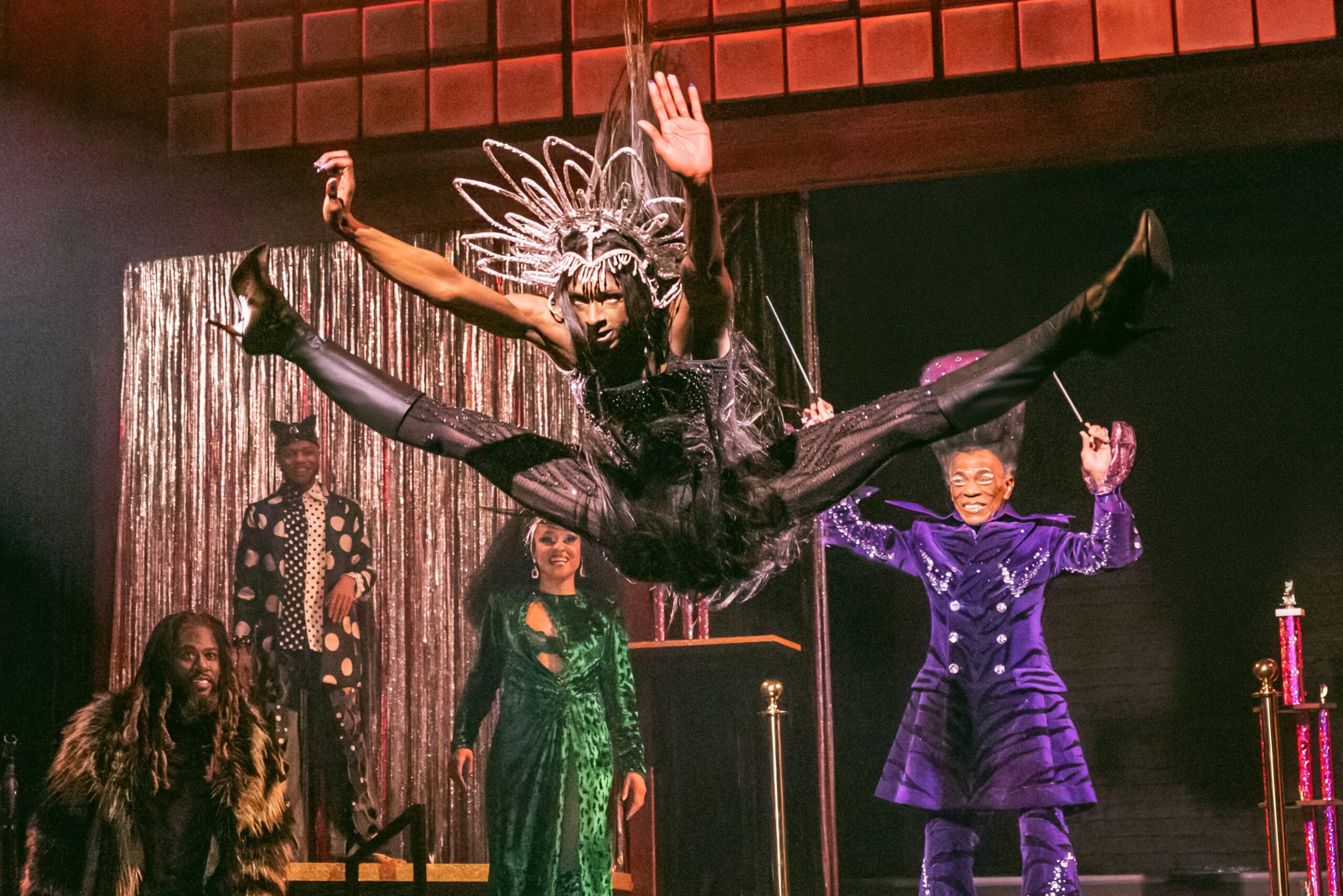
Robert “Silk” Mason (foreground) in Cats: The Jellicle Ball. Photo: Matthew Murphy ad Evan Zimmerman for MurphyMade
Wiles’s and Lyons’s choreography is more ballroom than Broadway, which means we get more short, flashy solos than big group numbers, but that’s also part of what Rachel Hauck’s runway-centered set demands–with banks of seating on both sides of the stage and a defined runway that protrudes into the audience, you don’t get the wide horizontal space that allows for precision group choreography. And, as with the other elements, there’s just enough that’s classic Broadway to hold it together–not least, of course, the songs which are among Lloyd Webber’s catchiest, arranged well to suit the variety of vocal ranges and performance styles within this cast.
It’s not a perfect show, of course. All the added business pumps the run time up close to three hours, and I felt that a little in Act Two, where the creators try to add a little bit of a more serious reminder of the history and the challenges ballroom and queer culture have faced: when the ball gets raided by the cops, Old Deuteronomy takes the fall for goods stolen by Macavity’s crew and is taken away in handcuffs. The powers of Mr. Mistoffelees are needed to bring him back home. Combined with a slide show paying homage to founding house mothers, it’s a useful reminder that everything isn’t glitter and glam for queer culture, albeit one that isn’t entirely integrated. Also, the show’s more interactive elements struggle a little in a Broadway house; if you’re close enough to the stage to feel like part of the action, you’re also hampered by sight lines from seeing it all.
If you hated Cats to begin with, I don’t know if this will cure you. But if you love Broadway musicals in all their glory; if you love an inclusive, expansive view of what it means to be a theater artist and a theater audience; if you welcome a chance to see an enormously influential subculture get its moment in the spotlight–you might just love it. There was an older white woman sitting in front of us, in a prime orchestra aisle seat, snapping her Cats merch giant yellow fan at every opportunity and dancing in her seat, practically in tears of excitement. Her son bought her the ticket, she told me. Having her joy constantly in my view while I watched Cats: The Jellicle Ball with my adult critic’s eye reminded me of what it’s all about.