
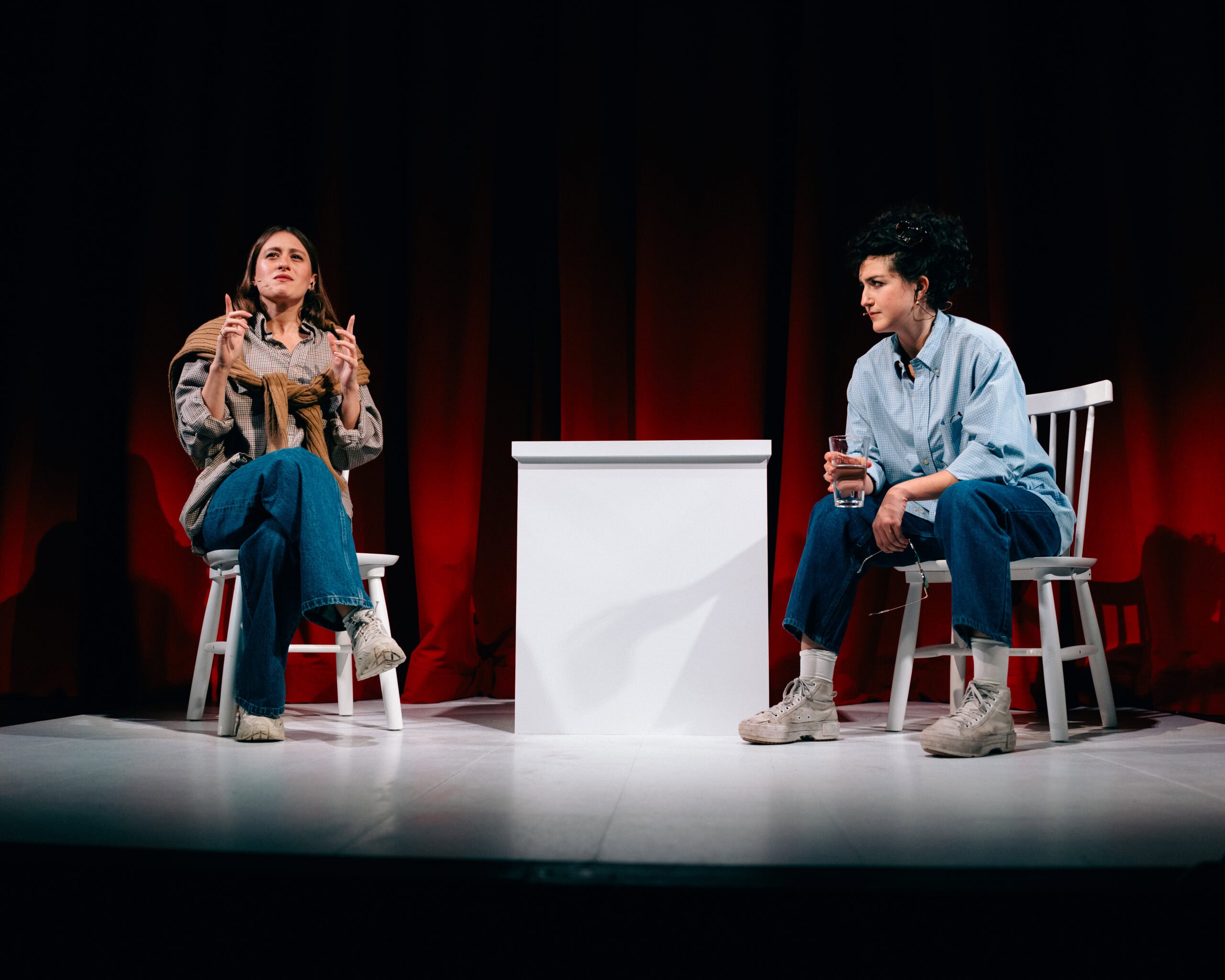
Juliana Sass and Chloe Claudel in Two Girls. Photo: David Jacobson (A24)
Two Girls: A Homeric Retelling in the Oral Tradition, Eliya Smith’s tricky nugget of a verbatim play, takes as its ostensible subject an infamous 2007 shock-porn video known as “2 Girls, 1 Cup” [that’s a Wikipedia link, not the video itself; I’m not trying to ruin anyone’s day]. I learned from that very Wikipedia entry that the video is in fact a trailer for a full-length Brazilian porn film, but it’s the trailer that went viral early in the YouTube era, when viral videos weren’t a thing that happened approximately a million times a minute. Smith has never seen the video–and once she starts working on this play, she intentionally continues to avoid it–but this “Homeric retelling in the oral tradition” has her asking men to describe it from memory, whether their memory comes from viewing it, from being told of it themselves, or from watching someone else’s reaction video. (Let us not dwell on the filthy joke of putting “oral tradition” into the title of a play about this particular subject; we will instead focus on “Homeric,” on a story that evolves and lives in the memory of the teller more than in its definitive recorded form.)
Juliana Sass and Chloe Claudel take turns playing Eliya and her male interviewees; Claudel also co-directs with Mitchell Polonsky. The men approach this task, for the most part, with seriousness, even gravity; one of them goes as far as to bring in the work of French theorist Julia Kristeva (relevantly, but also, in context, reading like a move to make his own consumption of porn an academic exercise). Different men remember details differently—what the women wore, what the cup itself looked like; one is oddly concerned with the background music. (One of the piece’s best visual effects is that the actor playing Eliya holds a cup or glass, which shifts from coffee cup to Solo cup to clear glass based on the recollection of the interviewee.) But inevitably, the discussion circles ever closer to the disgust at the core of the experience. No one is really willing to admit to finding the video arousing, though one of the subjects says, almost wistfully, “I hope you find the guy who’s really jerked it to ‘Two Girls, One Cup,’ because clearly, that would be a vital, you know, the linchpin of the whole enterprise.” No one really knows why they watched it other than its omnipresence.
But “2 Girls, 1 Cup” is also a distraction: a pretext or a cover for radioactively scary questions about abjection and disgust and bodily permeability that Smith can’t stop fixating on. (There’s an echo here of You Got Older, which was revived in this space this spring.) For all the revulsion triggered by even the memory of this truly vile viral clip, and for all the seriousness with which the interviewees take Smith’s request, the “investigation” is always already a little facetious, a candy shell that will crack to reveal a bittersweet, and much more personal, center.
Two Girls wears its status as verbatim theater on its sleeve–we can see the listening devices in Claudel and Sass’s ears, a technical gesture that has become the signal of this style of faithfully interview-derived pieces, and Smith writes the rules of the verbatim genre right into her dialogue. But Two Girls also foregrounds Eliya as a character. Verbatim theater is very rarely introspective theater, for perhaps obvious reasons: It’s usually framed as an investigation by the playwright, and it requires the witness/recorder to elide themselves from the scene, to serve more as a translator than a subject or even a voice. But here, Smith writes herself into the story. She’s not interviewing strangers, but men with whom she has pre-existing connections–but then she also bleeps (by literally writing “beep” into the dialogue, delivered flatly) every detail about those sources that comes up in conversation. It’s a push-pull of intimacy and distance, reality and artifice, the revealed and the hidden, the horrified inability to look directly at something and the rubbernecking inability to look away.
If Smith and Claudel’s previous collaboration, Dad Don’t Read This, was chaotic and dialed up to a fever pitch, this is the opposite. Claudel and Polonsky slow everything down, the pace measured and deliberate and the focus tight, as we are led to the moment that teasing confection cracks open to reveal Eliya and her roommate, Cait, two girls, at home. From a flat plane where the two swap places in programmatic motion in front of a cherry-red curtain, Forest Entsminger’s set turns into an apartment kitchen. Sass and Claudel remove costume layers to wear matching white camisoles and jeans and move around the space naturally. Now they’re just talking–or performing Eliya and Cait just talking–about themselves, about disgust and betrayal and abjection in their own bodies. And there will be one more feint, or reveal–an interruption of this quiet, heartfelt conversation by doorknockers for Greenpeace, whom we hear in recorded audio but never see. What we see is Eliya and Cait dancing: grounding themselves in the bodies that have betrayed them.
That final twist, for me, is more successful intellectually than emotionally. On the one hand, the way it splits the verbatim audio from the physical presence in the room with us circles back to the illusion of verbatim theater, circles back to the question of what it means to live in a body. On the other, it punctures the tense intimacy of the piece. It’s a distraction–but also a distraction that I keep poking at in my mind like a tongue drawn to a sore tooth. Two Girls feels unsettled, trailing off into its ambiguous ending, but it’s unsettling all the same.