
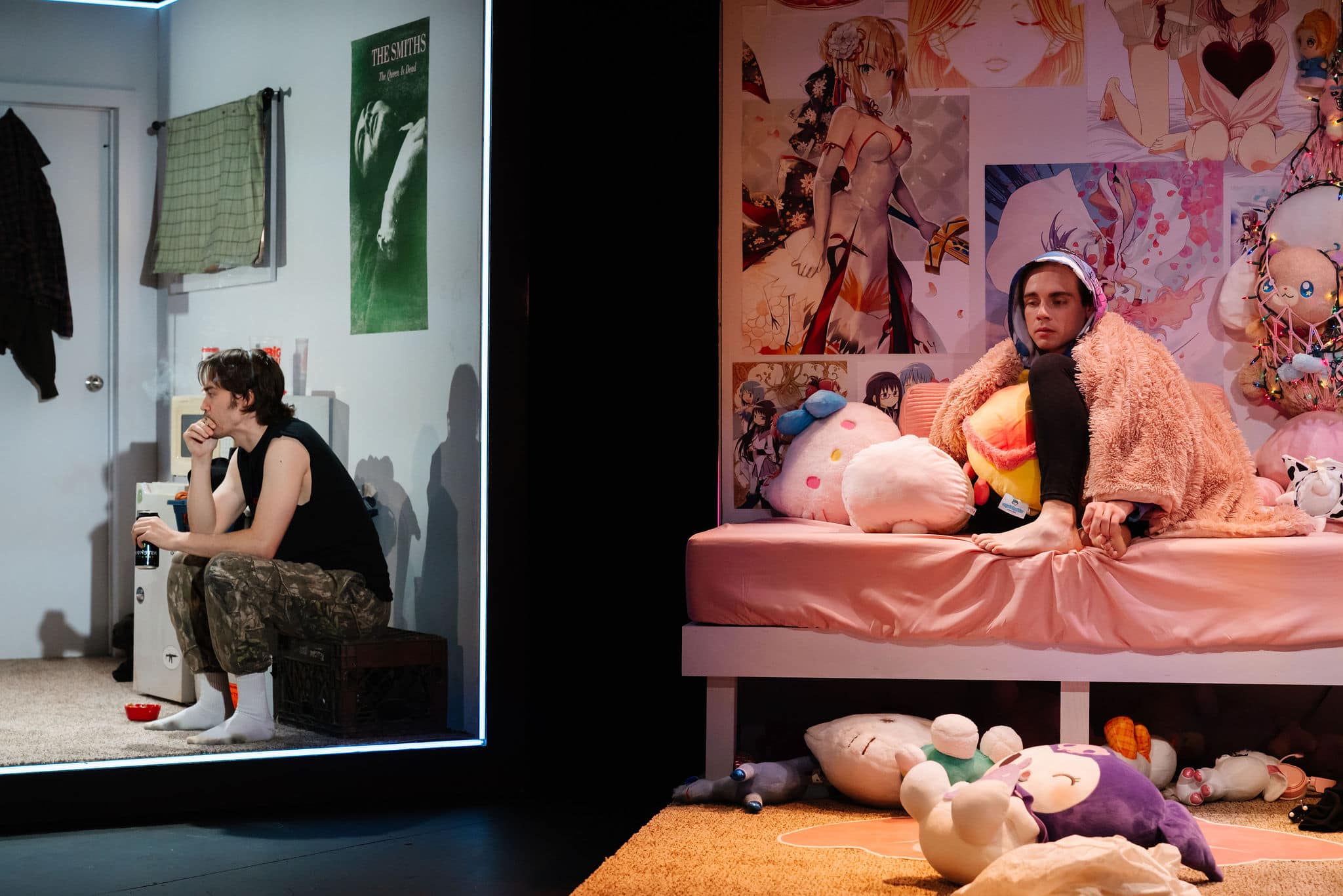
Zachary Desmond and Christopher Dylan White in Degenerates. Photo: Jackie Abbott
The Holes and Degenerates make oddly fitting bookends to a theater week with Arias with a Twist in the middle: two more-or-less realist shows that center the question of how to be a man in modern America, one puppet fantasia that presents confidence and joy in the singular, glittering embodiment of a non-gender-normative masculinity. I found the approach of The Holes puerile. Degenerates digs deeper into its characters, but still leans toward giving an uninterrogated credence to their views, and ties up their stories in overly simple ways.
The men of Degenerates are lonely, angry, and wounded; the world has rejected them and therefore it is irredeemably corrupted and unjust. Playwright Else Went is unsettled by the term “incel” (though her characters use it to describe themselves, creating an elaborate taxonomy of different categories); she says in a program note, “To be dubbed ‘incel’ is to be imagined socially irredeemable. . . . If you are told repeatedly that you are unlovable . . . and you can find no instance to contradict this claim, eventually you will come to accept ‘unlovable’ as an immutable fact.”
Else and director Emma Rosa Went take these men and their struggles seriously and empathetically by zooming in tight–we’re in the hothouse of the men’s collective psyche, with the rest of the world seen (until the very end of the play) as negative space: the hollow outlines of absent figures. That isolation is of course the point; their atomization is a self-reflecting logic that both sustains them and traps them. But it also means that the broader context in which these men are enmeshed—economic malaise, schooling or early adulthood shifted off course by living through a pandemic, social and intellectual life increasingly happening online—exists only through their perceptions of it, and their perceptions pretty uniformly lean toward the world hating them. One of the men is desperate for a “whole person to care about me,” but the only people we see are his fellow “monsters”; they don’t see themselves as whole people, so their friendship doesn’t count.
Yet their assertions are our only evidence of their unlovability, and the “origin stories” that they share are real, specific wounds that have been blown up in their minds into unalterable universal principles: a girl rejected me, therefore not only will all girls reject me, but all “femoids” are evil. (One would think that a woman had never been rejected in the span of world history.) It’s a solipsistic cycle that makes it impossible to “contradict this claim”; they’ve put on blinders and now complain they can’t see. Case in point: Two of the main characters live with their parents, who seem to treat them fairly well, but that’s a source of more shame than emotional support. (There is a perfect metaphor in the fact that Miller has a mother who makes homemade chicken nuggets, which are riddled with BBs from Miller’s taking lazy potshots at their chickens.) The third has a sister who seems genuinely supportive.
Miller (Zachary Desmond) has created a Discord server for other local incels; there’s a vague idea of it growing into an IRL community but he hasn’t done much to make that happen. As the self-styled leader, Miller has assigned himself the responsibility of being a teacher and an accountability monitor for the rest of the group. He’s got “research” to back up every offensive or aggressive assertion, and has found some sort of purpose in his life by forcing the others to confront their own uselessness.
Kemp (Tyler Nowell Felix) has internalized his rage into self-loathing: The play begins with him calling a suicide hotline, but finding the anonymous counselor on the other end of the line too abstract to help; he can’t even trust that she’s human. He doesn’t want to die, exactly, but he’s tired of feeling invisible, unrecognizable to the rest of the world as human–and Miller’s constant prodding to “commit to something,” even if that something is suicide, isn’t helping.
Target (Christopher Dylan White) has actively chosen isolation: At only eighteen, he’s estranged from his family, working as a cam boy and never leaving the house for longer than needed to take out the trash. (The fourth member, Serge [Juan Arturo] is quickly revealed as the “wrong fit” for their group once they learn that he has an ex and a kid and that he’s a “volcel” or voluntary celibate.)
Kemp and Serge appear, at the beginning, only as voiceovers; what we see is Miller and Target in their separate rooms (designed by Mikiko Suzuki MacAdams): Miller’s is a dingy basement whose only decor is a Smiths poster, and Target’s space is packed to the gills with anime posters and squishy plushies. The first two-thirds of the play gradually focuses in on the friendship/situationship between these two damaged men as they circle toward an IRL encounter, toward the possibility of becoming truly connected. Miller is both an easily recognizable redpill type—that guy who’d rather rage at the unfairness of it all than do a thing to change it, the guy who’s built a fortress of certainty out of his own insecurities—and a person who at some level recognizes the corner he’s backed himself into but hates the idea of admitting he was wrong more than he hates standing in that corner forever. Desmond wields Miller’s online lingo like a weapon; every blow he takes from the world, he turns into a “well-documented fact” that gets added to the arsenal. With Kemp and Serge he uses his own lacerating self-loathing as a power move. But with Target, there’s an attraction he can neither deny nor accept.
Target is different from the other men in the group—a “mental cel” who’s chosen social isolation as a coping mechanism and an online sex worker by trade, he approaches manhood in a less angry, more openhearted way. He almost seems to be trying on Miller’s flavor of aggressive masculinity in much the same way that he puts on “sexy cow makeup” for some of his clients. Target’s discomfort with Miller’s rhetoric flashes across White’s face, a lot, but he still values the intimacy—and the sexual tension—between them. And when Target invites Miller to come visit him in person, Miller becomes the first person Target tells that one of his clients has offered to fund a gender transition. “Can’t get a girlfriend, become the girlfriend,” as Miller puts it. For Miller, that idea serves as a veil of plausible deniability he can throw over the attraction he feels, but for Target, the motivations are murkier.
In fact, after sitting with it for three days, I still don’t know what to make of Target’s gender transition journey. It’s proposed as a money-making scheme; he records himself coming out to his sister as proof of concept to the client who’s paying for it, and we don’t really know whether he intends to go through with it. But by the end of the play, Target seems to have fully embraced transition, with a new name, an explicitly feminine dress style, and a new friend who knows her as a cute anime girlie. [Note: the script uses “he” pronouns for Target until the very end, when the character’s name changes to mark transition.] I don’t think there’s an intention to imply that coming out will cure one of toxic masculinity, nor that violent anti-women incel rhetoric is a side effect of unacknowledged queer desire, but the relationship between Miller and Target could lend itself to that interpretation. (Similarly, I don’t think the existence of a slightly snarky female voiceover reading some of the stage directions is meant to imply that women really are dismissively controlling these men’s worlds, but it’s an interpretation that kept intruding.)
It doesn’t help that the transition becomes actualized in act 3, where the Wents tie things up with too tidy a bow, as the three main characters move forward on trajectories much simpler than the painful messiness of the earlier action. Miller, disavows Target to broaden his platform in the online male rights world; Target steps fully into gender transition; and Kemp tries to make a connection in the real world, with one gentle failure and one success. The ease with which both Kemp and Target are able to break the spell of poisonous ideas makes it seem like those ideologies are easily countered by a single offline encounter.
That encounter gets even more of a magic gloss, as Kemp and Noelle immediately retreat again to an online relationship, this time via friending each other on AnimeDB. The pervasive mediation of almost all social contact through the digital sphere is subtly woven through, and possibly as scary as the rhetoric: from Kemp’s uncertainty whether the suicide hotline therapist is AI to the Discord server where the men meet to Target’s job as a performer for the camera to hearing the coming-out narrative only through a digital recording to Miller’s final triumph as a YouTube guru. The online sphere is the problem, the solution, the air they breathe. Depicting that social dynamic, Degenerates is effective and accurate: The environment is so pervasive it’s invisible; there’s no way back to an unmediated life.
But the thing is, that doesn’t make them unique. And in a week where the news is all about a woman being gang-raped by a bunch of fraternity brothers who suffered minimal-to-no consequences, I want more of the “why”–Why do these men proceed down this dark path? Why does the idea of being labeled “unlovable” become a national concern only when it’s men who experience it? And why should my empathy for them so far outstrip their empathy for every woman alive? Degenerates gives us a glimpse under their hood, but doesn’t answer the questions it raises.