
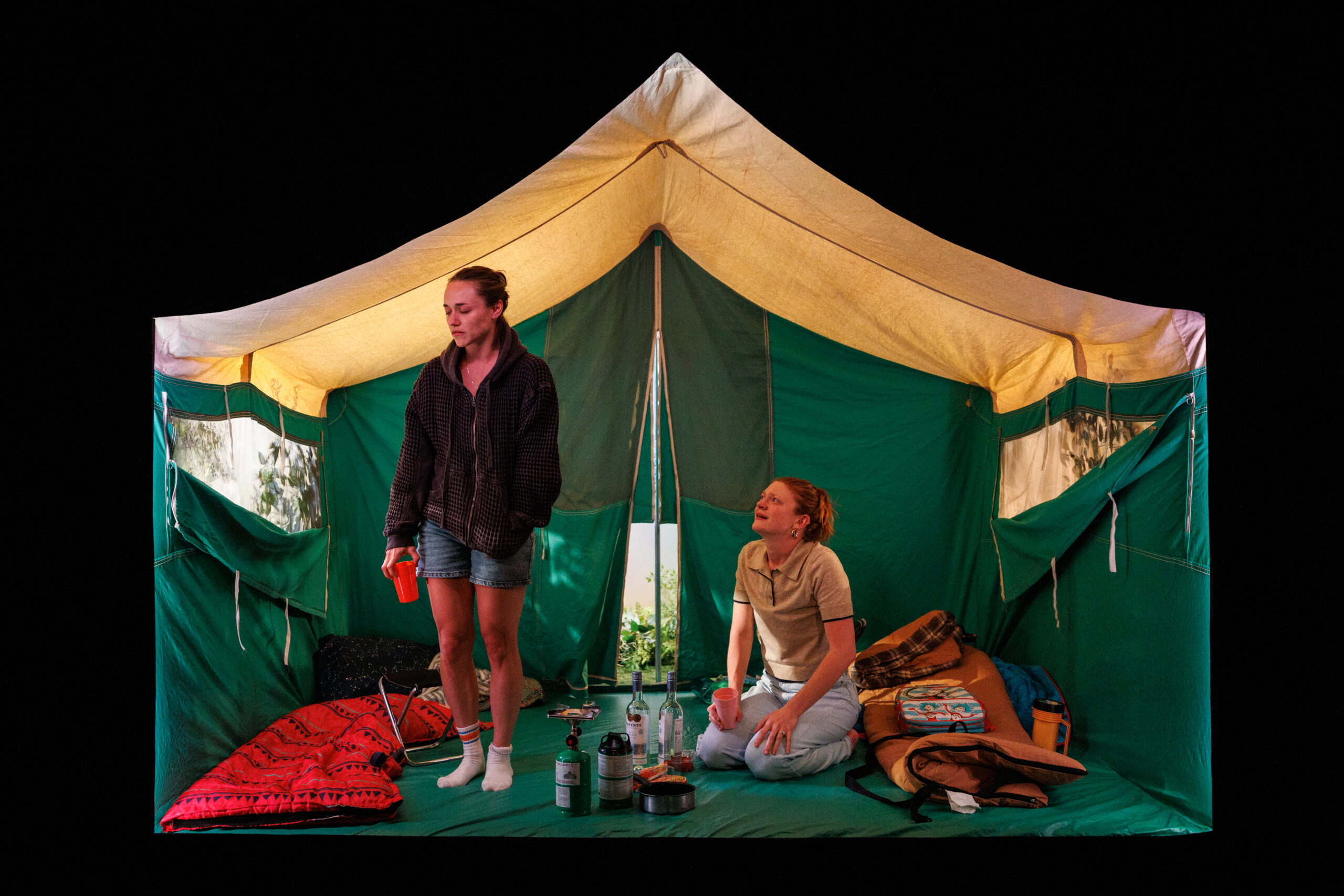
Alice Kremelberg and Colby Minifie in Camping. Photo: Maria Baranova
To this spring’s bounty of plays about teenaged women trying to grapple with their present and imagine their future—Dad, Don’t Read This, Indian Princesses, Girls: Chance: Music, Girl, Interrupted—Camping serves as a bittersweet coda, starting with its protagonists at fifteen and following them forward into a future that remains stubbornly anchored to those adolescent selves. All of Camping, the first play by Victoria Lynne Barclay, takes place in the same tent, at intervals over twenty-five years. Ari (Colby Minifie) “borrows” it from her brother when she’s fifteen and never gives it back; it’s ratty but she can’t let it go because, as she says to her best friend, Brit (Alice Kremelberg), “It’s the only place in my life where anything exciting has ever happened.”
Claustrophobic, intimate, protective, domestic all at once, that tent becomes both playing space and metaphor for Ari and Brit’s relationship. (It’s a perfect use of the small downstairs space at HERE.) Krit Robinson’s set is pristinely simple–just a functional tent, flaps and side panels and all, perhaps slightly unrealistic in that it’s tall enough to stand up in, but it’s not really tall enough for either of the characters to do so comfortably. It’s the private world Ari and Brit share, cordoned away from the others in their lives. The narrative feeds us other people just outside that thin boundary—Girl Scout campers when the two are counselors; the boys Ari and Brit are waiting to have (bad) sex with; the friend group at a music festival; later their husbands and children. And Salvador Zamora’s sound design and Vittoria Orlando’s lighting give us the sense of a full, immersive world of weather and people and music surrounding them—but we only see Ari and Brit, and only in the tent.
They have lived entangled lives: Born in the same hospital. Neighbors since birth in a small-town Ohio trailer park. Best friends through high school. Sneak off with Ari’s brother’s tent to lose their virginity on the same night. Plan—or *don’t* plan, really—to stay in town and go to the same shitty state school and drift into the same shitty unquestioned lives that their classmates do. Only they’re smarter than that, and the intensity of their connection scares them in ways Brit is scared to even think about and Ari desperately wants to talk about but can’t quite find the words. So Ari goes away to college and the undercurrents between them drag them together and push them apart over and over.
Through the play’s grounding them in space and letting them travel in time, we get a terse balance of stasis and motion, a sense that their lives whiz by without making any real progress. We can feel the passing of time in Minifie and Kremelberg’s performances, under Adrienne Campbell-Holt’s direction: Minifie shifts her physicality–she seems to move slower and grow stiller as she ages, her very posture taking on a sense of resignation–but we also feel a slow emotional deflation, a rueful acceptance of the choices she’s made, however unhappy they’ve made her. Kremelberg’s spark fades faster, and she meets adulthood with a practiced weariness is more emotional: she’s been closing herself off from imagining possibilities for so long that she’s shutting down inside. “Maybe I like my life, that I chose,” she taunts Ari, but she knows and we know that she mostly chose not to choose. (Sarita P. Fellows’s costumes also help track the progression; the first few scenes show them stripping off layers as they go from awkward teenagers in oversized T-shirts to showing off their bodies at a rave in sparkly bikini tops, then layer on adulthood in sensible polos, mom jeans, and tube socks.)
At the beginning, they are fifteen, the last virgins in the ninth grade, who’ve made a deal to have sex with some boys in a tent just to get it over with, though Brit hadn’t so much as kissed a guy before. (The play is packed full of casually horrifying disclosures about living while female in the twenty-first century, from that painful first sexual experience to Ari’s sex life after childbirth and Brit weighing the trade of sexual favors with a former teacher for a ride home from work.) By the end, they’re forty-year-old mothers, one divorced and one about to be. Ari and her husband have moved back to her hometown and bought a plot of land; Brit never left.
And yet—they’re still mired in the same fears and shames that they’ve always known. Brit, who’s been tending bar at a local place since she was too young to legally serve alcohol and married a local dirt bag who cheats on her, has never felt good enough to succeed in life. She feel class anxiety compared to Ari’s college friends; her religious upbringing has rooted homophobia deep, which means she can’t cope with her feelings for Ari. Ari thinks she’s ugly and weird and knows she’s queer, but marries her rich-boy college friend anyway, because that’s safer than letting her feelings for Brit out more explicitly than with a veiled, tentative nudge.
The downside of a play that drops in on its characters at such long intervals is that every scene hits them at a high point, so emotions run feverish throughout. Campbell-Holt keeps both Minifie and Kremelberg at peak intensity, and Barclay likewise scripts moment after moment where everything seems at stake for the two. The repetition and recursiveness are part of the point, I recognize, and the play’s final moments leave an unanswered question of whether they can break free into something new. Still, there’s perhaps one too many “unforgivable” betrayals followed by forgiveness; the friendship, with all its sexual tension, is believable and lived-in, and we don’t need to prove its strength over and over in this way.
Minifie and Kremelberg’s chemistry feels genuine: you never doubt that they know each other better than anyone else ever will, and yet we can also always see the spark that Ari is trying to flame and Brit to smother. Minifie in particular does so much with a look that sometimes it feels like Barclay and Campbell-Holt are pushing too hard on the words when the subtext is doing the heavy lifting. One moment in particular sticks with me: talking about the inadequacies of sex with their respective husbands, Brit asks Ari what she thinks about when she masturbates. The entirety of the play is encapsulated in the look Ari gives her in return.