
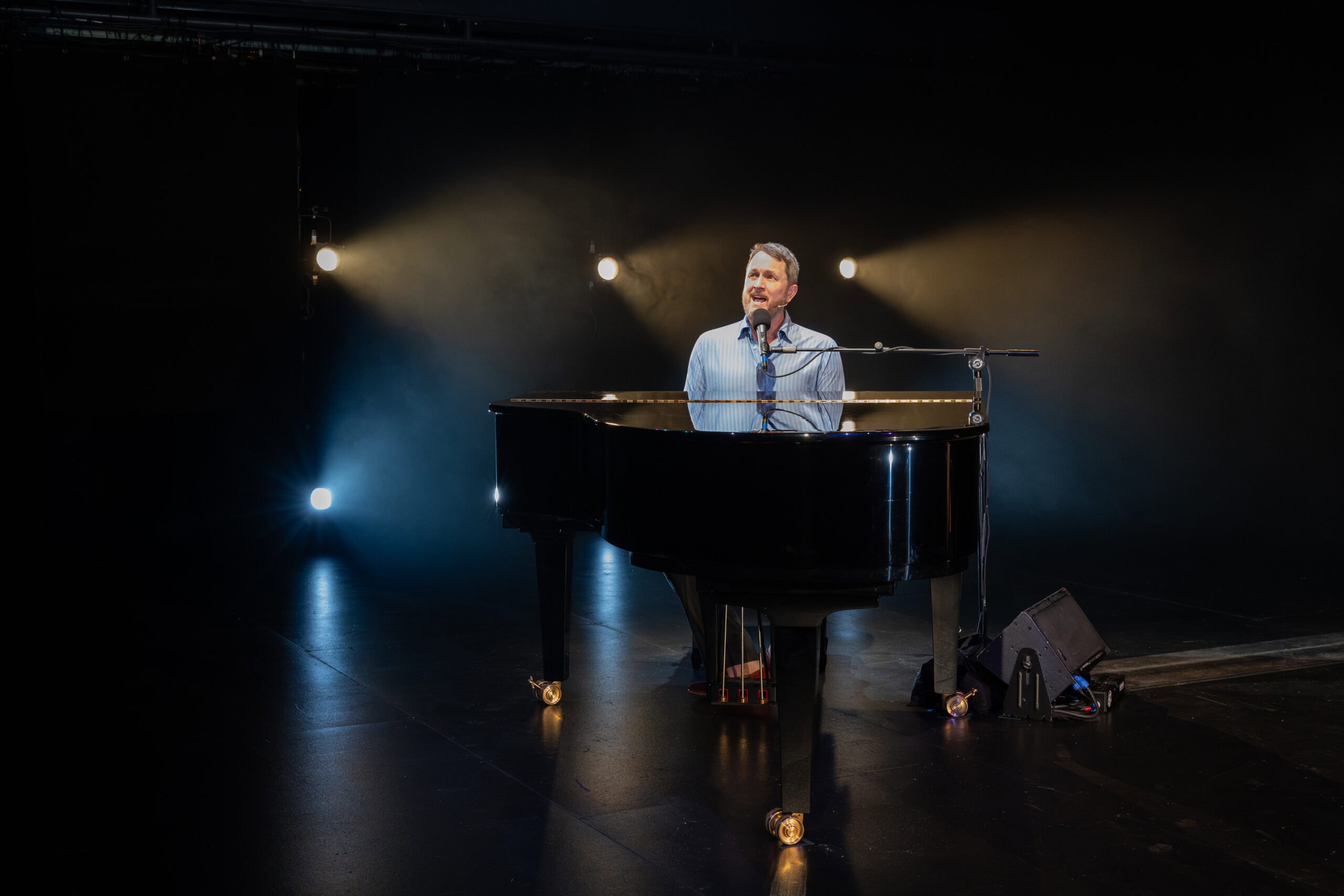
Todd Almond in I’m Almost There. Photo: Ellen Qbertplaya
Todd Almond’s I’m Almost There is a witty song cycle that takes the form of a shaggy-dog tale with a not-very-well-hidden marshmallow heart. Produced by Audible and Edinburgh star-maker Francesca Moody Productions (of Fleabag and Baby Reindeer fame) and directed with offhanded ease by the indefatigable David Cromer, the show as presented at BAM feels a little bit like a Swiss army knife, serving many practical and enjoyable functions in one efficient chamber musical: It’s a tight hourlong show for three performers and almost no set, one that’s easy to take on the festival circuit (well, maybe except for the harp). It’s storytelling plus music, so equally well suited for Audible’s audio-only format. It’s a self-deprecating comedy that’s not standup, but not far off the long-form comic monologues that Edinburgh and Netflix love–but it also ventures just psychologically deep enough to explore exactly how a person can put obstacle after obstacle in the way of their own happiness. It’s bookended by a gentle, sweet, and not at all saccharine queer “missed connections” romance, but it’s also stuffed with crisp comic character sketches of a series of urban weirdos. It’s got the virtues–focus, easy camaraderie with the audience, intimacy–of a solo show, and it’s also got the benefits of the extra instruments and voices of Erin Hill and Noah Max Amick when needed. And, of course, it’s got the music of Todd Almond, who writes catchy, clever, elegant pop songs and orchestrates them in ways you might not quite expect. Here, he’s working primarily with piano (mostly but not entirely played by him), accompanied by a full-size harp and an electric bass. The combination adds both a drifty ethereal quality and some understated funkiness.
Our narrator/singer, played by Almond, is a neurotic, slightly introverted composer who gets arm-twisted by a friend into attending an Easter brunch. (It’s hosted by rich gays who own a triplex in Tribeca, so there’s a lot of pressure to appear successful.) The friend never shows, but he makes electric eye contact with another man who’s on his way out of the party–a man named Guy (metaphor alert), and they spend a magical day traversing the city by foot. It seems, for an afternoon, like Guy is the guy who could change everything–but then the night ends with an awkward fumbled non-kiss, and that, it seems, is that.
Except the meet-cute gets cuter, and Guy turns up at our narrator’s door bearing coffee the next morning. The few flights of stairs between apartment and street are the only obstacle the Singer must navigate to let Guy in: to (metaphor alert again) open that door to something wonderful. Fortunately, at this point the metaphors get more eclectic and the storytelling shaggier, as a picaresque series of distractions keeps shoving that simple journey off the rails.
This is a guy who makes a point of not knowing his neighbors, after failing at some half-hearted attempts to do otherwise: ”I never ask their stories / I let walls do what walls are meant to do,” he says (and sings) at one point. Yet somehow at this moment, when he’s in theory trying to make progress toward a meaningful goal of his own, he becomes sequentially and increasingly entangled, philosophically (pathologically?) unable to say no to a request as he encounters all of the following: A missing, possibly suicidal cat. A bathmophobic (fear of going downstairs–a real word, who knew?) neighbor who’s mired in nostalgia and also might be a vampire. A very gentle multi-level marketing cult. The “sexy beast” across the hall, who’s even hotter when he’s swearing that he hates you. Communion with a dying mouse. You get it; there’s more.
Almond plays most of the other characters, usually without costume or props, in dialogue with himself as narrator. But for one song, we get Guy: in a tweedy blazer, wearing wire-rimmed glasses and holding two cups of good coffee. He’s a reader, he says, and he’s learned from Joyce Carol Oates that “dialogue can be deceptive / dialogue can be a weapon / or a calculated cruel distraction / who we are is how we act and / what we want is in our movements / what we want is in our bodies / what we want is in our silence, not our words.”
And in the action, to that point, has been something like Zeno’s paradox: Our Singer can’t ever seem to cover more than half the distance between here and there, and “almost there” might as well be “never happening.” And as he narrates his adventures, spinning us a story that simultaneously takes place in a few moments on a spring Monday morning and spans months, we see that possibility of love receding. We’re being decoyed by dialogue, when what we want–what Guy wants, what the Singer wants–is just a simple action.
The outre adventures that befall the Singer on the stairs give us the humor of I’m Almost There; they give us the memorable images and the witty lyrics. But that yearning to see the switch flipped from “almost” to “there”–to see desire turned into action–that’s the heart of the piece. I won’t spoil the ending, but I will say there is genuine suspense and the possibility of heartbreak in it.