
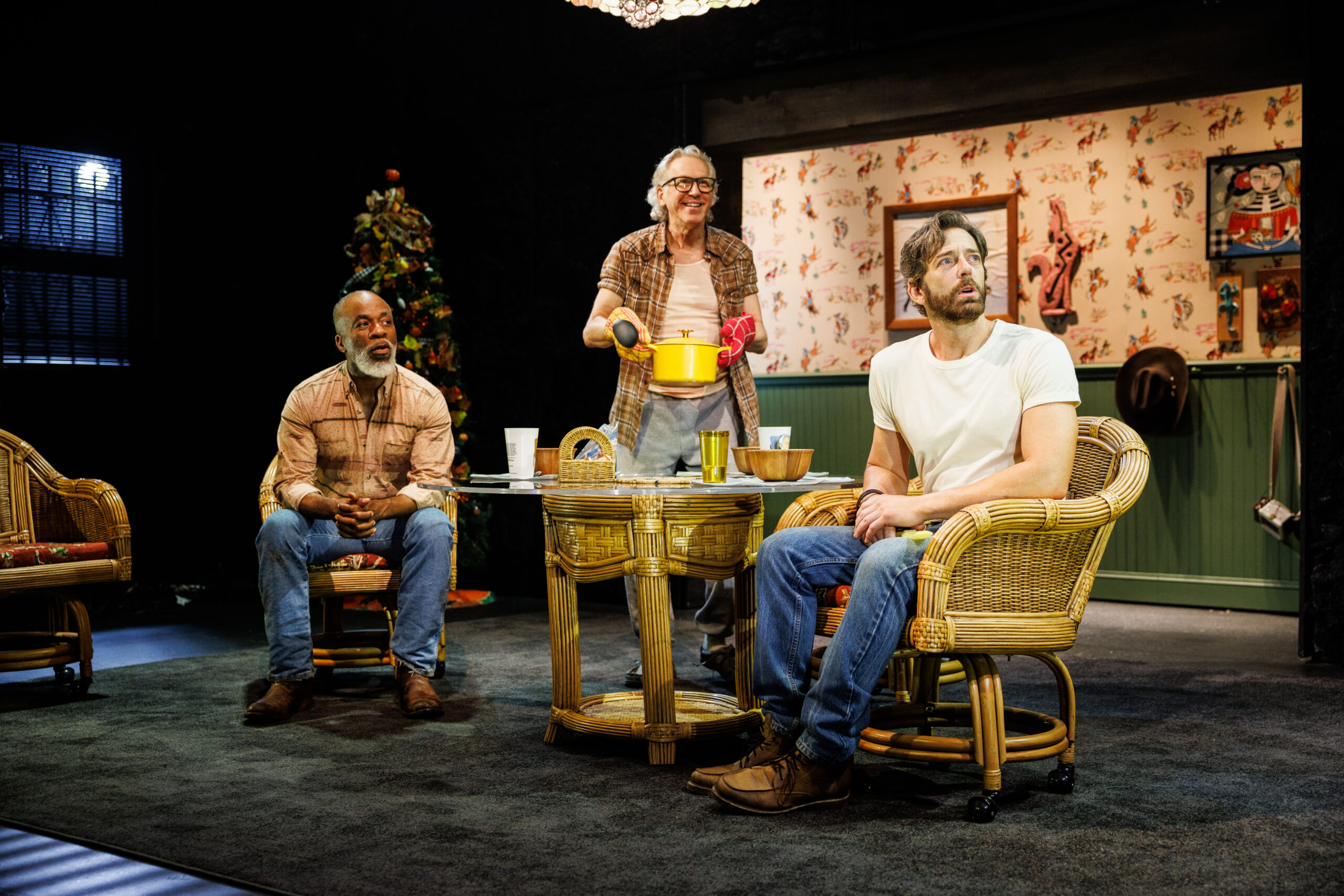
“Jerome” at Playwrights Horizons (Photo: Maria Baranova)
There is a sign documenting Jerome, Arizona’s dwindling population stuck to the curtain at Playwrights Horizons where John J. Caswell, Jr.’s Jerome is having its world premiere. It’s now a ghost town, the sign proclaims. Where did everyone go?
Caswell uses this liminal location as the backdrop for a three-person play exploring loss, illness, love, and grief. The set’s inky black igneous basalt walls give the impression that the characters are somehow prehistoric, like we are discovering these men in cave paintings. Their tale is eternal, and will continue.
And it’s also highly specific, with the plot spanning 1992 to 1994, the years before the thirtieth anniversary of the play’s central couple. Con (Stephen Spinella) and Doane (Jeorge Bennett Watson) were Army buddies who realized there might be more there. As the play opens, they are celebrating their twenty-eighth year together and scoping out the trade at a Halloween ball. Con’s health is failing and he thinks bringing in a third person to their bedroom might satisfy Doane’s unfulfilled desires.
That Bruin (Ken Barnett) ends up meaning much more to the couple is surprising to them, though not necessarily to the audience. Caswell’s play jumps time after their first sexual encounter and Bruin is firmly ensconced in their relationship, though as Doane’s feelings escalate, he is determined not to let them overshadow his love for Con. As Con’s health deteriorates and the bond between Bruin and Doane expands in his absence, the dynamic between the three characters is shaken.
Bruin is reluctant to reveal anything about his past, but Con is on the case, sleuthing through the phone bill. Bruin makes many long distance calls to San Francisco. He seems to be triggered by the beeping of a timer set to remind Doane to take his statin. It comes to light that Bruin hears the beeping as a reminder to take another kind of medication, for someone he has left behind.
The specter of AIDS hangs over the play, though none of the characters has it. The literal ghost town where they live is representative of the much larger world of vanishing gay men. These three men are insulated in their remote town, and at least one of them is hiding from the horrors he’s seen outside. The play bears down on Bruin, pressing his guilt and his love on him until he has to make some hard decisions and look at himself in the morning’s stark light.
Dustin Wills’ production is at its best when the play is focused on Con and Stephen Spinella can remind us why he’s one of the most important working actors. Spinella captures Con’s physical weakness, but brings out the firecracker he used to be. One of the trickier aspects of Caswell’s play is that we meet Con and Doane at a time when they’re not at any sort of peak in life, which makes it harder to understand what Bruin sees in them, other than a way out of his old life. But Spinella’s natural magnetism at least expresses the connection Con and Doane have had for each other for nearly three decades, even if we can’t see it in the present.
The three actors feel out of sync, though. The play doesn’t really come together, aside from a fantasy sequence in the second act, because there isn’t an electricity in their dynamic. It’s disjointed, several lines were flubbed at the performance I attended, and the play’s dramatic tension dips in and out. For all the intensity of Caswell’s writing, the production is often dull to sit through because there is no zip between the actors.
Wills, who also serves as the scenic designer, finds a great coup-de-theatre at the end of the first act, though, and the resulting fantasy sequence at the top of the second is the most interesting part of the play. When it relies on more traditional scene work, the play lags and it feels like Wills is more interested in the non-realism aspects of Caswell’s play than the eighty percent of it that is realistic.
That Spinella still manages to pull true depth of emotion out of the character is quite an achievement. He’s able to bring Con’s feelings so close to the audience, while somehow still underplaying the hurt, the pain, and the ultimate acceptance the character is experiencing. Even when he is getting the play’s biggest laughs, it’s a tightly controlled deployment of Con’s barbed wit. Even if the rest of the production limps around him like the tinsel Con is always talking about hanging, there’s a great performance at its center.