
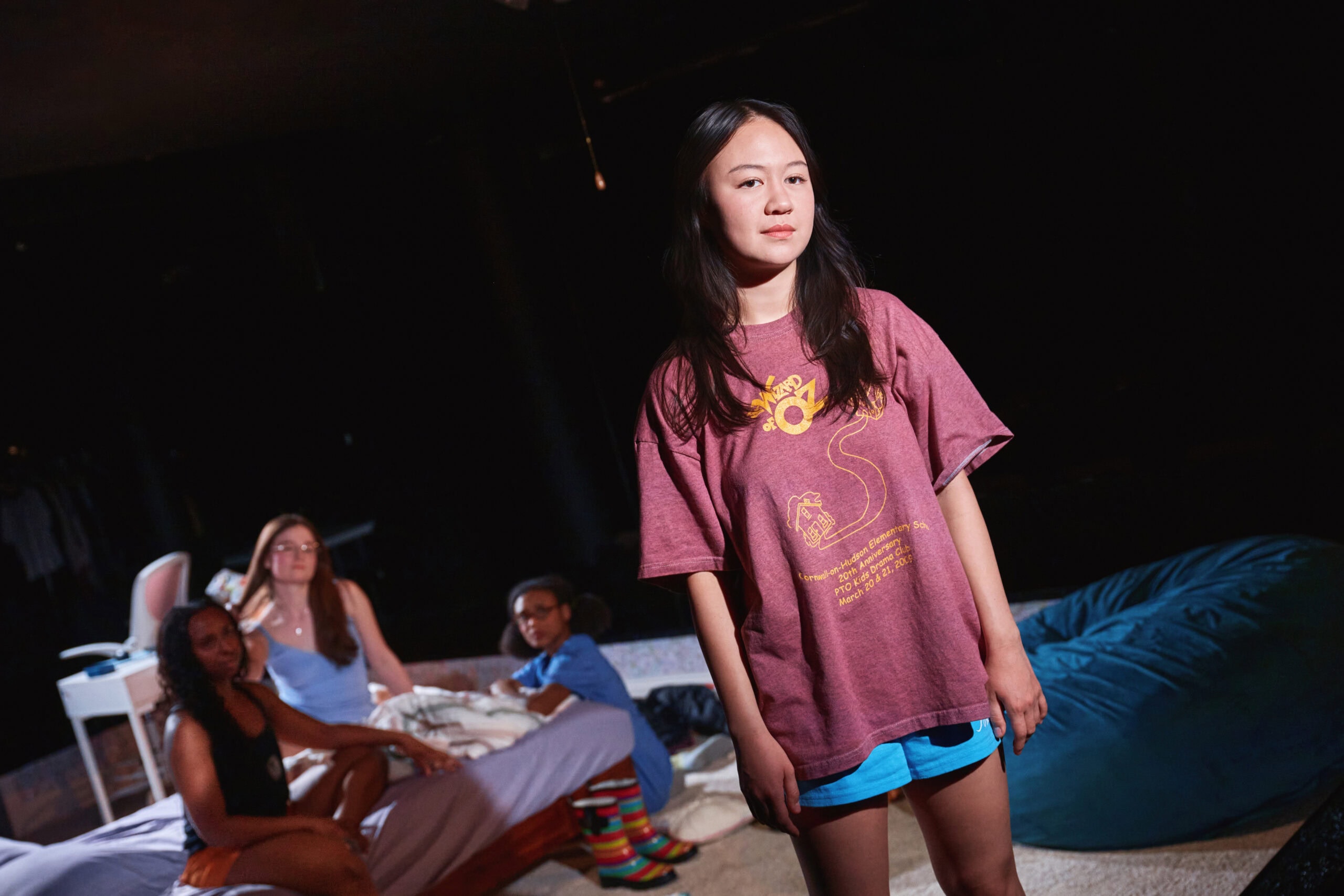
Renée-Nicole Powell, Sophie Rossman, Kayta Thomas, and Amalia Yoo in Dad Don’t Read This. Photo: Valerie Terranova
Everything matters. Everything is hilarious. Everything is the worst.
As I watched Dad, Don’t Read This, I had a spiral of cringe and gratitude running through my brain: Cringe at the raw shock of recognition of awkward feelings and memories I thought I’d left behind in my own long-ago adolescence. Gratitude at the fact that I never have to live through the wringer of being a sixteen-year-old girl again, let alone a sixteen-year-old girl trying to navigate her existence both online and IRL. (The sixteen-year-old girl I was never had to worry about all of my worst moments being preserved for posterity online and commodified back to me via algorithm.) Which is to say, playwright Eliya Smith, director Chloe Claudel, and a heart-on-their-sleeve ensemble of young actors, anchored by the incomparable Amalia Yoo, will shred you into little tiny pieces if you ever were, ever raised, or ever loved, a sixteen-year-old girl in suburbia. Not just because Smith and Claudel capture the wretchedness of feeling “like there is an on fire log of wood in the center of my body all the time,” though they do, but because in tiny shining moments, they capture the ecstasy and the freedom of starting to figure out how to build a life. The adults these girls will be flicker through the adolescents they are–particularly Yoo’s Mal, whose monologues–mostly about the Sims–structure the play.
Dad Don’t Read This moves on an engine of secrets and vibes, not plot (this is not a criticism). Its four characters are a group of friends who hang out mostly in Mal’s bedroom because her parents are just the right amount of caught up in their own drama that the girls can slip in and out virtually unnoticed. (Her dad will sometimes make a round of smoothies, and certainly he’s the dad being addressed by the title, but no adult enters the sanctum of Mal’s room.) The girls are one another’s intimate confidantes and bulwarks against the world, but they’re also all constantly hiding emotions and events and information from one another. They’re just starting to realize where the boundaries of intimacy lie, and how hard it is to really know another person, to trust themselves, let alone anyone else.
They’re each exquisitely sensitive to their places in a larger social web outside this room, one that accepts each of them on different terms, but here, they are on the same level. Here, they also have re-creations of themselves in the Sims: like the real world but better, especially for Mal (Amalia Yoo). In the Simworld, someone is always in control, and they can both play God and know the comfort of living in a well-ordered world with a controllable number of variables. In the Simworld, “there are pluses and minuses on top of both the sims’ heads so everyone knows how well the conversation is going and it is easily decipherable to everyone whether the other sim likes the not me sim or no.” In the Simworld, there is clarity; in Mal’s life, there is nothing but snarls of feeling and an inability to slow her racing mind.
Mal is a theater kid with big emotions, a big mouth, and an appetite for life that she doesn’t quite know how to manage–which is one of the reasons she disappears every day at lunch without telling her friends where she goes. It’s also the reason she sneaks out of her room at night wearing an entire wardrobe as layers, just so she’s prepared for anything that might befall her. Her friends are a motley crew, bound by history and love and habit more than the choices they are presently making. Sophie (Sophie Rossman) is the girliest of the girls: she’s pretty and sheltered and her inability to walk the line between polite friendliness and flirtiness puts her in the crosshairs of predatory men. Noelle (Renée-Nicole Powell) is the closest to being cool; she’s an athlete and moves in and out of multiple circles of friends, but these are the girls she wants to pile into one bed with for a slightly drunken sleepover. And finally there’s Lida (Kayta Thomas), the awkwardest of them all, paralyzed by the conflict between her own need to be liked and her desire to share her geeky enthusiasms. Olivia Vaughn Hern’s costumes help fill in details in the character sketches: Mal’s Wizard of Oz T-shirt and Chorus Line sweatshirt; Sophie’s soft-focus floral prints; the science jokes on Lida’s tops; Noelle’s athletic gear and Ohio college sweatshirt.
The piece is set in a specific time and place (suburban Ohio, 2014), and Smith captures that moment of cultural shift to a life that increasingly takes place online (though even the online life of these particular teenagers has the claustrophobic insularity of suburbia). But the toxic, intimate mix of gossip and spite and affection and yearning and a rage they can’t even put into words feels more universal. (As, apparently, is the trick of mixing one shot from every bottle in your parents’ liquor cabinet into a water bottle.) So, too, does their equivocal relationship with their bodies.
On the one hand, they’re physically comfortable with one another–piling into bed together, breaking into ecstatic dance moves, flopping down on Mal’s beanbag chair. On the other, there’s the dissociation of already knowing how their bodies can put them at risk; one of the piece’s most wrenching moments is Sophie’s story of an encounter in a restroom line where a grown man sexually harasses her in a way that makes her immediately need to change her clothes when she gets to Mal’s. On the one hand, they’re obsessed with making their Sims “woohoo” (Simlish for sex); on the other, the idea of real porn is like that sore tooth they can’t stop poking at.
We watch little dyads and triads of intimacy and rejection and clinginess and enmity come and go among the four, punctuated by Mal’s headlong tumbling monologues about her idealized Sim world, where generations can be sped up to pass in hours, and where the girls can experiment with an analytical cruelty. Smith has carefully crafted all the nooks and crannies of relationship in the dialogue, but so much of the piece happens in the way the characters react to one another, and it’s here where Claudel’s work with the ensemble shines. There’s plenty of opportunity for melodrama, but instead all the girls have a quiet matter-of-factness that’s ultimately more emotionally affecting.
As she did in last year’s John Proctor Is the Villain, Yoo has a gravitational pull that sneaks up on you. She seems to be tossing off lines, deflecting emotion—but you see the density of everything she’s not quite saying flicker through her face and her body: Mal’s diffidence and her fear and her fierceness and her burning need to fast-forward to a future that has more choices than she does here, trapped with her warring parents. Renée-Nicole Powell’s Noelle is the least self-conscious, or maybe it’s just the confidence that comes from being the closest to popular. She’s a little savvier than the others, a little more polished in her ability to slide between the layers of the different social spheres that surround them. Sophie Rossman’s Sophie is the least comfortable in her own mind–despite the therapy she’s hiding from her religious parents–there’s a constant unease in her. (Which is part of what makes one of the play’s most joyfully weird moments her extended solo tap dance, in front of a backdrop of stars–it’s her moment of physical freedom.) And Kayta Thomas’s Lida is nothing but self-knowledge, paired with a self-lacerating judgment that stops her from sharing that self she knows so well. She’s an instinctive peacekeeper out of self-protection, but when she lets loose, we see the sharpness of her observations and her tongue.
Multiple generations pass in Simworld over the course of the play, but only a couple of weeks in real time. And yet we see these friendships being broken and remade; we see the multiple versions of Mal striving toward the light of adulthood. Dad Don’t Read This is messy and raw and doesn’t really go anywhere, but the fierce energy of its voice and its sharply observed characters–and particularly those moments where the play’s casually realist surface cracks open to reveal a weirder sense of narrative time or a stunning, mystifying image–will keep it in my mind for a long time.