
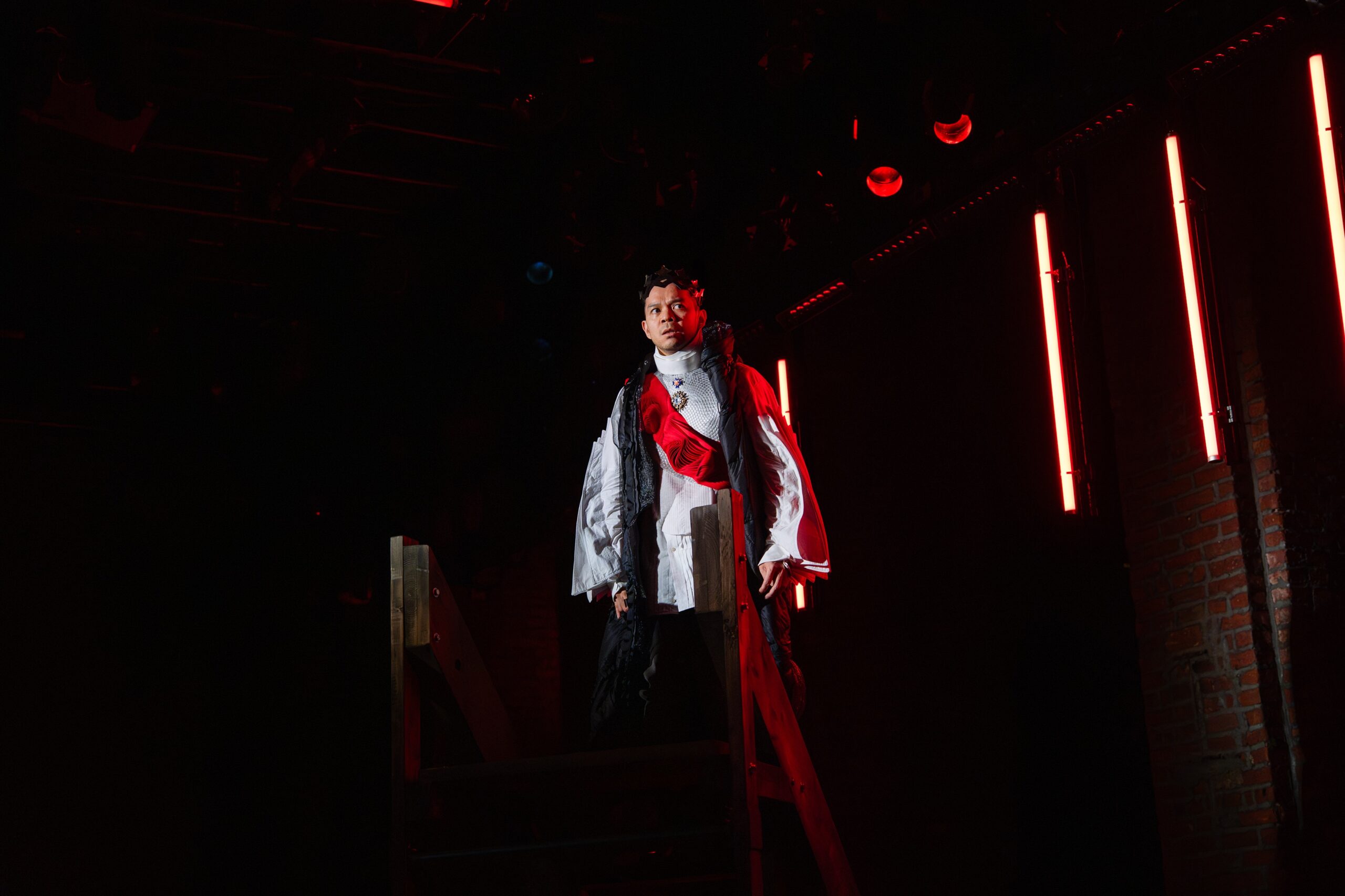
“Henry VI: A Trilogy in Two Parts” at the Public Theater (Photo: Hanjie Chow)
Shakespeare in Love includes a great line about Henry VI. Ben Affleck enters the theatre as Ned Alleyn and is swarmed with love by the industry folks gathered there before an ignorant outsider asks who he is. Offended, bellicose, Alleyn announces in his best leading-man voice, “Silence you dog! I am Hieronomo. I am Tamburlaine. I am Faustus. I am Barabas, the Jew of Malta.” The first is the protagonist of Thomas Kyd’s Spanish Tragedy, the latter three icons of Christopher Marlowe’s catalog. Alleyn’s point is that he is the man atop the London theatre scene, as evidenced by the fact that he has played all the leading men that matter. Then, Alleyn recalls that Shakespeare is standing behind him, turns, shakes his hand, and says in his most pedestrian of tones, “Oh, yes, Master Will, I am also Henry VI.”
The joke is that at this early point in Shakespeare’s career, giants of the early-modern stage like Kyd and Marlowe made Shakespeare, at best, an afterthought of the English theatre. Kyd and Marlowe were creating bold, compelling characters, and all Shakespeare had to offer the great Ned Alleyn was wan, mundane Henry VI.
The line is also particularly funny given that genius would develop: Who on Earth remembers the three parts of his Henry VI trilogy? His early-career attempts at the chronicle-history genre, Henry VI Parts I, II, and III are verbose, dramatically unfocused, violent, and tedious. They were an on-stage blip during Shakespeare’s career and largely ignored by contemporary theatres.
In this regard, the National Asian American Theatre Company’s production of Henry VI: A Trilogy in Two Parts—a two-play rendition of the trilogy running in rep at the Public Theater— does an excellent service of offering the rarest of opportunities to see these afterthought plays on their feet. Audiences familiar with the crookback villain Richard III may enjoy seeing the early development of that character (the Henry VI plays are the first three parts of Shakespeare’s First Tetralogy, which culminates with the much better Richard III). Those who enjoy the more popular and frequently staged Henry IV and Henry V plays (which Shakespeare wrote later in his career as a prequel to the First Tetralogy) may find insight into the playwright’s early thinking about the drama surrounding those kings.
But whether the unique and fleeting opportunity to see these plays and the potential intellectual fulfillment of drawing connections to more famous components of Shakespeare’s oeuvre is worth the six-hour investment necessary to see both of these plays remains an open question. Adapted and directed by Stephen Brown-Fried, the production is no doubt visceral and passionately performed. Brown-Fried’s capable cast—most of whom are called upon to perform several meaty roles over the trilogy’s large canvas—pour themselves into their roles such that the drama and palace intrigue the drove the Wars of the Roses and ripped apart England with years of civil war seem at all times urgent.
The production can do nothing with the plays’ shortcomings, though. At this point in his career, Shakespeare seems not to have figured out the key to his later success with chronicle histories: The characters must be the focus, not the historical record. Richard III, Prince Hal, Falstaff, Henry V: These are wonderful characters that stand up to any of Shakespeare’s creations. The Henry VI plays lack such an anchor. The result is a long historical narrative with little more than glimpses of compelling characters. Richard Plantagenet is a sly villain, here well played by Rajesh Bose. Jack Cade is a fun champion of the lowly, played with great vigor by Orville Mendoza. Teresa Avia Lim’s warrior Queen Margaret seems all the more powerful by Lim’s defiance of the under-expectations her enemies will put on her slight frame. But these glimpses never coalesce into a focused story. Instead, every detail of the historical drama gets told and all the many characters who face death get a poetic swan song on their way out as the violence marches on.
Brown-Fried and his ensemble’s ambition to resuscitate the Henry VI plays from the dusty shelves of theatrical history are laudable and offer much to the Shakespeare completists or enthusiasts for his histories. When the next opportunity to see these plays on stage will materialize is anybody’s guess. I hazard that it will not be soon. If Brown-Fried and company were looking for some overlooked greatness in these plays, that effort has gone wanting. Like Ned Alleyn recognized, the Henry VI trilogy has earned its place as an afterthought.