
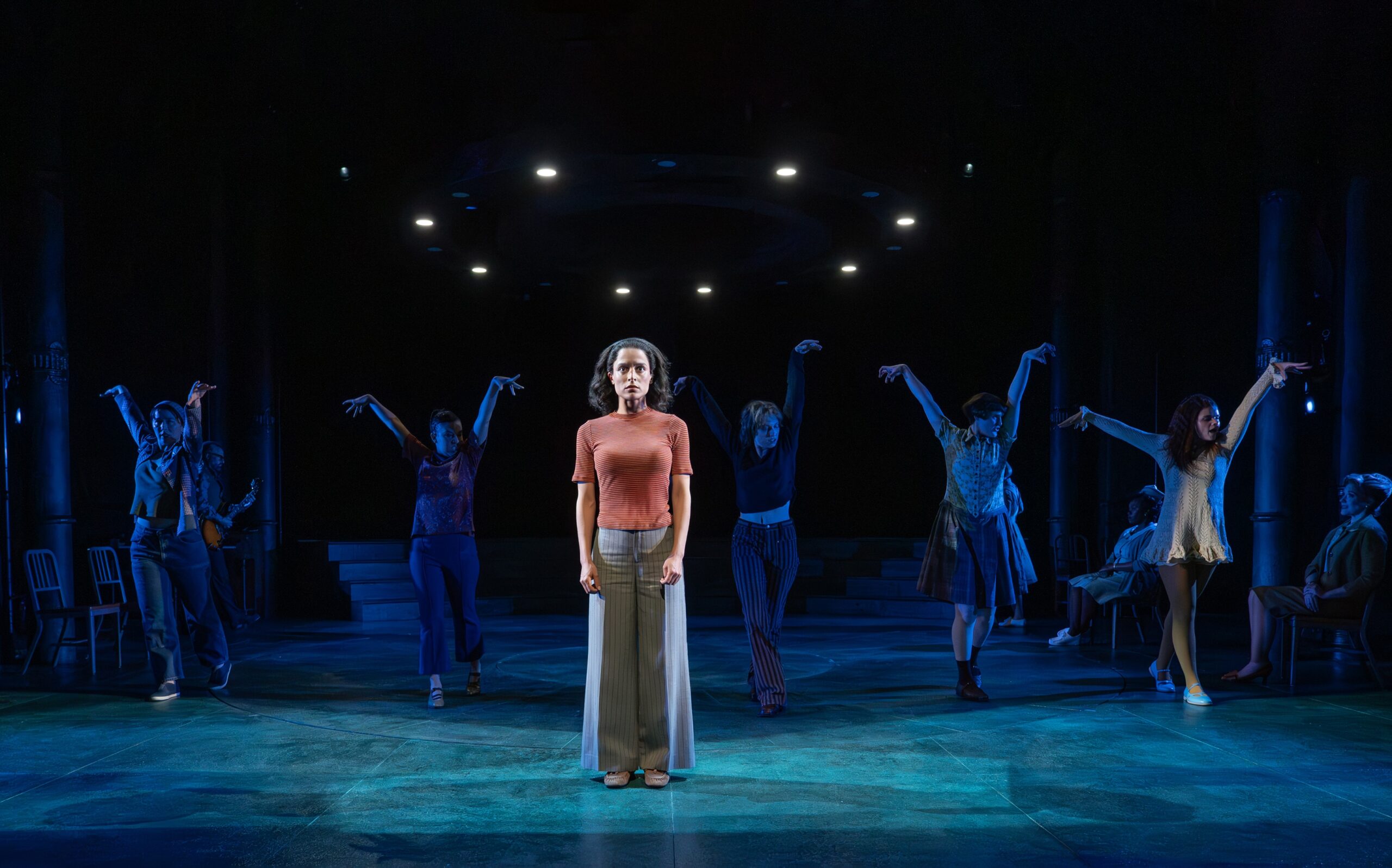
Juliana Canfield (center) and Mia Pak, Gabi Campo, King Princess, Sally Shaw, and Katherine Reis (background) in Girl, Interrupted. Photo: Joan Marcus
In 1967, Susanna Kaysen was eighteen years old and already tired: weary of the indignities of being young and a woman and an aspiring writer whom no one will take seriously; feeling besieged by the violence and societal upheaval around her. After she makes an impulsive, ill-conceived suicide attempt, her father sends her for a psychiatric consultation; fifteen minutes later, she is unceremoniously popped into a cab and sent straight to the renowned McLean hospital for what she thinks will be a seventy-two-hour hold. The minute the nurses start rifling through her belongings for possible danger, she tries to revoke her consent and leave–but she’ll be there for eighteen months. She won’t find out her diagnosis for another twenty years.
If this all sounds familiar, it’s because Kaysen wrote a bestselling memoir about her experience in 1987, Girl, Interrupted, which was turned into a film some ten years later. Now, it’s being presented by the Public Theater as a “play with music,” with a script by Pulitzer Prize winner Martyna Majok and songs by singer-songwriter Aimee Mann. A great many things have changed about psychiatric treatment in the last sixty years–and even if they hadn’t, enough has changed about health insurance and healthcare costs that the kind of months- or even yearslong inpatient stay depicted here has become increasingly rare except for those deemed criminally insane. Still, as the Public Theater’s artistic director, Oskar Eustis, says in a program note, we continue to live in “a society practiced at removing agency from young women” and a lot of the emotional content of Girl, Interrupted remains all too familiar, albeit in a slightly retro package: The terrible loneliness of not knowing whether you can trust anyone around you, or even your own perceptions. The crushing weight of being told by authorities with absolute certainty that you’re crazy. The tendency to pathologize defiance, especially in young women. The frustration and fear of feeling like something is very wrong and not knowing how to articulate it or fix it–and losing the tools to diagnose whether the problem is you or the world.
Majok, with a keen eye for character detail and her light hand with structure, does elegant work with the adaptation. It leans, perhaps a little too heavily, on Susanna-as-narrator to frame the story with the clarity of distance and the confidence of having lived twenty years of successful adult life post-McLean. The journey is from Susanna-then to Susanna-now (both played by Juliana Canfield), not the arc of returning to health or certainly the efficacy of treatment: Susanna’s sessions with lead psychiatrist Dr. Wick (Emily Skinner) serve more as tart exposition than as revelation. Her mental state seems not too different when she leaves McLean then when she arrives, and she’s allowed out upon presentation of a reasonable “plan” for how to support herself. Still, Majok makes smart choices about what to lift directly from Kaysen’s prose, what to turn into dialogue, and how to balance the two sides of Susanna: the reasoned and reasonable narrator versus a younger self who was troubled enough to find a certain comfort and safety in her extended stay in the constrained quarters of a psychiatric ward. Where Kaysen is often episodic with her character portraits, letting the fellow patients and staff members come into focus for sharp moments and then recede again into the background, Majok shapes Susanna’s cohort of the unwell (but not locked-ward unwell) into more of a throughline. “There’s community here, Susanna. If you want it,” Dr. Wick tells her.
We meet the figures as an undifferentiated mass of fellow adolescents that overwhelms Susanna, and then get to know them individually, as she does: Lisa the brash, lonely sociopath (King Princess). Susanna’s roommate, Grace (Mia Pak), another aspiring writer whose grip on reality attenuates sharply midway through. Tori (Gabi Campo), a drug addict from a wealthy Mexican family who’s terrified of going back home. Polly (Sally Shaw), bearing the scars of self-harm. And Daisy (Katherine Reis), glamorous, seemingly battling an eating disorder, bouncing in and out of McLean as she grapples with some disturbingly sexualized familial relationships. But then we see them start to slip away: to ill-advised discharge, to parents who stop paying, to getting sicker, to suicide. It’s a depressing arc, to be sure–staged effectively by director Jo Bonney and choreographer Sonya Tayeh, who have each character slowly recede to an upstage platform where their ghostly presence remains even as they leave the story.
Juliana Canfield always has a quiet, watchful stillness at her core; she draws attention by being so utterly present, and that self-possession works for this intensely observant character who’s always analyzing her own responses and crafting her understanding of a situation. But while the focus is always on Susanna, there are standouts among the rest of the ensemble: King Princess is an appealingly unpredictable and raw Lisa, and Katherine Reis’s Daisy has a serenity that slowly becomes terrifying as we realize what it masks.
The downside, though, is that Susanna’s lens is so dominant, and we get so little access to the interiority of the other women (except in song; we’ll get to that), that Susanna starts to seem saner just because we know what’s going on in her head, and only her head. Majok picks up a lot of the dialogue Kaysen ascribes to the other women, but any perceptions about whether they “belong” there or are being “healed” resides in Susanna’s narration. The other characters remain fuzzy around the edges, which makes it all the more shocking when we’re reminded–by a suicide, by the story of Polly’s self-immolation, by Grace’s withdrawal into delusions and painting the walls with feces–of the farther end of the mental illness spectrum. The staff members are even more abstract–to the point where all the unhelpful figures of male authority, from Susanna’s father to her doctors to her partner as an adult, are played by one actor. (Manoel Felciano brings verve to all of his micro-characters, while also playing several instruments as part of the musical accompaniment.) Even the lead psychiatrist, Emily Skinner at maximum chill, is there as a vehicle for Susanna’s character notes.
The production elements enhance this sense of muddiness and abstraction: dots’s set is a series of semicircular platforms and levels; I never fully understood the purpose of one of its central elements–possibly because Heather Gilbert’s lighting is dim and shady. Sarah Laux’s autumnal-hued costumes give a light reminder of historical period.
The secret weapon of Girl, Interrupted, the play, is Aimee Mann. There’s haunted, plaintive poetry in the songs (orchestrated by Todd Almond)—minor key, desperately sad, full of longing and loneliness, lyrics rich with clever slant rhymes and the secrets they’re unable to say in plain prose. Daisy’s song about the “love nest” her father has rented for her; Lisa’s song about the life that awaits them “out there”; Tori’s bleak acknowledgment of self-medicating by shooting speed; Susanna and Lisa’s pained recognition in “Suicide Is Murder” of how few of their cohort remain with them–there’s short stories of horror in each one. (As good a song as “Give Me Fifteen,” a jazzy number sung by a male doctor about how quickly he can process patients, is, I think the effectiveness of the music would be greater if only the inpatient cohort got to sing.)
Majok can’t entirely crack the problem of turning a one-voiced memoir into a truly multi-voiced piece–but Mann’s songs buoy her efforts, making the whole thing richer, sadder, fuller. Each of the patients is her own tragedy–her own life, interrupted–and it’s Mann’s songs that really make us feel it.