
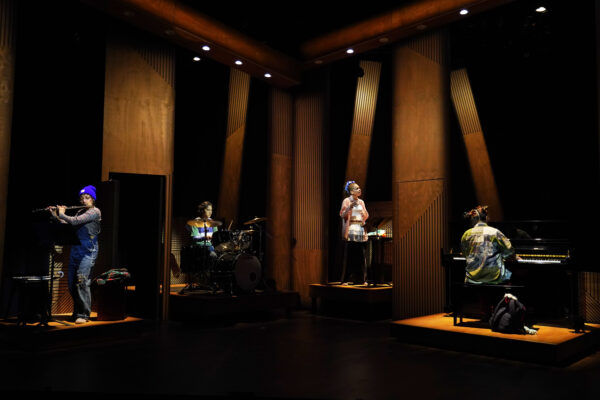
For teen girls, finding your way in the world remains a complicated journey. For characters in this new play, ||:GIRLS:||:CHANCE:||:MUSIC:|| by Eisa Davis, they might be facing more than their fair share of challenges.
And while we need more voices of young women on stage Davis’ play just never seems to lift off the ground. Further, the world Davis creates might be a bit inaccessible if you don’t speak its musical language.
Set in a music camp in the Bay Area, Fax (Hillary Fisher) is a rule-following, chatterbox studying voice. Rile (Yeena Sung) is an over-sharing, truth teller who studies piano. Clementine (Gianna DiGregorio Rivera) picks up any instrument quickly and is always studying but no one seems to see her. And Margot (Naomi Latta) is a genius drummer who they are all in awe of but she’s keeping a lot hidden.
Fax is quite buttoned up, so the free-range Margot challenges her to find a love of music through improvisation. And just simply start to be more connected to herself. The undercurrent of attraction is not to be dismissed either.
Davis captures a moment of intensity between Fax and Margot as they become close and then their friendship blows up. But there is a massive gap in the drama. Again, some disconnect between what was being said and what was conveyed to the audience emotionally.
On the surface, these young people are carrying a heaviness that any of us can relate to as they navigate complex family, mental health, and relationship issues, but the way they talk about it rings false. They never have that vibrant energy of teens speaking their own language, scoffing at the adults around them, and seeing the world for the first time. I longed even for an inarticulateness.
Davis flashes forward to their future adult selves and those moments are usually clear but it puts the breaks on the play each time. It also fractures something in the character development. Let us grow to know or enjoy these young people.
Because the characters are studying music and creating it themselves, this play has a lot of musical interludes. Davis composes the music in the show which is featured alongside established pieces by Claude Debussy, Gioachino Rossini, Frederic Chopin, and Cole Porter.
The actors also create “chance” music that is not pre-planned. There’s an opportunity for the audience to help set the selection for the chance music at each show. 12 audience members can place a sticker on a piano keyboard and those 12 notes will be the melody used by the cast to “improvise and create original music during the show.”
I have no ear for music so how this 12-note sequence was used throughout I could not tell you. I glanced at the insert in my program about this but did not realize it was an motif for the evening and not just the intro to the show.
I just don’t hear or process music like other people. So a varied sequence of musical notes being used like a motif is just lost on me. Sometimes you just know you’re at a show not made for you and this was that.
There is a big moment in the play when Fax, Margot, and Rile put their differences aside and end up collaborating on a piece of music which incorporates each of their talents.
I understand this was meant to be the moment of clarity for the characters: when they find their voices, connect with each other, and make music that feeds them. Yet, the long piece just left me empty. Perhaps this kind of piece would tickle minds who enjoy experimental music. Although I’ve enjoyed my fair share of contemporary composition but this wasn’t that.
If the storytelling had been stronger then I probably could have just skated past my music issues and focused on the characters. But the play just keeps hitting so many forced theatery buttons in a bad way. Nothing felt organic or earned.
Then there is a literal earthquake that rattles their friend dynamic.
Once we got to a major time leap ahead to their adult selves looking back on their time in music, the whole thing played out as a strained memoir. Lessons they’ve learned in life. blah blah. Somehow this turned the show into an embroidered throw pillow in an AirBnB. Live. Laugh. Music. Improvise.
I was confused by the leaden direction. Director Pam MacKinnon stages pivotal moments with the actors backs to us, totally underlit. Or she opts to use the upper level in the audience to place a character who is conversing with someone on stage, while they are not facing each other.
I appreciate the cast have a talent for playing instruments, riffing off of 12 random notes, and building musical phrases of their own design. In this case, they just fell upon my tone-deaf ears.