
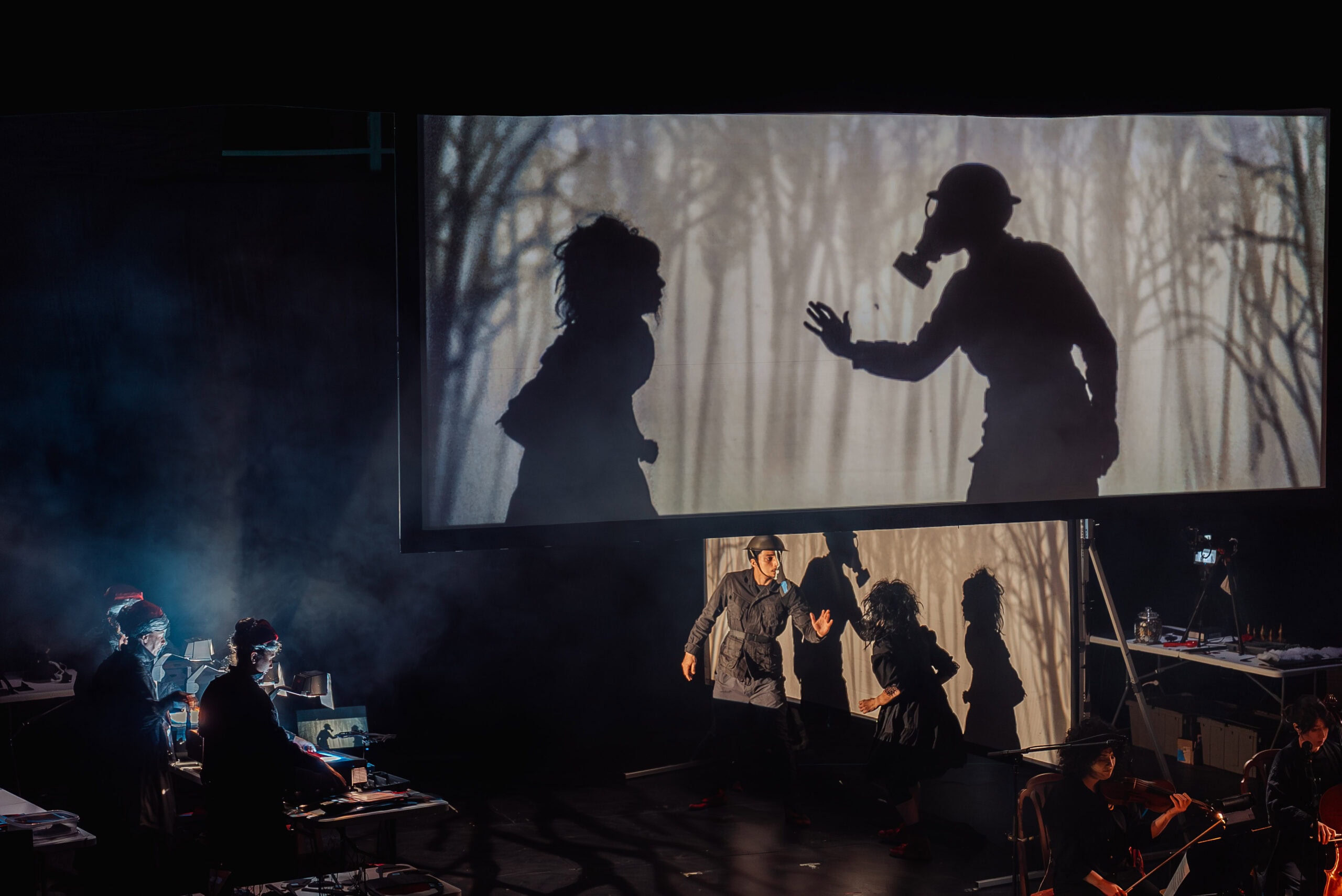
Sarah Fornace and Jeffrey Paschal in The 4th Witch. Photo: Charlie Doyle
It feels almost pointless to use words to describe the generally nonverbal work of Manual Cinema, a group that has invented their own defiantly analog form of live performance that sits at the border of film, theater, dance, and in this case, a few nods to opera. (Every time I write about their work, I come up with a new way to describe the hybridization, and am newly impressed by it.) Using vintage overhead transparency projectors as canvases and light sources, they bring to life whole, rich worlds that are occupied simultaneously by scenic background shots, shadow puppets (designed by Drew Dir), and silhouetted human actors (with masks designed by Julia Miller). The members of the ensemble (Lizi Breit, Leah Casey, Sarah Fornace, Julia Miller, Jeffrey Paschal) shift back and forth between puppeteer and performer; while the puppeteers create their projections and transitions, a live camera captures the work and displays the finished product on a screen above the stage. You could watch only the screen, and you’d think you were seeing a stylized animated film, accompanied by live music (played and sung by Erica Kremer, Lucy Little, and Alicia Walter). But the intricacy of their craft becomes even more evident by virtue of also seeing behind the scenes.
The 4th Witch is a compact piece (compared to, say, their sprawling, multilayered Frankenstein). Loosely inspired by Macbeth, it nestles behind the scenes of the Scottish play’s plot, in a moment just after the general Macbeth has triumphed on the battlefield and become ruler. Instead of medieval Scotland, though, this is set in an age of machine warfare: bombers flying overhead, tanks creeping across the landscape, and soldiers emerging from them in monstrous gas masks. (I’m not sure I could pinpoint tell you why, but the setting felt French to me, perhaps because of qualities in Ben Kauffman and Kyle Vegter’s music.) The color palette is stark: ninety percent black, white, and gray with the occasional splash of red blood or a fiery evening sky. (When the puppeteer/actors take their curtain call, we see they’re all costumed by Sully Ratke in black with accessory touches of red–a detail that may have gone unnoticed during the performance but adds to the unity of the whole.)
A house is hit by a bomb and the parents of a little girl (Sarah Fornace) are killed, buried in the rubble. Frightened by the general (Jeffrey Paschal), the girl flees to the forest and takes refuge in the house of Macbeth’s three witches, and there follows a tale whose aesthetic owes as much to the Grimm Brothers and to mid-century war films as to the Scottish play. Taken in by the witches (Julia Miller, Lizi Breit, and Leah Casey), the girl, played sometimes by a shadow puppet and sometimes by Fornace, learns their ways and begins to acquire their powers. But what good is power, when she can’t turn back time and return to the life she fled?
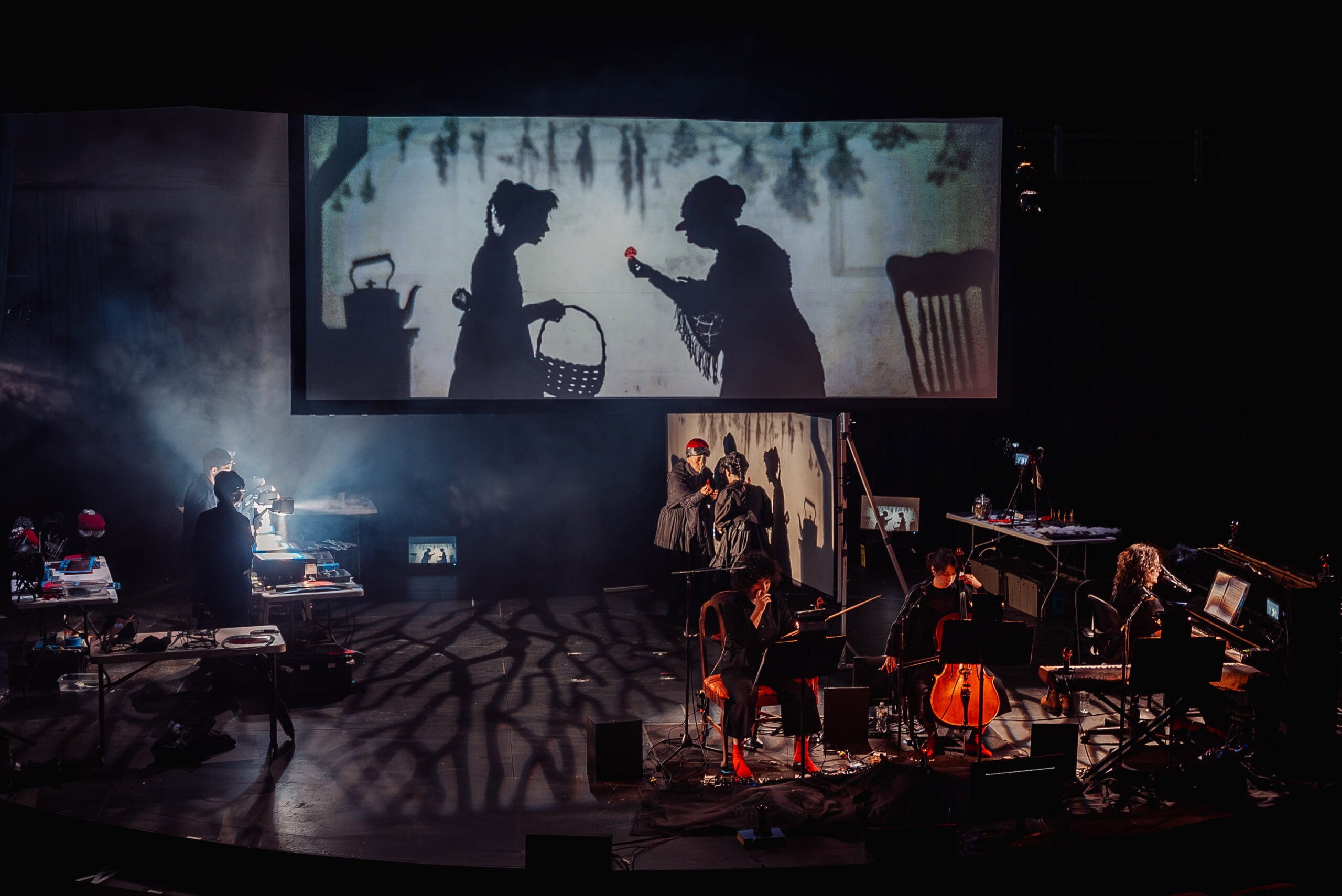
Sarah Fornace and Julia Miller in The 4th Witch. Photo: Charlie Doyle
There’s a little “Hansel and Gretel” in the witches’ house; there’s a lot of wartime newsreel in the establishing battlefront shots and the bomber planes streaking across a gray sky. And if the imagery, the musical score, and the occasional use of title cards tilt toward silent film, the fully realized soundscape, also by Ben Kauffman and Kyle Vegter, adds a more immersive–sometimes even assaultive–quality.) Overall, the setting, the period, and the mechanics of craft work together beautifully here–the handmade ingenuity of life in wartime; the magic of witchcraft. And there’s an unfortunately timely poignancy to a story of a child as a refugee from endless war in a week where bombs are falling with increased force on Ukraine.
My only quibble here is that the Skirball auditorium may be too big for a lot of the audience to get the maximum experience. Its wide and relatively shallow stage works well for the artists, but even in excellent orchestra seats, I couldn’t see the close-up work as much as I wanted to. They do invite the audience onstage after the show for “puppet time,” a chance to get up close with their technical setup and their puppets and props, but it’s not quite as satisfying as being able to see the puppeteers’ hands while they work their magic. I love to see Manual Cinema filling houses this big, but the audience experience does suffer a little for it.