
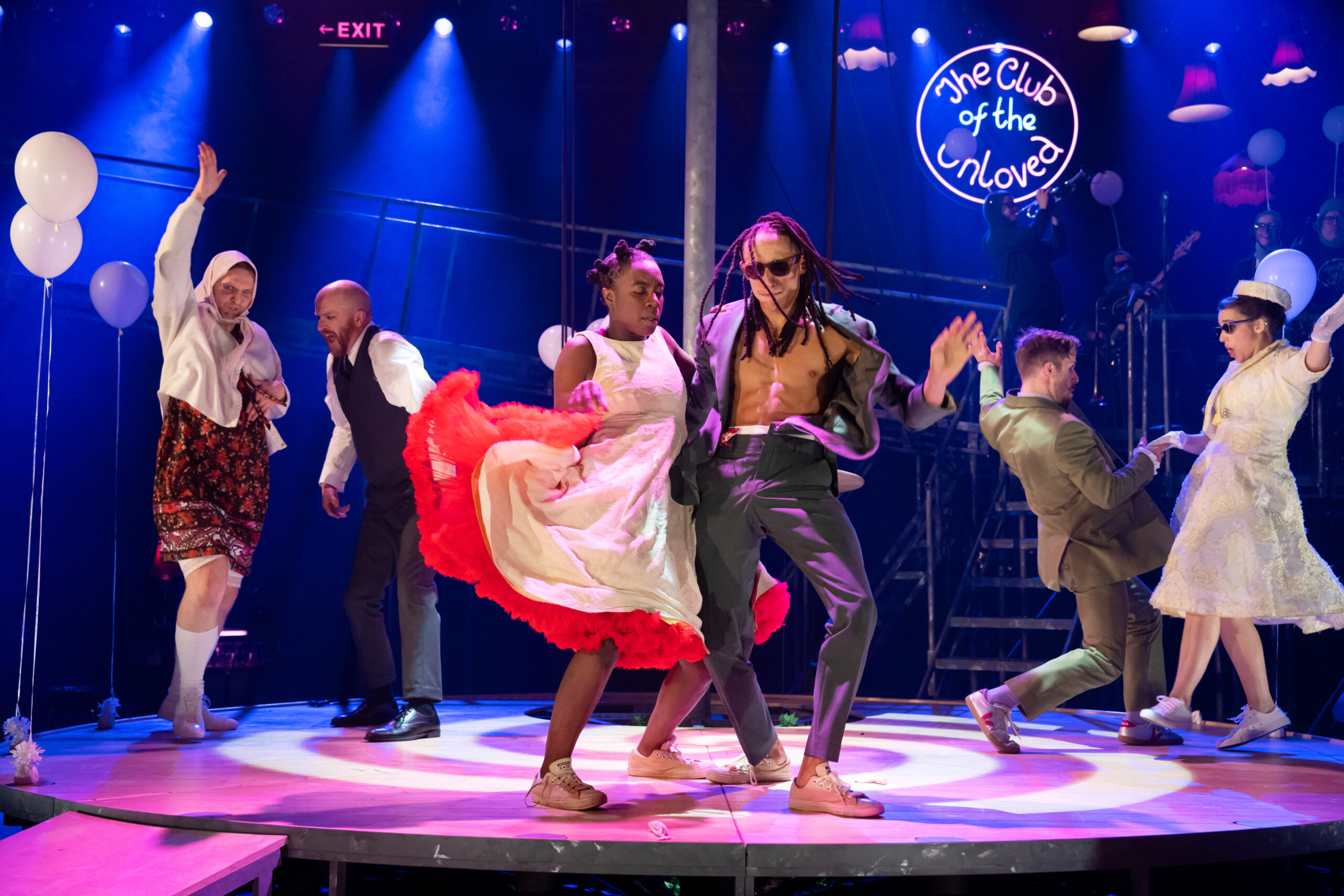
Tom Fox, Edward Rowe, Nandi Bhebhe, John Leader, Matthew Churcher, and Stephanie Hockley in Tristan & Yseult. Photo: Julieta Cervantes
Why do some people have two great loves and other people get none? That’s the question at the heart of Tristan & Yseult, created in 2003 by playwrights Carl Grose and Anna Maria Murphy and director Emma Rice for the Cornish company Kneehigh, and now in revival at St. Ann’s Warehouse. (Kneehigh shut down in 2021; Rice’s own company is behind the current tour.) This question dances around the edges of the piece for most of its two-hour-plus run time, hovering in the space between the framing device and the story of Tristan and Yseult. That frame situates the show at the Club of the Unloved (indicated by a neon sign that flickers in and out of life with a sizzle on cue) and sets up a group of “Love Spotters” as its chorus/company, led by Whitehands (Stephanie Hockley), an elegantly dressed woman with a glamorous mid-century modern vibe, who narrates the story.
Excluded from the world of romantic love, the Love Spotters can only view it from afar. Think birdwatchers of romance, with binoculars, anoraks, and fuzzy balaclavas–but they also play in the onstage band, take turns as lead vocalist for a mix of original numbers and pop songs rearranged into aching torch songs, step into the lead roles as Whitehands leads us through the Tristan and Yseult narrative, and embrace us in the audience as potential fellow travelers in the land of the lovelorn. (Perhaps it’s the inspiration of Kneehigh that led the creators of the Benjamin Button musical, which uses its company in similar ways, to set their show in a Cornish village.)
The underlying story is a simple one: King Mark of Cornwall (Edward Rowe) is at war with the Irish-king-cum-gangster Morholt (Tom Fox). Tristan (John Leader), a melancholy knight errant, washes up on Cornwall’s shore at exactly the right time to help Mark win the key battle. (In some versions of the story, Tristan is Mark’s nephew; here he’s more of a kindred spirit who arrives as a stroke of luck.) Deciding to complete his victory by taking Mark’s sister, Yseult (Nandi Bhebhe), as his bride, Mark sends Tristan to find her and bring her to Cornwall. But a love potion intervenes, Tristan and Yseult fall in love instead, and tragedy ensues.
Grose and Murphy’s script adds welcome nuance in several spots. Tristan is as much a foreigner in Mark’s court as Yseult is—Mark may feel an instant connection to him, but he and Yseult share the bond of being in an unfamiliar environment. All three members of the love triangle are presented as communicating across language barriers; English is their common tongue, but none of their native tongues, and we feel the mutual lack of understanding that underscores their bonds. The story also layers in two other love relationships that aren’t conventionally romantic: Yseult’s with her maid, Brangian (also Tom Fox), and Mark’s with his bodyguard, Frocin (Matthew Churcher). Brangian puts her own future marriageability at risk to help Yseult, and Frocin feels supplanted by Tristan and will ultimately be the one to reveal the affair to Mark—only to learn that Mark much preferred his blissful ignorance. Also, and most crucially, Yseult truly has great loves in both Mark and Tristan, Tristan with a fiery passion that may burn itself out and Mark with more constancy and respect.
But while the Tristan and Yseult plot delves movingly into the different forms love can take, the Love Spotters remain external to it. And because we spend a lot of time with them positioned as actors in or storytellers of the main narrative, rather than being independent agents, it takes a long time to see how the frame will connect to the specific love story being told. There is a running thread whereby minor characters get exiled back to the ranks of the loveless when their part in the story completes, but I didn’t quite see it until I read it in the script, perhaps because the Love Spotters are so unindividuated (except for Whitehands). To be very British about it, they’re a little bit muppets: endearingly awkward, never quite coming into their own.
Rice lavishes the show as a whole with so much theatrical embellishment and flashes of whimsy that the formal diversions often take over from the emotional content—musical numbers, dance breaks, slapstick-styled fight scenes, some light aerialist work, negotiations among multiple languages (French, Cornish, Gaelic), verse portions of the script, bird puppets. The theatrical elements are executed cleverly, they’re visually striking, and they often bring considerable pleasure, to be sure. The entire ensemble moves with physical precision whether dancing, caroming off a crash pad at stage left that allows them to fling themselves from the stage with abandon, swinging in a hammock, scrambling through the audience, or suspending themselves from a pole to snap clandestine photos. Bill Mitchell’s set feels like playground equipment for giants.
Some of the flourishes are exquisite in their simplicity–like the hand gesture that lets the speaker of different languages become mutually intelligible (dictated by the script), or the use of red scarves that billow out as blood when a character is wounded. Etta Murfitt’s choreography for both fighting and dancing is witty, and the actors can all move; Churcher’s Frocin gets some extra credit on this front (Rice did the original choreography). Among the performances, John Leader captures Tristan’s fundamental distance from the concerns of ordinary mortals; he may love Yseult but his eyes remain “unanchored, alone.” Churcher and Fox capture Frocin and Brangian’s never-voiced devotion to their employers, a yearning that could never be satisfied across the divide of power.
There’s just so much of everything that it’s easy to be distracted from the human elements: the snarl of betrayal and jealousy, loneliness and love. And it’s not Yseult’s betrayal of Mark that cuts the deepest, but fate’s betrayal of the Love Spotters. The misdirection is intentional, of course; the congenial chaos of the ensemble leading us to that one sharp shock: This is what it means that some people get no love at all.
When we get there, we can see there were clues all along. For example: Tristan’s first appearance is in a tableau with Whitehands, and as Tristan lies bleeding from a stab wound in his side, she asks him if he loves her: “He has been loved enough to save a thousand loveless souls,” she tells us. “But this is the end: and you cannot have an end without a beginning.” But as we journey back to that beginning and then forward to this critical moment–the moment when Whitehands’s role will be revealed to devastating effect, there’s an awful lot of treacle layered over the painfully bitter revelation at the core.