
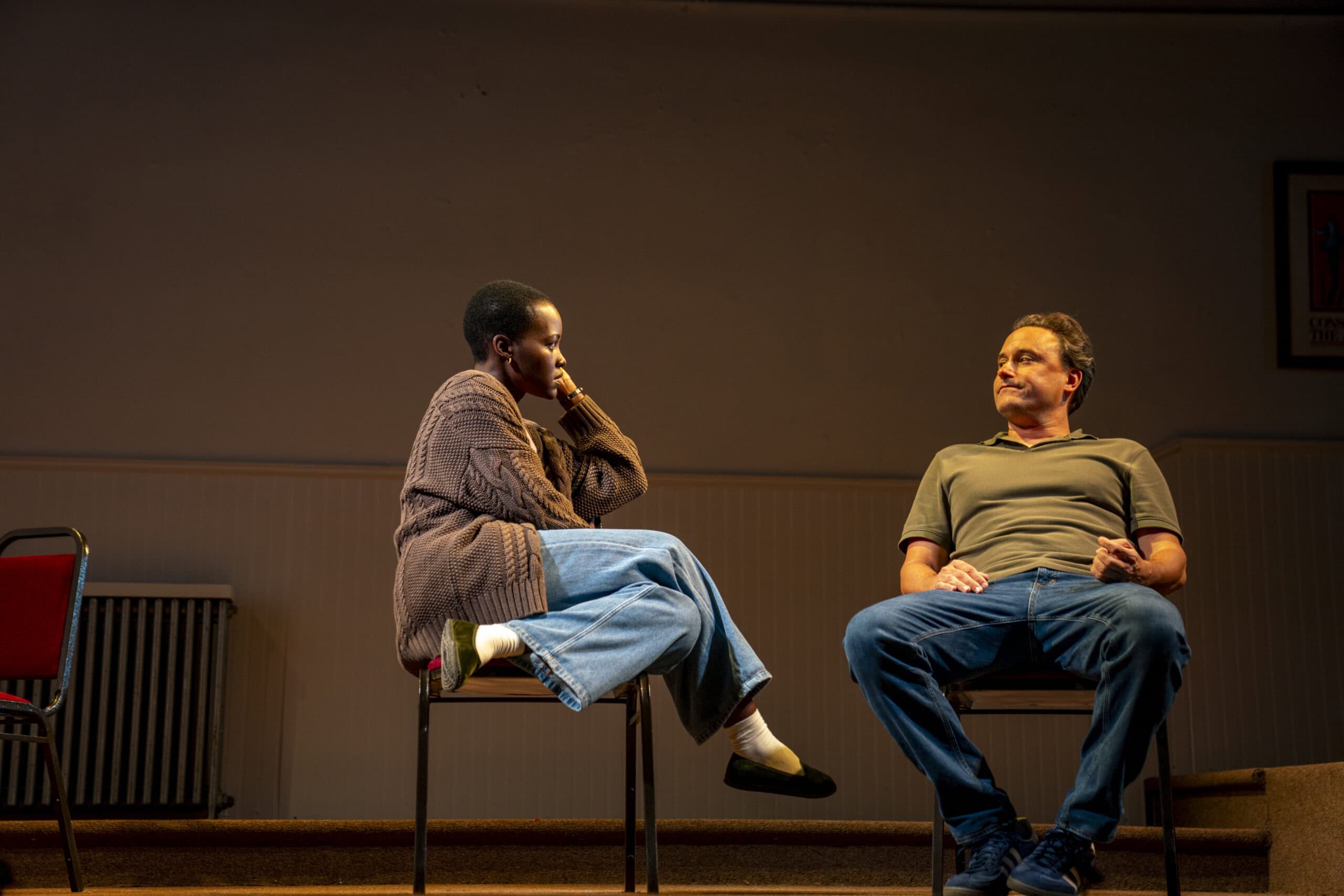
Lupita Nyong’o and Greg Keller in Pre-Existing Condition. Photo: Jessica Kourkounis
Given that Pre-Existing Condition is written by Marin Ireland and directed by Maria Dizzia, both actors of marked subtlety and nuance, it’s no surprise that in both script and execution, it’s an entirely un-showy play about domestic abuse. There are no screaming fights, no thrown punches; we never even see the abuser. The play takes place entirely in the aftermath of trauma, and its fragmentary structure, with abrupt scene endings and abstracted characters, mirrors the experience of trauma, of losing the narrative thread of one’s life, of an inability to follow a single thought, of the way that aftermath shades and warps human relationships.
The unnamed central character, A, has left a partner who hit her–only once, but with 20/20 hindsight she can see all the precursors now that weren’t apparent then. (A will be played by a series of actors over the course of the run, roughly one per month; I saw Lupita Nyong’o, and Philippa Soo begins her run on 9/28.) The rest of the ensemble (Greg Keller, Sarah Steele, and Dael Orlandersmith) play multiple roles also labeled only with letters, standing in for all the people A tries, and often fails, to call on for help: Her mother (Keller), who can’t even recognize the pain in her daughter’s voice. A whole series of unhelpful lawyers (mostly Keller), some kind and others condescending but all ultimately dismissive of the scope of her potential “damages.” Her therapist (Orlandersmith), who can’t give her what she wants as fast as she wants it. The facilitators of a domestic abuse support group (Steel and Orlandersmith), from which A will “graduate” without feeling like she’s made much progress, and without being able to stop comparing the severity of her abuse to the others in the group. Her friends (mostly Steele and Keller), some supportive and others oblivious. Keller also plays a series of men she tries to date, some of them perfectly nice guys who don’t know how to react when A’s emotional portcullis suddenly slams down and some of them less nice guys, who react much the same.
This one event has knocked her life off course as surely as her ex’s punch knocked her down. Mired in self-recrimination, fear, depression, anxiety, and pain, she struggles to find her way back, with no guideposts: “I don’t really know, I guess. What I want. What will help.”
Nyong’o’s A is intensely physically contained; she’s a petite person who feels like she’s actively making herself smaller. Dizzia opens the play with A facing away from the audience as she consults with a pro bono legal advisor (Steele), who is warm but matter-of-fact, and we can feel A’s emotional paralysis through the back of her head. The rest of the ensemble has a sense of expansiveness and comfort in their bodies that we never sense from Nyong’o; they all feel grounded and Nyong’o might blow away at any moment. (Sarah Steele happens to be visibly pregnant at the moment, and it folds well into that aura of her characters’ being at peace with her physical self in a way A can no longer be.)
Similarly, we can feel A trying to force physical chemistry with the dates she goes on, but it never quite sticks–some of Keller’s more blithely insensitive dudes don’t help, of course–and ultimately hitting a wall when real physical intimacy enters the conversation. Even with that sense of constraint throughout, the act of shutdown behind her eyes in these moments is abrupt and stark, an involuntary but complete withdrawal.
There are two strands of time running through Pre-Existing Condition. The world around her moves swiftly forward: Minimize A’s trauma and go on with life. None of the lawyers she consults see a payoff in her situation, given that she wasn’t injured badly enough to require hospitalization; some ask her to find “perspective” on how little she lost, comparatively. She’s constantly reminded that she won’t get any money out of her pursuit of justice, and disregarded when she says that wasn’t what she was after anyway. One of her dear friends (Steele) urges her to consider how bad her ex feels about the whole thing.
But A finds herself instead experiencing a paralyzing stasis: Reliving the moment of the punch over and over again, a memory that “lives in my body now. It’s not going to go away.” Unable to trust her own self-perception: “And there are days when I feel like maybe I always was trash and this experience just made me see that finally.” Seeking an intimacy she no longer feels capable of.
The production’s physical elements come down hard on the side of stasis, rather than progress: Cate McCrea’s set is a room of excruciatingly shabby neutrality, with dingy off-white walls painted poorly enough that the flaws are visible from the audience, ugly plastic stackable chairs, and half-staircases leading off to other rooms we can’t see. Isabella Byrd’s lighting mimics the harsh fluorescents that would normally populate such a room. I did not see the original production in 2024, featuring the same team but in a much smaller theater. In this more conventional proscenium setup, that aggressively bland room, its only decoration a poster upstage reading “Consider the Alternatives,” comes off like literal purgatory: a characterless place through which A must pass to reach the path her life will take.
Ireland’s refusal to locate the play in place or time or to give its characters names also contributes to the feeling of being suspended in a space between reality and archetype: This woman could be anyone, and she will be represented over the next few months by actors of varying age and race. The people surrounding her are everyone, but exist in their patterns of reaction (helpful, empathetic, dismissive, uncomprehending) to A rather than in their own emotional lives. That universality helps to focus our attention tightly on what A is actually saying, to follow her experience–in all its confusion and uncertainty–rather than to let our own emotions be drawn by connections to other characters.
Toward the end of the play, A asks a friend to listen to months’ worth of voicemails she’s been afraid to play. He acts as a filter, repeating to her the recorded words from her phone. Some of them relate to the events of the play–another lawyer who can’t help her–but many are birthday wishes, or “just-to-say-hi” messages from her mother or her friends. It’s the moment at which we feel A start to grab hold of her circumstances, start to feel her way toward moving forward. And yet that progress is still partial. In the closing monologue, she says, “Sometimes, yeah, I remember good things. But the scary part is the good things and the bad things sort of sound the same to me now in my memory. Like they’re all things I should look out for now. It all sounds the same.” Pre-Existing Condition doesn’t give you a traditional narrative or characters–but it gives you searing insight into the way trauma traps the psyche.