
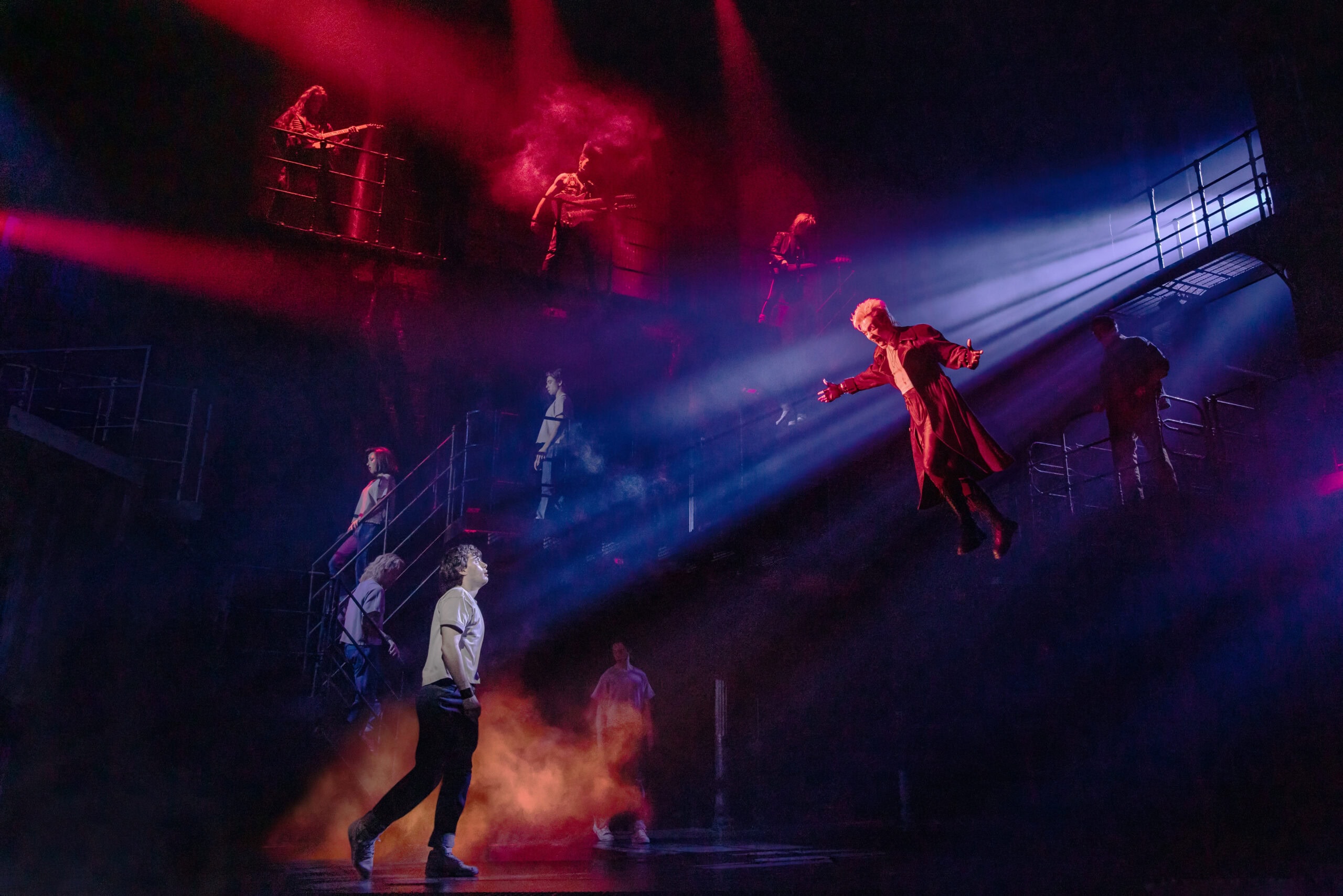
LJ Benet, Ali Louis Bourzgui, and the company of The Lost Boys. Photo: Matthew Murphy
It is telling that the website for The Lost Boys, a new musical adaptation of the 1980s horror comedy film, features only the vampire ensemble. Because while most of the changes made for the stage have to do with building themes and relationships among the three members of the Emerson family–whose older son, Michael (LJ Benet), is almost seduced into joining the vampire family known, a la Peter Pan, as the Lost Boys and whose younger son, Sam (Benjamin Pajak), becomes the engine for slaying them [spoiler alert]–the show is so much more compelling when the vampires are on stage.
If you like your musicals to run on an engine of bigger, louder, faster, MORE, The Lost Boys is for you. Dane Laffrey’s set is a mechanical marvel that not only stretches up three full stories into the heights of the Palace Theatre’s fly space and includes a functioning elevator but creates a sunken level, often sinking with actors on it, and Michael Arden’s production fills all of that vertical space ingeniously, usually operating on at least two levels at once. It doesn’t entirely make sense that there would be a functioning elevator in an earthquake-damaged ironworks, nor why vampires who can fly would need to travel in it anyway, but coherent worldbuilding was never part of the charm of The Lost Boys on stage or screen, and it’s a cool effect. And that’s only one of the elaborate locations: we’ve got a fully built-out two-story house/abandoned taxidermy workshop, the tawdry glitter of a low-rent boardwalk, a train trestle shrouded in fog.
Choreographers Lauren Yalango-Grant and Christopher Cree Grant also use that vertical space for aerial choreography–another reason the vampire sections win out; the Grants also do the ground-based choreography, but there’s not much of it. (The magic of the flying effects is slightly undercut by the fact that by the time the vampires lift off, we’ve already spent much of Act 1 watching set pieces fly in and out in ways that seem more technically challenging than flying people. Still, it’s always a thrill to watch actors defy gravity, and the angled beams of light and drifts of fog that surround the flying are atmospheric.)
The Lost Boys are figured as a goth-rock band, which makes sense narratively and also gives them a chance to perform some of the flashier songs; Ryan Park’s costumes deck them in the requisite black leather, combat boots, and studs–as well as sketching the entire boardwalk-freak-show aesthetic of the ensemble. The lighting design (by Jen Schriever and Arden) is so tricked-out that an entire rock-concert-level rig descends down to almost audience eye level just to pull off the effect of a motorcycle race (a key scene of the film that doesn’t work particularly well for the stage)–but also beautifully limns the vampires’ subterranean lair in dust and shadow. Adam Fisher’s sound design gives the vampires the ability to deploy surround effects and adds a touch of reverb to their voices.
But The Lost Boys never makes a particularly strong case for why it needed to be a stage show, let alone a musical, in the first place–other than the fact that the line for merch trailed far out into the lobby at 7:40. Certainly it’s not the greatness of the songs by The Rescues, which range from decent but forgettable rock-opera to treacly “I want” songs (and one unbearably cheesy coming-of-age/coming-out anthem). And while I know part of the raison d’etre of the Broadway musical is–to quote another show opening this week, Schmigadoon–that “when you’re too emotional to talk, you sing,” the creators of The Lost Boys have gone too far in literalizing the subtext, verbalizing the themes explicitly and in the process sucking out much of the edge and mystery in the underlying material. It’s entirely characteristic that the very first song, “No More Monsters”–carrying us through the Emerson family’s move from Arizona to the childhood home of mother Lucy (Shoshana Bean) in Santa Carla, California–features the lyrics “We got a lot of baggage, Mom” and that their family is “suckin’ the life out of” Michael.
David and Sam’s father (Ben Crawford), you see, is the abusive “monster” that they are fleeing; David is bearing recent wounds that are subsequently healed by his partial vampiric transformation. Lucy’s father, recently deceased, is given a homecoming via returning his ashes to the house he has bequeathed to his daughter, which gives Lucy and her sons a place to run to. The Lost Boys (a la Peter Pan’s crew) are all parentless runaways, with a “head vampire” (the identification of whom proves critical to rescuing Michael from the vampires’ thrall) serving as the closest thing to a father in the play. The theme of healing from inadequate fathers–“fathers who don’t deserve us,” as David says–isn’t particularly subtle.
In addition to this added theme, we now get a heavy-handed journey of self-discovery for Lucy (via the song “Be Kind, Rewind,” in which she yearns for a fresh start in lyrics larded with 80s movie title references) that culminates in her joining the final vampire battle bearing a weapon crafted by her father, and a heavier-handed coming-out story for Sam (via the song “Superpower,” which melds his queer identity and his love of comic books into a dancing chorus of rainbow-clad superheroes). Shoshana Bean and Benjamin Pajak can only do so much with the forced pluckiness that underlies both characters.
Appropriately, if predictably, the vampires’ songs have the rawness and complexity that the rest of the score is lacking. Those characters, even love interest Star, may have negligible character development, but charisma and mystery will get you a long way, and these performers have it. Ali Louis Borzgui’s David (the Kiefer Sutherland role in the film, and Borzgui’s been given a probably unnecessary blond wig just to make sure we get the connection) and Maria Wirries’s Star draw the lonely, brooding Michael (LJ Benet) into the vampire orbit, David teasingly and Star plaintively. The other three vampires, Marko (Brian Flores), Dwayne (Sean Grandillo), and Paul (Dean Maupin), don’t get to talk much, but they sing, brood, and fly with flair.
There’s a chance here to make the Lost Boys more than villains whose special-effects deaths we’ll shortly cheer–but The Lost Boys doesn’t take it. The show’s strongest scene is the vampire initiation: the Lost Boys tempting Michael with belonging; it’s the place where the visuals, the aerial work, and the actual storytelling combine into something that hints at taking on a life of its own, independent of either the underlying IP or the strain of sentimentality that’s been infused into it. The inadequate fathers, the rubble of downward economic spiraling, the loneliness epidemic that’s plaguing us all now–these ideas are all in The Lost Boys, but the play settles for sentimentality and fan service.
The musical can hardly avoid getting tangled up in its mixed imperatives to be faithful to the source material and to add musical theater tropes. Yet it also feels like some of the big special effects moments are perfunctory nods to the original, rather than being reimagined fully for the stage: the vampires sleeping upside-down in their lair; the motorcycle race. (The characters of the Frog Brothers, Alan [Jennifer Duka] and Edgar [Miguel Gil] feel the most like they’re quoting the screenplay, except for the part where Alan’s full name is “Jessica Alan”). The pacing gets uneven—the climactic battle sequences are rushed, and because the house set is so elaborate, it’s hard to know where to focus. Each death feels like a box ticked with a little puff of smoke; the effects here are not as special as they could be. (And one innovation I could surely live without: the addition of the theatrical equivalent of the post-credits sequence in a kicker scene post-curtain-call.)
If you’re going for sheer Broadway spectacle, there’s a lot to enjoy in The Lost Boys. If you’re going because you’re a fan of the movie (which I wholeheartedly am), be forewarned of the thematic sledgehammers. If you’re going to see an old horror property transformed into something properly new and musically inventive, you might want to wait for the next revival of Teeth.