
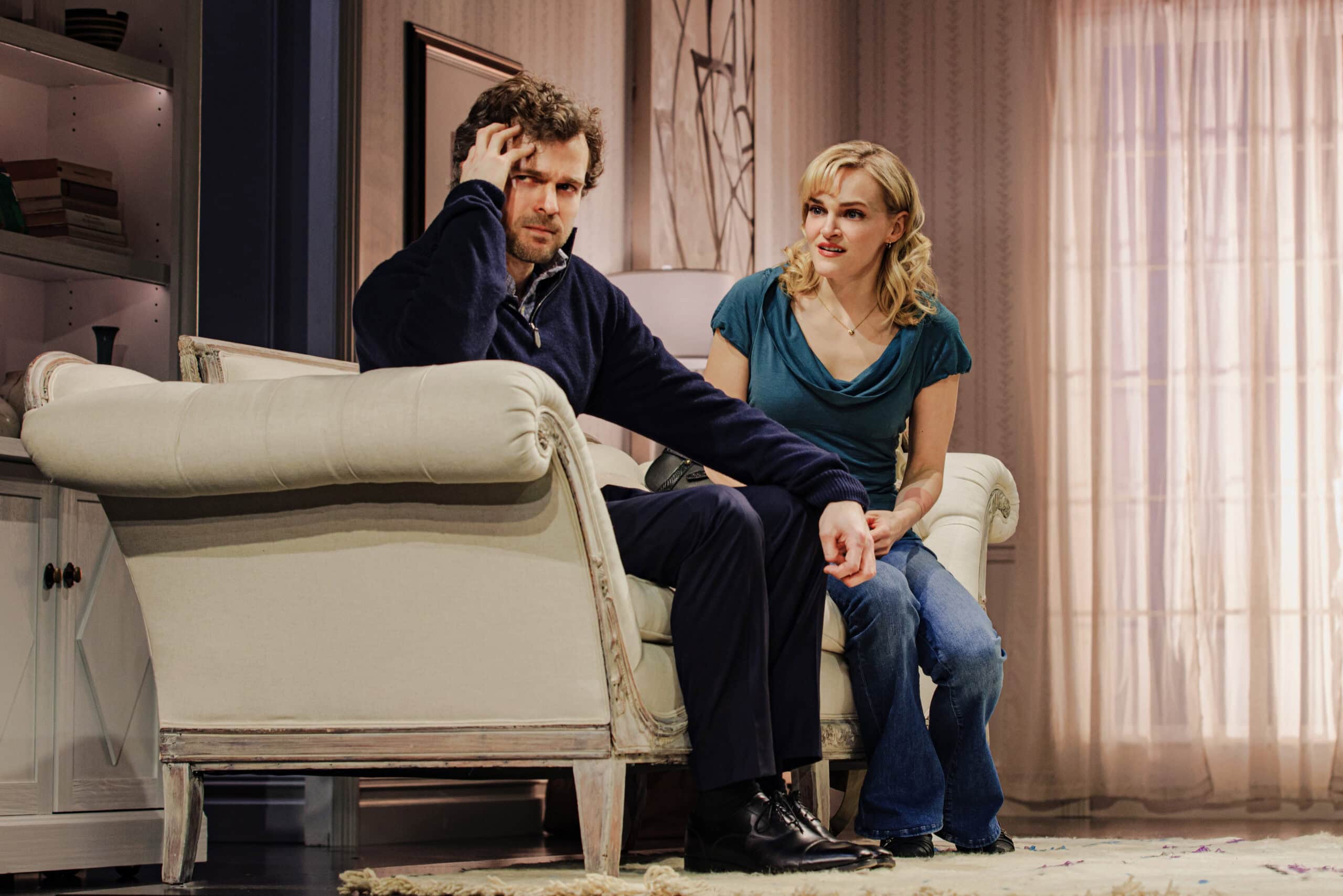
Alden Ehrenreich and Madeline Brewer in Becky Shaw. Photo: Marc J. Franklin
At the beginning of Becky Shaw–a 2008 play by Gina Gionfriddo now revived on Broadway with a starry cast under the crackling direction of Trip Cullman–it’s four months past the death of Richard Slater, wife to Suzanna-known-as-Susan (Linda Emond) and father to Suzanna-known-as-Suzie (Lauren Patton). (Narcissism alert #1 may be that mother and daughter have the same name.) Their differing attitudes to this death–as well as their equal willingness to massage the truth when it benefits them–can immediately be seen in the way that Susan overstates the interval in order to justify the fact that she’s already moved on to a new partner and Suzie understates it in order to properly underscore the depth of her grief.
Suzie, a thirty-something grad student, is undone by the loss of her father–both emotionally and financially, especially when it turns out he’d run the family business that was the source of their wealth into the ground. Mostly lacking in practical skills, she’s dependent in many ways on her “brother” Max (Alden Ehrenreich), a childhood friend quasi adopted by her parents—mostly her father—after his own mother died. Susan, on the other hand, has whittled her emotional needs down with ruthless pragmatism. Her husband has just died, she’s facing increasing disability from MS, the financial picture isn’t rosy, and so she’s acquired a lover/companion. She has nothing to offer him but money, as long as she has it, but if that makes it a relationship where everyone has something to gain, she’s happy. (We never see Lester, but he has stuck around at least a year by the time the play ends.) If Suzie blinds herself to the flaws of people who love her, Susan thinks cruel acknowledgment of flaws is the currency of human communication.
Max shoots past pragmatism and all the way into pure instrumentalism. People are only as good as they are useful, and he can only take responsibility for the small circle around himself that he can control: Amassing money in order to achieve an independence and security his upbringing never provided. Executing his responsibilities toward the two women who are the closest thing he has to family (his father is still in the picture, sort of, but not a reliable source of any kind of human support). Not thinking too hard about the emotions embedded in those responsibilities.
These people are all psychologically stunted in different ways, in other words, none of them really able to see beyond the boundaries of their own warped needs. Suzie claims that “Sometimes lying is the most humane thing you can do”–but she and her whole family rarely make the humane choice, instead finding the cruelest possible barbs in which to embed kernels of truth. (To take just one example, upon the occasion of the death of Max’s mother, Susan took him shopping for a suit, saying, “Your mother is dead and your father dresses you like a gay hustler.”)
In the opening scene, Max, a few months after Richard’s death, brings Suzie and Susan to New York to share some hard financial truths and jolt Suzie out of her depression. But Susan refuses to hear the former, and Suzie and Max’s resultant bonding-and-griping session ends up in bed. When Suzie turns Max’s advice to find a new hobby into a whirlwind courtship with and, six months later, a Vegas marriage to Andrew (Patrick Ball), an aggressively sincere (we learn more than once that he cries at pornography) aspiring writer whose savior complex is paired with a self-effacement so great that no one remembers his last name, it’s not clear whether she or Max is more surprised. (They have not, of course, dealt with any feelings that may have arisen after they slept together.)
And then Becky Shaw (Madeline Brewer) shows up. She’s the title character, and so you’ve been waiting for her all along, but so much has already happened–a death, traumatic grief, the revelation of a family secret, a hook-up between two old friends/foster siblings, and a hasty marriage–that at first it’s hard to see what she’s going to add to the mix. Yet her entry into the others’ lives becomes a lever to pry open the fissures already building between them, and her open acknowledgment of her needs and damage is seen as weakness that the others can use for purposes of their own. Our main players exist on a spectrum of privilege that takes for granted Ivy League educations and spontaneous trips to Vegas, even if not all of them are presently cash-rich; Becky is a stranger from a different world–a working-class Rhode Island native and college dropout. And in turning a never-acknowledged love triangle into an awkward quadrangular stew, Becky’s very presence shines a harsh light on the substrate of neediness, savior complex, contempt, frustration, and loneliness among Andrew, Suzie, and Max. Becky can be as manipulative as anyone else in the play (and there’s a backstory about her fraught relationships with Black men that’s unsettling), but she’s mostly fighting with defensive weapons rather than offensive ones, and that sets her apart in this narcissistic crowd.
Max and Andrew have only met a couple of times, but when Max is spending a few months in Boston for work, the well-meaning but not very well-informed Andrew decides to set up a blind date between Max and Becky, his coworker. It seems at first that there might be a spark of something, game recognizing game. Becky and Max do have a kind of people intelligence that the other two lack. But Max can’t get over his distaste for Becky’s fragility; what brought out Andrew’s wounded-bird protective instincts makes him flinch away.
What could have just been a bad date that turned into a funny story later ends up as a clash of pathologies: Andrew’s need to be needed, Suzanna’s need to be the emotional center of every relationship, Max’s need to show he’s in control, and Becky’s need for every sort of human contact. It’s a navel-gazing exercise in collective selfishness–which is only made worse when a crisis with Susan requires Suzie and Max to rush to her home in Virginia on the anniversary of Richard’s death. (Susan only appears in the first and last scenes, Suzie and Max’s family of origin a sort of bookend to the core action, but Emond is as ever indelible.) The final scene, when the full ensemble is together for the first time, is a brilliantly nasty spin on the drawing room comedy, riotous and queasy-making at once.
Which is kind of the tone of the whole thing: Gionfriddo’s dialogue slashes and burns its way through two and a half hours, and though the laughs flow freely, and there’s a certain glee in seeing people for whom love is an emotional weapon get one by one hoisted on their own petards, it also leaves a sour weariness at the nastiness of people. While there are some gender dynamics at play in the ways in which each wields their weapon of choice, the tenor is broadly misanthropic. But the problem isn’t that these people are unlikable so much as that they’re exhausting in their constant calculating and calibrating, in their inability to have a conversation without strategy underlying it. There’s not a line in the play–even from Becky–that you don’t have to flip over to see what game it’s in the service of, whose point is being scored and tallied.
It’s hard for a director to keep momentum with characters whose outer surfaces are so carefully engineered to avoid inadvertent subtext, but Cullman has cast smartly, and builds physicality into each character: Patten and Brewer feel like they’re vibrating even when sitting still, and Brewer never seems able to get comfortable, but they shrink in on themselves, where Ehrenreich radiates energy outward. Emond’s careful posture is an active fight against the disability indicated by her cane. And Ball’s Andrew has a casual comfort in his body that no one else can match; he’s the only one who seems to enjoy physical contact with other people. (Kaye Voyce’s costumes do excellent character-defining work as well, especially for Becky, whose bright colors pop against the others’ neutral attire and the black or cream that prevails in the different rooms of David Zinn’s set.) There is a crispness to all of the performances that casts the oppositions presented in the text in stark outline: worth versus money; honesty versus intimacy versus “pockets of mystery”; whether the kind lie or the cruel truth is more deserving of trust.
Zinn’s set–and the way Cullman has the actors perform on it during scene transitions, moving furniture around in ways that never seem quite purposeful or efficient and sometimes standing by and watching while others bustle–provides a key insight into the deeper dynamics of the play. All of the spaces till the final scene are sketched–pools of black space with just-enough generic furniture to serve the purpose, surrounded by a void; identical doors that seem to go nowhere across the upstage wall. But Susan’s home is a fully realized, traditional Broadway domestic interior–soothing neutrals, light pouring through windows, wall decor and the suggestion of a practical hallway where the characters exit to the restroom.
There’s a generational shift encoded in the space: the adriftness of a generation reaching its mid-thirties without having fully achieved the adult life our parents had. Gen X was the first to hit this quandary, but it shows no sign of ending; the post-war American ideal of suburban home, heterosexual nuclear family, 2.5 kids seems ever farther out of reach. Max has professional success but no human connections; Andrew and Suzie are married but foundering financially and not rooted in careers; Becky has neither and is estranged from her family to boot.
When Becky Shaw premiered in 2008, it was of the moment–studded with a soundtrack of contemporary indie rock (Max may have disdain for Andrew’s musical taste, but the play as a whole surely subscribes to it), depicting Gen Xers reaching what we were told would be the prime of their adulthood and yet still feeling unformed, unfulfilled, unable to achieve the thing previous generations seemed achieve without even trying (Susan’s life may show that this wasn’t an unalloyed good thing). Almost twenty years later, those goals feel ever more out of reach (though, yes, I still like the music), and that sense of misanthropic disaffection now rules–and may be about to destroy–the world. There’s a sense of entitlement that pervades the play–even Becky, whose emotional neediness engenders a sense of entitlement to Andrew’s time and support, though her self-awareness level is a bit higher–has come to dominate American culture. I admire Becky Shaw’s excoriating cleverness and its unflinching look into its characters’ worst behaviors. But in a world with vicious narcissists at the helm, it’s not entirely appealing to be asked to find them funny.