
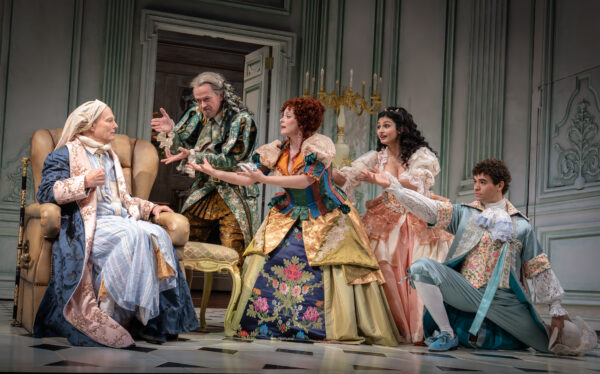
Bill Irwin, Dylan Baker, Rachel Bloom, Ava Lalezarzadeh, Daniel Croix Henderson (Photo: Joan Marcus)
In 1673, Molière wrote The Imaginary Invalid, a comedic satire about a hypochondriac that makes fun of medical overbilling, healthcare quacks, and wellness cures. Bill Irwin has adapted and stars in a new version of Molière’s play that is still set in 17th-century France, but references AI, primary care physicians, and Roundabout subscribers.
The plot still follows Molière’s, and the themes of love, greed, and listening to your own body remain relevant, but it’s all a bit slight. Director Brandon Dirden has rounded up a crack team of comedy actors alongside Irwin, including Crystal A. Dickinson, Dylan Baker, and Rachel Bloom. But the production does not play as a knockdown-drag-out farcical comedy (though at times individuals try to take it up to that level). It is more a droll situational comedy with some “life lessons” thrown in.
Argan (Irwin) is a wealthy hypochondriac who never leaves his house and is being fleeced by doctors and pharmacists who sell him cures and medical regimens for the nothing that ails him. His treatment is heavy on enemas and little else. He won’t listen to reason, and least of all his wise-cracking maid Toinette (Bloom in her Broadway debut).
Argan is also being taken for a ride by his second wife, Beline (Dickinson), who is eagerly waiting for him to die to take his money. She is trying to convince Argan to disinherit his darling daughter Angelique (Ava Lalezarzadeh) by sending her to a convent. Angelique is desperate to marry Cleante (Daniel Croix Henderson), but Argan has decided she should marry Thomas (Hiram Delgado), a son and nephew of doctors (Brooke Ashmankas plays both doctors), so he can get free medical treatment. A whole new kind of in-network HMO.
Irwin is always a pleasure to see on stage, even if here he’s always “suffering”—his wallet and his bowels get the worst of it. In Irwin’s take, he’s really just a man who has lost touch with his reasons for living, and his loved ones have to trick him into focusing on life rather than death. Though it’s a melancholy tone in what is supposed to be a comedy.
Meanwhile, everyone else around him is preoccupied with love, sex, and desire—Angelique and Cleante, the ardent young lovers, are bubbling over with emotion (Lalezarzadeh has a sweet fierceness to her). Beline may be avoiding any intimacy with Argan, but she has a vivacious romance with her notary (also Delgado). Even Argan’s brother, the affable Beralde (Dylan Baker), tries to get him to see the joy in life.
The comedy involves mistaken identity, secret plots, obvious disguises, doubling of roles, and Argan’s emergency runs to the toilet to play up the farcical nature of the play.
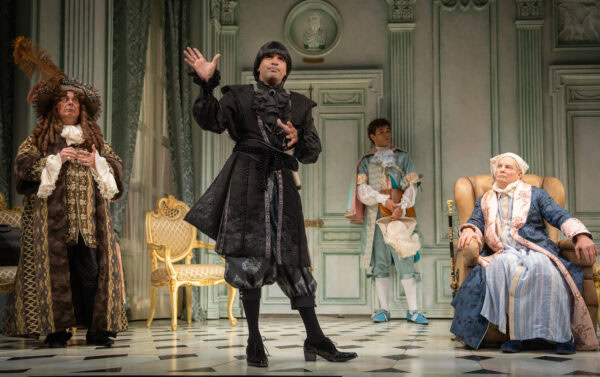
Brooks Ashmanskas, Hiram Delgado, Daniel Croix Henderson, Bill Irwin (Photo: Joan Marcus)
The show’s funniest moments are the most over-the-top ones. In particular, Delgado as Angelique’s dim-witted, horny, and intense suitor, Thomas, tosses his bowl cut wig back, makes declarations about his disbelief in the circulatory system, and cuddles up to his father like an overgrown manchild. He is ridiculous and the exact kind of arranged marriage nightmare to drive someone into a convent. He nearly had Dickinson cracking up on stage when Thomas is overcome by Beline’s sex appeal.
Bloom dresses up as a fake doctor to convince Argan that not all doctors have his best interest at heart, but I had a hard time hearing what she was saying with her Freudian accent to boot, though she is generally a straight arrow/delightful foil to Argan and his whining.
Then there are the Molière-throwbacks which I struggled with. There’s a troupe of actors in commedia dell’arte masks who open and close the show. They literally set the stage, “pulling” in the set walls and ceiling on red ribbons. It’s a beautiful visual, but their presence or role is forgotten until they show up again at the end of the show.
Molière used commedia dell’arte and these archetypal characters in his plays, but I’m not sure it helped the show’s tone problems. The masked characters were a little creepy (maybe I am a heathen) in their bulbous noses and lit from below with footlights. There’s just something kind of dark and foreboding about this moment, and then the play launches into its light-hearted poop joke-oriented satirical comedy. Would this all be more legible to a theatergoer in 1673, or would they too wonder “WTF, are those noses necessary?”
Then the acting troupe wraps up the show with a soft shoe number. I assume this is a nod to the original Molière play, which integrated dance (it was called a comedy-ballet and had musical interludes). While an interesting historical reference, it felt tacked on.
As for the costuming, Angelique and Cleante were rouge-cheeked lovers out of a Fragonard painting (yeah, his paintings came later, but the couple captures the spirit of his paintings and the Fragonard palette in their pink and blue costumes). Everyone else felt really exaggerated to the point of buffoonery. This was intentional. Obviously, the doctors are meant to be so rich and dripping in finery to show off how much they have been stealing from Argan. And Beline’s rhinestones, feathers, and exposed décolletage say everything we need to know about her. But I did not understand Beralde’s ribbon-adorned hair and Toinette’s outfit, which was a patchwork of colors, fabrics, and textures. It seemed a lot louder than her character was.
In the end, for me, the medical satire was less effective than the show’s self-referential theater jokes. Jokes about Roundabout subscribers being doctors and falling asleep made it ever so briefly feel like the material was trying to do what Molière was trying to do—satirize the people literally watching the play. It was not mean-spirited, and frankly, they could have thrown in a joke about the audience coughing so loudly that the first monologue could barely be heard and it would have been very up to the minute.
SO MUCH COUGHING…unwrap those damn candies for the love of god.
The coughs were not imaginary.