
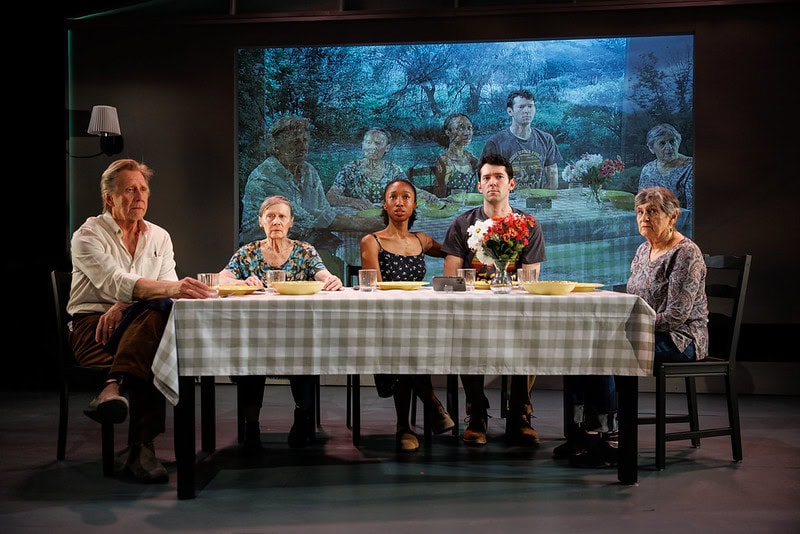
L to R: Jack Wetherall, Tina Shepard, Amara Granderson, Patrick Dunning, and Ellen Maddow in The Door Slams, A Glass Trembles. Photo: Maria Baranova
A meditation on the experience of time inspired loosely by Thomas Mann’s The Magic Mountain, Talking Band’s new piece, The Door Slams, A Glass Trembles has a bit of the aura of durational performance art. It’s only a little more than an hour long, but it still stretches and condenses time with curious effect: languid, meditative moments; skips and repetitions; whorls and loops. It is a scripted play (by Paul Zimet, who also directs)—as well as being choreographed and scored with precision (by Flannery Gregg and Ellen Maddow respectively)—but the content of it is less important, even less interesting, than the experiencing of it. The play’s action is set almost outside of time: a little pocket universe–“a month in the country”–that is sometimes the dining room of a home in a rural town in the present day and sometimes the dining room of the Berghof Sanatorium before World War I.
Fed up with the state of the world and the disappearance of their research funding, married scientists Marc (Jack Wetherall) and Clara (Ellen Maddow) have relocated to their country home. Their life is on pause, and this retreat also allows their son (Patrick Dunning) and daughter-in-law (Amara Granderson) to bring their baby for an escape. But to their neighbors Oona (Tina Shepard), a born and bred local, and Rick (Steven Rattazzi) and Rita (Lizzie Olesker), urban transplants who’ve put down firmer roots, Marc and Clara are dabblers. They will leave again; their residence is transitory. As the seasons change–scored by both Maddow’s music and a “picture window” of a large projection screen (designed by Anna Kiraly) that displays a nature scene–we see both the passage of time through this place, including the sudden accidental death of a local, and the stasis of this cloistered existence. (We never see the baby, who of course, would change more in a year than a group of adults and give us some visual correlative of time passing.)
But interrupting these quotidian scenes around the dinner table are trips into Marc’s memories, flashbacks to a trip he took across the Atlantic on a freighter and memories of a former lover, Anne (Delaney Feener, seen on video). It’s usually Clara who, knowing Marc as she does, recognizes when he’s slipped into this reverie; Marc himself says he has “difficulty thinking beyond the present.”
The modern scenes intersperse with scenes of another group gathered around another dinner table in the sanatorium, each playing another role: a group of patients/residents passing the endless days in flirtations and disputes and the occasional costume party. (Olivera Gajic’s costumes draw a sharp contrast between the practical flannels of twenty-first-century country living and the more elegant, intricate clothing of the past, and then dip into the whimsy of this party.) The exception is Marc: he remains himself, an interloper from another time, dressed in his modern clothes. And when the beautiful, vaguely otherworldly Clavdia (Feener) slams the door, it’s Marc’s glass that trembles. Cause and effect works differently for him.
The characters and the action are little more than sketches, narrative positions to be filled–even more so in the sanatorium sequences than the present day. The ensemble of actors works together with a lived-in familiarity; their affectionate relationships come through without much dialogue. Not knowing The Magic Mountain, I did find those historical relationships and context hard to grasp, but I’m not sure how much it mattered. The physical and structural mirroring between past and present worked anyway, both of them anchored on dinner conversations and the rituals of breaking bread together.
Flannery Gregg’s choreographic sequences, in which the process of setting a long dining table is run forwards and backwards, all to Maddow’s instrumental compositions, are the structural heart of the piece: a familiar action made strange by both repetition and reversal; daily life made into art.
Every time I write about a Talking Band piece, I find myself echoing their mission: to showcase the “extraordinary dimensions of everyday life.” Here, what sticks with me is a line of Marc’s: “If you feel it’s unreasonable to hope, think how improbable it is that we even exist. Yet here we are.” And yet he says this as he and Clara are packing up to move to Europe; their friends are helping and they’re moments away from leaving. Here they are; here they will not be. But they’ll take a moment to sit in the improbability of it all.