
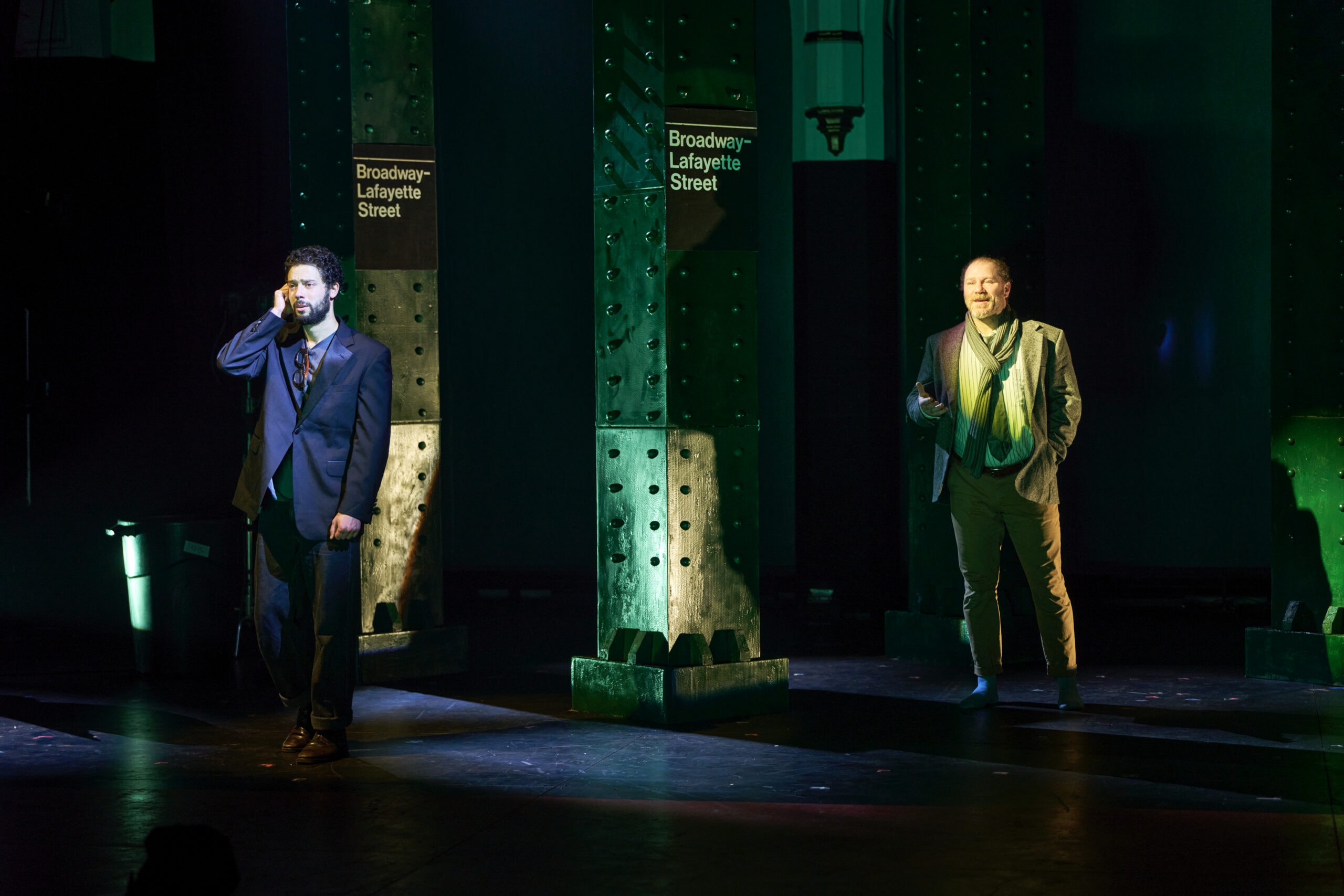
Eric Tabach and Elan Zafir in Seagull: True Story. Photo: Kir Simakov
If, like too many American theatergoers, you’ve seen the plays of Russian great Anton Chekhov done mainly as domestic tragedy, then Seagull: True Story, a play based on events in the life of its Russian exile director/creator Alexander Molochnikov, may be a revelation. Not because Molochnikov is giving us a brilliant production of The Seagull–though the piece includes recurring scenes and motifs from The Seagull, in interpretations ranging from heartfelt to radical to ridiculous, this is an original script by Eli Rarey. But the way Molochnikov and Rarey refract Chekhov through both the broadest of humor and our modern, globally interconnected, social-media-mediated world gives a new lens into Chekhovian tone: Rueful farce meets existential despair meets a recognition of the farcical, performative qualities of that despair. The sincere yearning for a meaningful life crashes against the tendency of fragile ideals to deflate into pragmatic compromise; principle clashes with self-interest, and self-interest always wins.
Even the most heartfelt moments are more than a little tongue-in-cheek; we’re never watching The Seagull so much as watching an artist who’s obsessed with The Seagull–and obsessed with being the kind of artist who’s obsessed with The Seagull–while also grappling with the questions raised in The Seagull about the value of art in a commercialized world, and whether there is any true freedom to be found through artistic expression. “I can’t explain it. I just feel that this was so meta,” says the manager of the Moscow Art Theater about an ecstatic freedom dance at the end of one of the internal Seagulls, and he’s not wrong.
Like both Molochnikov himself and Konstantin, the melodramatic young hero of Chekhov’s Seagull, Kon (Eric Tabach) is a hotshot young director at the Moscow Art Theater. He’s directing an avant-garde Seagull–with his mother, Olga (Zuzanna Szadkowski), playing the leading role of Arkadina (who is also an actress who’s the mother of an avant-garde theater director; it’s meta all the way down)–when Russia invades Ukraine in February 2022. One of his cast members (Quentin Lee Moore) is reflexively pro-war; others are fully against. Olga and the theater’s manager, Yuri (Andrey Burkovsky, the piece’s buffoonishly brilliant master of ceremonies, who plays multiple roles of the narrator/deus ex machina type), are trying to walk a middle ground, albeit for slightly different reasons: Olga’s willing to capitulate just enough to keep her job and stay more-or-less safe; Yuri is a pragmatist for whom ethics are a trivial luxury. “No one cares what you believe, what you think, what you want!” he berates Kon. But when Kon first refuses to sign a document transferring the rights of his piece to the theater and promising to revise the play “in the event of changes in public sentiment,” and then accidentally-on-purpose-while-stoned uploads an Instagram post criticizing Putin, he books a fast flight to New York, leaving his best friend/dramaturg, Anton (Elan Zafir), to speak out against the war. While the nepo baby runs off to take refuge with his mother’s friend Barry (Burkovsky again), a commercial producer in New York, the less-well-connected poet lands in prison.
But the land of the free is also the land where commercialism is king; Barry is delighted to meet Kon, but could not be less interested in funding his “visionary” work. No, Barry is interested in the “family-friendly avant-garde”: an immersive, virtual-reality inflected Three Little Pigs musical at an event space in Bushwick. So Kon, after being rescued by an actress on a subway platform (Gus Birney) and whisked off to her artists’ commune in Bushwick, is going to have to make his own art with his new love and her friends.
The targets of Molochnikov and Rarey’s satire are often low-hanging fruit, but they’re not letting anyone off the hook: Not the repressive Russian government, with Putin’s ridiculous self-inflated masculinity delightfully lampooned by Burkovsky and a group of dancers performing as a horse. Not an America that’s catching up to it by the day; the comments on the early days of the war in Ukraine are eerily reminiscent of this moment, even down to “you’re not allowed to call it a war.” Not the smarmy gloss of commercial theater that wants to have its avant-garde cake and eat it too. Not the feckless self-righteousness of the Bushwick squatter set.
And it’s important to note that the lens is also turned on Kon himself, who’s all too willing to advertise that he’s standing on principle even as the line between his egotism, his privilege, and his principles blurs into invisibility. He’s the one, after all, who has enough resources and institutional power to get himself on a fast flight to New York and finagle enough of a visa to be allowed into the country in the first place. The question of Kon’s actual talent remains for me open throughout—in Moscow he’s both nepo baby and wunderkind. In New York, while the ways that his commune/company objects to non-inclusive language choices in Chekhov are played for satire, they also show us a director who is not at all in charge of the room. I am choosing to believe that this satire is self-aware, that part of the play’s “true story” is the way that our engagement with the actual tragedy–the war, the exodus of people of conscience as free expression is penalized–is undermined time and time again by Kon’s willingness to make the self-aggrandizing choice.
Molochnikov, fortunately, is a talented director, though perhaps more so with the production’s physical elements than its actors. The piece’s presentational elements are often its most effective. Sound (by Diego Las Heras) and music (composed by Aydur Gaynullin, Maestro Gorsky, Noize MC, and Fedor Zhuravlev, and performed live by Zhuravlev, as well as musical numbers performed by the cast) are used as elements of structure and punctuation; the use of handheld microphones helps underscore the piece’s complex relationship with the fourth wall. Alexander Shishkin’s set, with two gently lit dressing tables as its most tangible elements and its larger pieces made visibly from cardboard, adds to that “let’s put on a show” quality.
The performances vary, though: Zafir’s Anton, understated throughout, becomes the moral center through his very simplicity. Burkovsky, in entirely the opposite tack, is always extra, but the sharp edge of sardonic self-awareness never softens. (He and David Turner’s Mother Russia character in the recently closed Mother Russia have a lot in common.) But Tabach’s Kon flounders; I think the play is stronger if we believe his artistic vision alongside his willingness to compromise it, but I didn’t, quite.
Unlike Chekhov, Rarey doesn’t invest much energy in either of his leading women: Nico is little more than her beauty and her status as muse for Kon–which she does call him out on at the end, but it’s too little, too late–and while Nina-as-manic-pixie-dream-waif is very much in Gus Birney’s wheelhouse, there’s not a lot of there there. And Zuzanna Szadkowski’s Olga spends most of her time trying to wrangle Kon into a better position.
There is a certain theatrical energy that’s unleashed by being exactly as cutting toward the social-justice-warrior impulses of Kon’s cast of young creatives as toward Putin, but it does flatten the stakes for those actually living with the consequences of their conscience: notably Anton. Anton, in his way, is as much of a pragmatist as Yuri–but one who takes that stance to an entirely different conclusion: everything but ethics has become a trivial luxury in the face of war. If there’s no way out (Kon offers to take Anton to New York with him, but Anton recognizes New York doesn’t need a dramaturg who speaks no English), then plainly stating that “we have been rehearsing while people are dying” is the only path. Seagull: True Story acknowledges that path, but doesn’t really walk down it. Its acknowledgment of human cowardice may be one of the most Chekhovian things about it.