
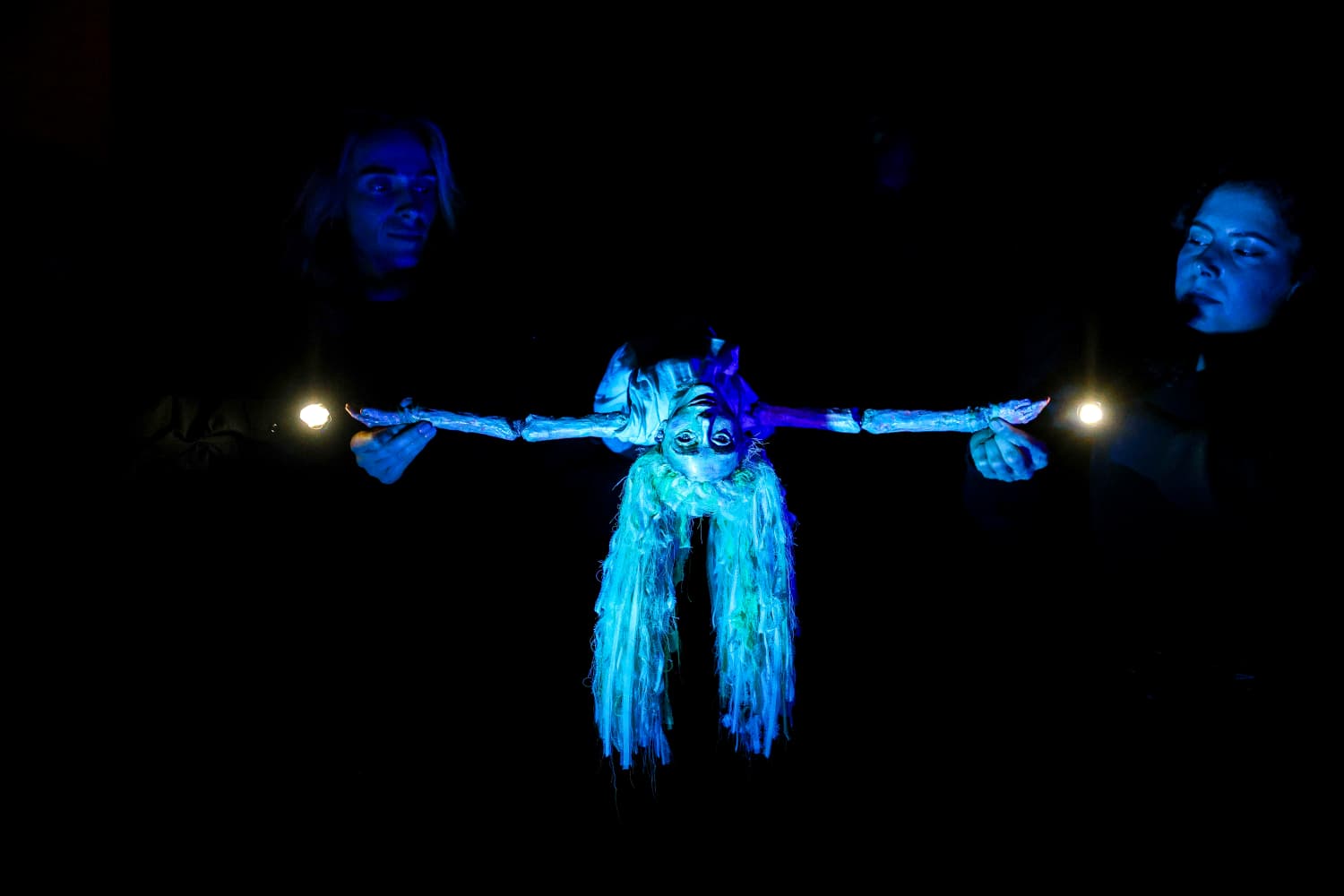
The central puppet of Cumulo. Photo: Ken Pao Studio
There’s beautiful puppet work in Cumulo, a short, wordless piece, created by Emily Batsford, that uses clever design to paint a journey from falling through to finding oneself, walking the line between dream and nightmare. But while it’s always lovely to look at (though not to hear; the score, by David Leon, is often intentionally discordant and at points almost auditorially assaultive), the action can get repetitive even in its 50-minute run time, and its imagery doesn’t entirely cohere into meaning.
The central puppet character (Plum, according to the press materials), designed by Yuliya Tsukerman, is built like an articulated marionette, with long, flexible jointed limbs, and a way of expressing emotions with an eloquent tilt of the head. Rather than being worked from above by strings, though, they are manipulated by a team of puppeteers (Emily Batsford, Camille Cooper, Gaby FeBland, Takemi Kitamura, Justin Otaki Perkins), who surround Plum in a way that allows limbs, head, and even spine to operate with a suppleness that elevates their movement, especially in the large segments of the piece where they’re falling or flying. (The gender presentation of the puppet, who has long blond hair and wears a white pinafore, is loosely feminine–at times I was reminded of Alice in Wonderland falling down the rabbit hole–but I’m following the show’s website, which uses they/them pronouns for Plum.)
The falling sequences, which the piece opens with and which recur periodically, are among the most indelible images: just by puppet positioning, the creators are able to convey the sense of motion and fear, even without much actual vertical movement. Its very last image is another piece of inspired puppetry, a beautiful explosion of material that’s chaotic, joyful, and satisfying all at once.
But in the middle, once Plum stops falling and starts flying, interacting with another humanoid puppet (who moves from enemy to ally), fighting some floppy monsters, and ultimately journeying onward toward that emergence, Cumulo loses a bit of steam. The other puppet never develops beyond a foil/sidekick for Plum, and none of the monsters feel particularly menacing. There’s also a difference in scale between the two puppets that at times undercuts what the action seems to be saying about their relationship: the other figure, who seems to be older, is enough smaller than Plum that Plum tends to pull focus and appear the dominant partner in any exchange they have. True, the piece is Plum’s journey, but their centrality feels well established without needing to be underscored by the puppet design.
The landscape through which Plum moves is anchored on an ingeniously engineered “cloud machine”: a circular track on which clouds of different specs can rotate through the space, and which also allows them to be raised and lowered. (The cloud machine is designed by Joe Silovsky; Vinny Mraz also gets a set credit.) The mechanical rotation allows for the sense of clouds passing across the sky, and the height differentials give the vertical sense that the piece’s themes of falling require. (There are also clouds individually manipulated by puppeteers.)
Cumulo opens with a sort of live title card: the puppeteers enter displaying tiny clouds that are revealed as letters spelling out “Cumulo.” Then they pop the clouds in their mouths and eat them. It’s a bit of visual wit and clever interplay between puppeteers as performers and puppeteers as behind-the-scenes machinery. But while the rest of it has beautiful imagery and craft, it could use more of that lightness and wit.