
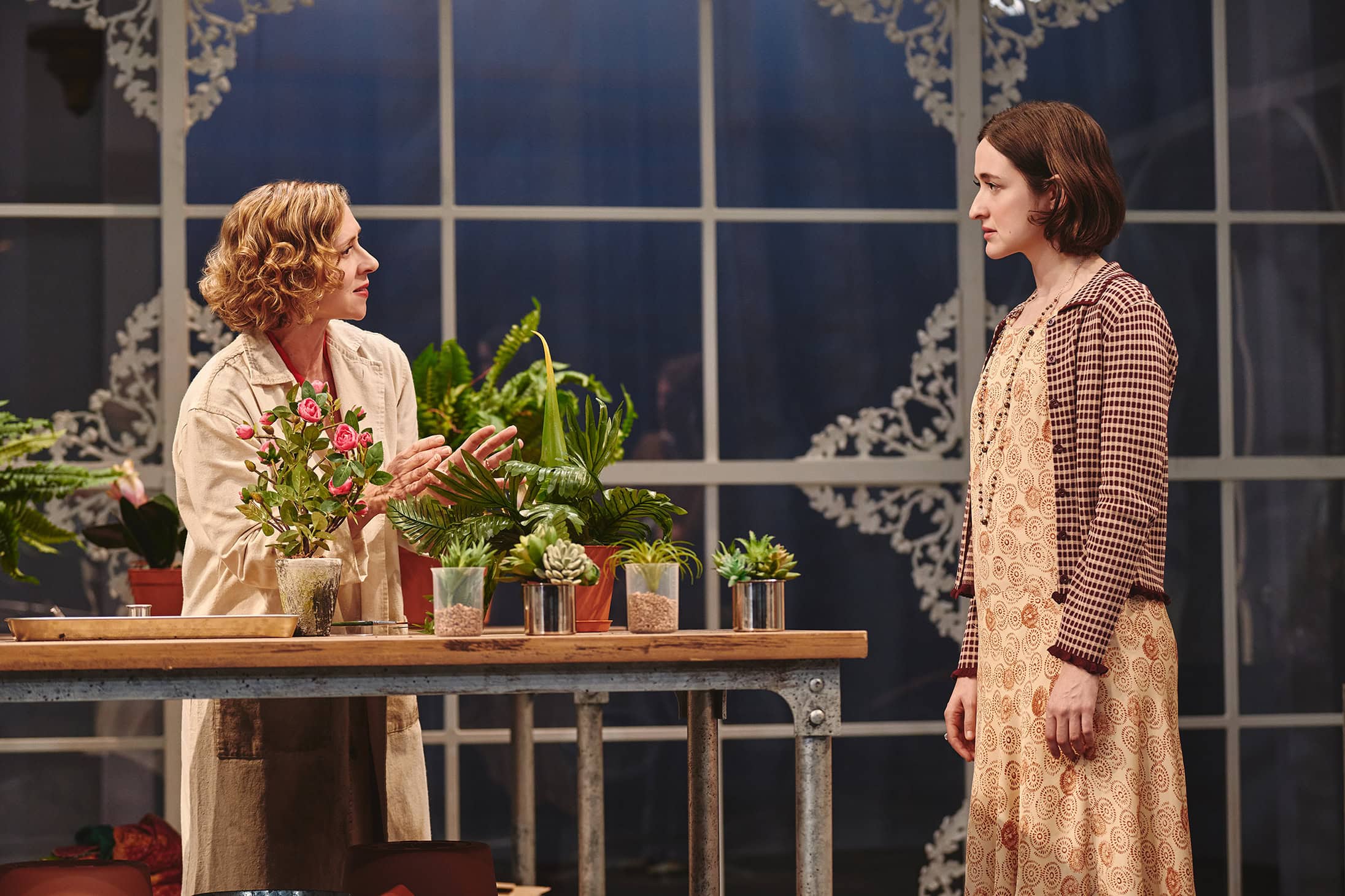
Miriam Silverman and Amara Leonard in The Verge. Photo: Valerie Terranova
A wonderful feature in this month’s issue of The Hat notes that Susan Glaspell’s The Verge and Eugene O’Neill’s The Hairy Ape originally premiered in the same season–1921-22, the final season of the legendary Provincetown Players–and are now concurring for the first time in more than a hundred years. The two plays, which have lost none of their bracing strangeness in the intervening century, focus on a central character facing an existential struggle for their own selfhood in a world wracked by cataclysm. The Hairy Ape remains a classic of the American theater and O’Neill is universally recognized as one of our great American writers; The Verge has languished, as has Glaspell’s status.
This revival, sparked by the organization Expand the Canon and directed by Fiasco Theater’s co-artistic director Jessie Austrian, seeks to change that. It is not at all coincidental, in the context of how The Verge became a lost classic, that the hero of The Hairy Ape is an excessively masculine man, and the central figure here is a woman who flouts just about every social norm of feminine behavior–norms that are sadly still familiar. (It doesn’t help that Glaspell burned nearly all of her personal papers before she died.) As Austrian writes in a program note, she’s seen similar roles “in the American canon but only occupied by men: monomaniacal geniuses, iconoclast seekers on a hero’s journey, characters who simultaneously inspire and repel.” The Verge is not an easy play to metabolize or appreciate, with its intensely stylized approach to character-building and its philosophical effusiveness–and Austrian is not wrong in noting that our protagonist simultaneously inspires and repels–but it also strikes some very modern chords.
Claire Archer (Miriam Silverman in full firebrand mode) is a scientist with a private laboratory (represented by Lawrence Moten III’s airy greenhouse of a set), a philosopher, a divorcee, an adulterer, a person with utter disdain for convention, and a mother who could not be less interested in her adolescent daughter. Her husband, Harry (Noah Brody), thinks she’s a madwoman and brings in a neurologist to assess her. Her dearest friend, Tom (Paco Tolson), and her greenhouse manager, Anthony (Paul L. Coffey), think she’s a genius. Her sister, Adelaide (Emily Young), thinks she’s a monster. Her daughter, Elizabeth (Amara Leonard), whom today we would call a paragon of normcore, finds her “amusing” and “different.” And all of these things are true. Claire is the incandescent core of the play, the blazing lightbulb toward which the other characters flutter like moths, or perhaps more accurately, the black hole into whose punishing gravity they will all fall. (Sarita P. Fellows’s costumes put the ensemble in brown and cream, with the occasional subtle pattern; only Claire gets deep jewel tones and, in the final act, a dramatic print.)
Claire is a scion of New England intellectuals; after a failed first marriage to an artist, she handed their daughter off to her sister to raise and married an aviator. She thought that the power of flight would “do something to a man,” that Harry would come back to earth different, a man to match her own ambitions and yearnings. Instead, he’s just as much of a stick-in-the-mud as her first husband, growing ever more prosaic and concerned about his breakfast rather than higher ideas. She amuses herself in an affair with another painter, Dick (Devin E. Haqq), taunting Harry to notice or react to it, and she holds Tom, an explorer, completely in her thrall as well. (Yes, she is literally a woman surrounded by Tom, Dick, and Harry, all desperate for her attention and wanly trying to influence her behavior.) Anthony is positively in awe of her. But Claire isn’t all that interested in other people–with the sometime exception of Tom, in whom she sees the potential to join her in more exalted understanding. Her interest lies in smashing things, in order to break out of the human condition, to “go mad–so that life may not be prisoned.”
She is also, in the way of expressionist characters, as much mouthpiece for ideas as human person–a vehicle for digging deeper under the surface of society and yawping about its failures. Speaking of mouthpieces, or of metaphor, her manufactured/hybridized/alien plants are called “Edge Vine” and “Breath of Life.” She’s forcing her will against the natural in her work and her life. And she will do anything to protect her vision–including destroying her own creations when they disappoint.
There’s a little bit of Hedda Gabler in Claire, but where Ibsen’s character is trapped by her desire for status and power over other people, Claire could not be less interested in conventional human success. It’s her own ways: “queer,” “different,” “apart,” “other,” that make her who she is. “It’s pretty egotistical to claim that what so many people are, is wrong,” Adelaide says to Claire, trying to coax her back toward a “normal” life. But “egotistical” hardly seems like an insult to Claire. In a world that’s just emerged from devastating war, she has a clear vision of something else. “They may be new,” she says of the plant variants she is creating by force of will. “I don’t give a damn whether they’re better.” “What’s the use of making them different if they aren’t better?” Elizabeth responds. But Claire refuses the (inherently capitalist) proposition that change must equal progress or growth.
Like the Provincetown Players, Fiasco is an ensemble company, and most of the cast here is drawn from their acting ensemble. It’s fitting, here, that Silverman isn’t a regular group member; it allows Claire to stand just slightly apart stylistically, and for the men to have a shared emotional vocabulary of bemusement with her. Austrian’s physical work with the ensemble is strong, and she makes interesting use of the exterior spaces in Lawrence E. Moten III’s airy greenhouse set. (The section of the play that takes place in a turret room, on the other hand, is staged in a tortuous way that felt overly fussy.) Silverman takes Claire’s exhortation to soar above as a key character note. She’s always rushing ahead, thinking beyond; even when her language is densely purple prose, she fills it with passion. Amara Leonard, too, finds her way into the core of Elizabeth through the language: pert, eager to seem sophisticated and blasé, but she’s made herself intentionally uninteresting in order to fit in. Noah Brody’s Harry is blithely shallow, but he finds the wit in the play, and his solicitude for Elizabeth–a tenderness Claire entirely lacks and even her guardian Adelaide seems deficient in–is a nice character note. Paco Tolson has the hardest job–the man almost good enough for Claire also needs to be the comic foil as he’s trapped outside the greenhouse early in the play–and he occasionally feels overburdened by Glaspell’s chewy verbosity.
In the end, though, The Verge rises and falls on Claire, and Silverman’s Claire is a shot to the heart. On my way out of the theater, I walked behind two women discussing that they’d very much feared the play would end with Claire’s suicide (a la Hedda Gabler) or institutionalization. Instead, it leaves us with Claire triumphant, and the rest of the company–and ourselves–less sure than ever whether she’s inspirational or repulsive. But in her unwavering insistence on valuing originality for its own sake, for seeking to transcend what we know and are without equating transcendence and improvement, Claire spits in the face of our own age as much as her own. She reminded me that endless growth isn’t inherently a virtue. That AI can never produce the unexpected. That a woman has the right to determine her own fate and make her own terrible choices. That she can be monster, madwoman, genius, all at the same time.