
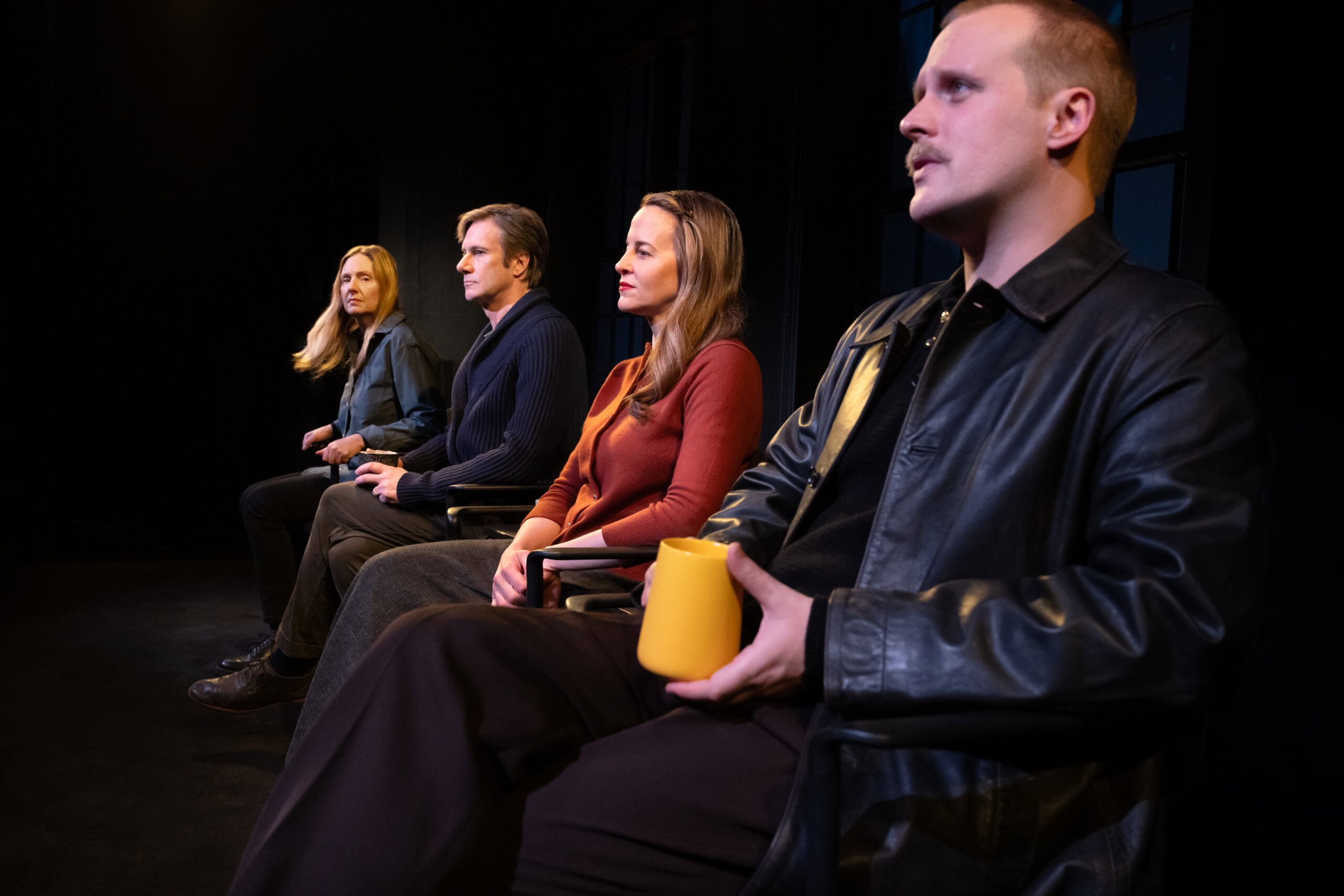
Hope Davis, Josh Hamilton, Maria Dizzia, and John Early in What We Did Before Our Moth Days. Photo: Julieta Cervantes
What We Did Before Our Moth Days, written by Wallace Shawn and directed by Andre Gregory, is, like many of Shawn’s plays, mostly presentational: four people spaced out in chairs across a shallow proscenium stage, addressing the audience directly as they pass back and forth a story that involves them all. It becomes clear right away that one of the characters is recently deceased, but we don’t know for a long time whether the rest of them speak from a shared afterlife, reality, or somewhere in between. The “Moth Days” of the title refer to a phrase coined in childhood by one of the characters–the recently deceased one, who grew up to be a successful novelist: one’s “moth day” is the day of one’s death. As he imagined it, “when people died, they were sort of gently and vaguely and flutteringly escorted into death by a flock of blind moths.” And a lot of his dialogue has this gentle, vague, fluttering quality; he’s full of hedging and qualifying statements, though we soon realize that’s a facade over a well of self-confidence.
At the beginning of the play, twenty-something Tim (John Early) receives the news of the sudden death of his father, Dick (Josh Hamilton), a successful novelist, at the age of forty-five. Dick and Tim’s mother, Elle (Maria Dizzia), married young and have been together more than twenty years. Their marriage was happy, for the most part, though peeking around the edges of their rosy descriptions are Elle’s offhand references to Dick’s anger, or to the way she sometimes had to trick herself back into loving him. But, over the past few years, Dick’s and Elle’s life has slowly diverged, as he embraces a more hedonistic social life and she craves quiet solitude. He has also had a lover, Elaine (Hope Davis), and Elle has known about her for some time, which has eaten away at her sense of self and of her marriage. Tim was also in a fairly dark place before his father died: friendless, adrift, and sexually obsessed with an adolescent girl.
While Elle knew about Elaine before Dick’s death, Tim did not, and his learning this fact about his father–and then forging a friendship with Elle, feeling that he and she share the quality of being somehow a secret shame to his parents–is as much action as the play has. The whole thing is austere and static, but it’s not inert. The storytelling is measured and considered, but it’s far from emotionless. In a three-plus hour show, there’s precisely one stretch of conversation between two characters; the rest of it is a series of long, lush monologues depicting four people’s lives with a kind of clinical retrospectiveness. (The meeting between Elaine and Tim is the one actual dialogue.)
The characters’ eloquence gives them each a patina of rueful self-knowledge, but we can still see that this honesty is for the most part kept contained inside their own heads. We can see the poison between them even though they rarely communicate with each other. “I’d simply dropped that whole idea of being a good person,” one of them says, at one point–but only to us.
I always find something uncomfortably intimate in Shawn’s writing–whether that’s because you’re peeping through a keyhole at other people’s private scenes or because his characters are divulging their innermost, darkest thoughts directly into our minds, there’s going to be something not for the emotionally squeamish. Here, we’re dropped right into that discomfort: the play opens with Tim telling us about bringing a non-English-speaking prostitute home and briefly considers letting the car exhaust run in his poorly ventilated garage and killing them both. But then we back up, into Dick and Elle telling the story of their relationship from high-school sweethearts to now, a seemingly charmed marriage–and yet we see where their son has ended up; we see the impotent fury that Elle has been reduced to; we see Elaine feeling Dick’s contempt for her even as she is drawn to him. These people’s lives are steeped in secrets.
Whether you find all of this mesmerizing or interminable will depend on how you feel about Shawn’s playwriting in general; he’s not a writer whose style shifts with his subject, and neither is Gregory a director who’s going to shower the bare bones of Shawn’s script in glitz and glitter; Gregory doesn’t even move actors anywhere but on and off stage at the act breaks. The design elements are similarly restrained: Jennifer Tipton’s lighting leaves house lights halfway up until Act 3, then highlights one character over another, or brings in shafts of sidelight. High windows behind them comprise the majority of Riccardo Hernández’s set, filled at time with projections of fluttering moths (by Bill Morrison). Bruce Odland’s music, melancholy and meditative, rises at the beginning and end of acts. The performers are very subtly amplified. It’s all so restrained that you become very attentive to the smallest inflection, the smallest nuance in a line.
Which is why it matters deeply that What We Did Before Our Moth Days has the very great advantage of a company of actors who are not only skilled but who, under Gregory’s gentle hands and light touch, balance an inherent likability with a relish for the weirder and more unsettling currents that seethe under the surface of these people grappling with the aftermath of an unexpected death: pedophilia and incest and alcoholism and rage; the uncontrollability of desire and the slow death of love. To overact this play in an attempt to give it more dynamism would flatten out its very subtle character shifts; to underact in the name of simplicity would make it feel like a lecture. But here the actors merge seamlessly: Hamilton in the anchor, a man whose tone never reaches beyond the reasonable; he may have given up on trying to be a good person, but he’s unfailingly well-mannered–but then there’s the references to his anger, to his alcoholism. Early takes the opposite tack: Tim is “sleazy,” and he knows it; he hasn’t quite embraced it, but it’s his parents who would be ashamed of him. He takes a certain relish in his own degradation. Davis’s Elaine gives off sexiness and warmth, but there’s a chilly solitude to her as well–she’s not the friend you can rely on, not the wife who supports, not any of the things Elle has been to Dick and Tim. And it’s Dizzia’s Elle who is the soul of the piece: a woman who has built a life on principles of goodness and decency: she teaches underprivileged children; she sacrificed her own dreams and talents for her family–and now, in middle age, her husband’s betrayal unearths in her the capacity for murderous rage.
I don’t know that the play ever really explains how these people came to be the people they are; Shawn isn’t all that interested in the causal chains of human relationships. He’s interested in secrets, the secrets we keep from others and for ourselves. And he’s interested in the moral compromises and choices we all make to live in a society: what we did before our moth days, after all, is our whole lives. What We Did Before Our Moth Days is, in a weird way, a kinder, gentler Wallace Shawn: there’s no searing indictment of society a la The Fever or subtle Nazi sympathies like Aunt Dan and Lemon or rounding up of intellectuals like The Designated Mourner. But even in that gentleness, there are constant flashes and flares of the darkness at the heart of people; of the ways our own self-interest blinds us to the needs and the humanity of others. In that way, it’s maximal Shawn.