
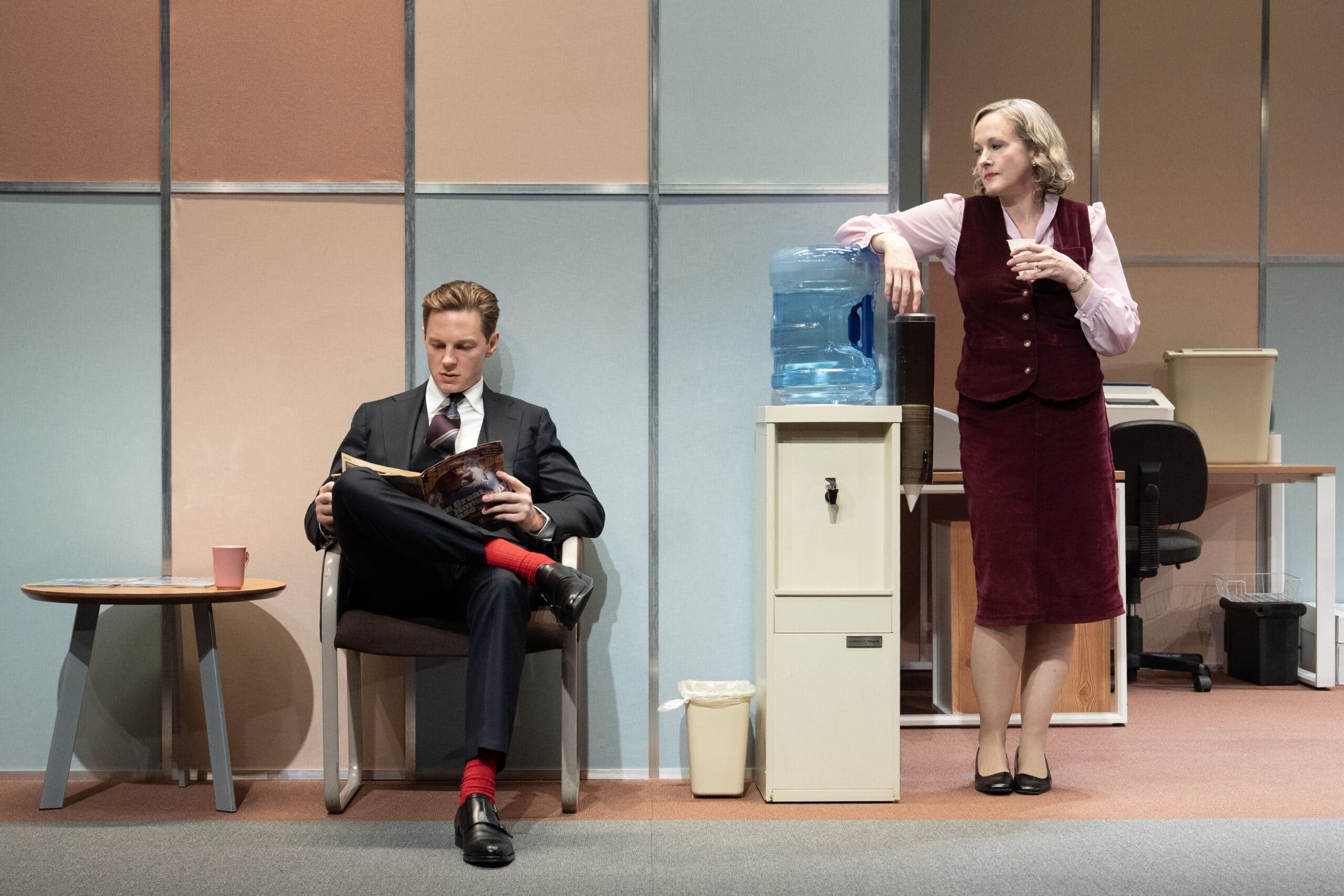
Will Pullen and Katie Finneran in The Receptionist. Photo: Joan Marcus
“If I can I let them go,” says a man, alone in some sort of a booth. Is it an elevator? An airlock? A tiny vestibule? We don’t know, and we don’t know who he is, but he’s talking about fly fishing. If a fish is too badly injured, he says, if it’s hooked through the gill, he’ll have to kill it and cook it. But if he can, he lets them go. The catching is the challenge; after that, he might as well give them their lives back. It takes a while to understand what this monologue has to do with the rest of The Receptionist, but once we do, that “If I can” takes on a whole new meaning.
Adam Bock’s play, first produced in 2006 and revived now by Second Stage, is a small, contained thing, set over two days in a deadly dull office whose purpose seems irrelevantly bland until the precise moment it’s revealed, and after that, the blandness becomes not bug but intentionally misleading feature. It’s a quirky little snapshot of how evil can be not only banal but relentlessly boring, the epitome of the “bullshit job.” In the “Northeast Office,” a minor, seemingly sleepy outpost of this undefined larger enterprise, Mr. Raymond (Nael Nacer) presides over what seems to be a staff of two: lower-level executive Lorraine (Mallori Johnson) and receptionist Beverly (Katie Finneran). Beverly, as in many offices, is the not-so-secret engine that keeps the machine running: She makes the coffee, she answers the phone, she jealously guards the office supplies, she’s a friendly–if judgmental–ear for both Lorraine and their boss. She’s even ordering a cake for their boss’s birthday tomorrow, though not one with his name on it: “Happy Birthday” is enough.
Out of these small, well-observed details is the world of the play made. It’s funny, in the way rueful recognition and/or mild nostalgia can be. Director Sarah Benson and set-design collective dots nail the ambience and the technology of the early-twenty-first-century office, where every desk has a computer but Lorraine still uses a rolodex to look up phone numbers, and where the drone of the fax machine connecting still interrupts now and again. The color palette, too, of particularly insipid pastels that someone once thought were the sweet spot between cheery and soothing, speaks of a moment. There’s humor and the characters’ banter is enjoyable enough, but there’s not a lot of there there.
Yes, it’s unusual that Lorraine–perpetually late, always just missing her bus–beats her boss to the office, giving her time for some girl talk with Beverly. It’s unusual, or maybe it’s not, that both Lorraine and Beverly are having minor personal crises–Lorraine had had an unexpected run-in with a narcissistic ex-boyfriend, which spurs her to lament her singleness and flirt rampantly with a visitor to the office, and Beverly’s husband and daughter are both behaving in ways that require several frustrated phone calls to resolve. And it’s very unusual that Mr. Raymond is so delayed, especially when he’s got a visitor from Central Office, Mr. Dart (Will Pullen).
Even though Bev soon susses out that Mr. Dart is married, with a young child, he and Lorraine drop into charged flirtatious banter; we even get a few flashes of Dart’s red socks (a bracing shot of contrasting color in Enver Chakartash’s costume design) to show that he might be a bit of a maverick. To the extent that we think we might be speeding toward disaster, it’s disaster of the domestic sort: Will Lorraine induce Mr. Dart to cheat on his wife? Why didn’t Mr. Raymond go home last night? (It is not a coincidence that the boss-men are almost entirely “Mr.” and the lower-level women only have their last names used when they’re in serious institutional trouble, but the gender politics are almost beside the point.)
The point is that reveal, impossible to talk about without spoilers, so be warned. In that moment we learn, with a tossed-off description of what Mr. Raymond’s “unfortunate afternoon” entailed, that the business of the Northeast Office is coercive and violent. The play cracks open that window only in small increments; it’s the Tiny Desk Concert version of totalitarianism: a little taste, contained in this quotidian environment, that lets us imagine what the real thing might be like.
But the environment is so generic, the turn so sudden, and the shift so abrupt from shuffling calls to voicemail to talking in explicit detail about the professional infliction of violence that it’s hard to map the one onto the other. Is a world where anyone can be taken in for torturous interrogation also a world where Lorraine went out for a night with a girlfriend and met a man who won $175,000 at blackjack? Where the little bakery down the street makes the best pastries? Where Bev and her husband collect teacups from around the world? I know that cognitive dissonance is the point–and possibly more believable in America now than it was in 2006–but the mild-mannered characters sit uneasily in this disjuncture.
Will Pullen’s Mr. Dart brings with him an air of cheery menace, but Nael Nacer’s Mr. Raymond and Mallori Johnson’s Lorraine show only the smallest hints of puzzlement at a “client encounter” that didn’t go down as expected. Where The Receptionist succeeds most is in Beverly, buoyed by the work of the great Katie Finneran, who makes her intensely specific and serious, while still finding the laughs. She may not be fulfilled in this satellite office but she is deeply committed to her responsibilities–to her family, to her employer, to her society. She’s aghast at the thought of Lorraine seducing a married man; she even disapproves of unwonted use of pens. When she finds out that Mr. Raymond was taken to Central Office, her first thought is, “He must have been doing something.” So when the system turns on her and she resists, we feel that this might be her first moment of rebellion–and we feel how quickly it is quashed.
I recently read the book Stasiland, which is built on a series of interviews of former residents of East Germany, about ten years after reunification: some Stasi informers or employees, some victims. The Receptionist wants to depict how easy it is to normalize a state apparatus of torture and universal suspicion, how ordinary it becomes. But Stasiland shows the price that’s paid in all the facets of daily life to maintain that kind of environment, the way it weighs down even those who are true believers in the cause. The Receptionist doesn’t dig that deep–it wants to have its social commentary and eat its comedy cake too.