
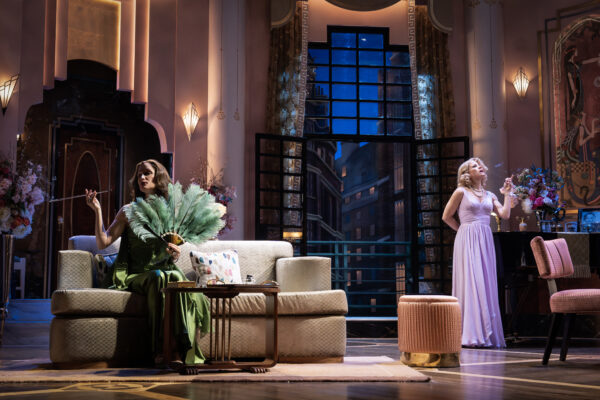
Rose Byrne and Kelli O’Hara in Fallen Angels (Photo: Joan Marcus)
Fallen Angels is a Noel Coward comedy centered around women, desire, friendship, and booze. It was wildly ahead of its time getting nearly banned when it was written in 1923 with its talk of premarital sex. While there is fizzy pleasure in the two female friends barely holding it together as they wait with bubbling anticipation of their past lover, something about Scott Ellis’ production just lags.
Set among bluebloods in London in 1928, Julia (Kelli O’Hara) sends her husband Fred (Aasif Mandvi) off to play golf for the weekend in Chichester with upstairs neighbor Willy (Christopher Fitzgerald) who is married to her bestie Jane (Rose Byrne). Both are in comfortable but not passionate marriages.
Julia and Jane have bonded for years over a delicious secret. They both had a wonderful torrid romp with a Frenchman named Maurice before they were both married and before they knew each other.
While this was an element of what forged their friendship now it threatens to tear these bosom buddies apart when Maurice writes that he’s coming to town.
Jane shows up on Julia’s doorstep with this news and panic, passion, and profiteroles ensue.
These upper crust ladies swoon at the mere memory of Maurice and as they eagerly anticipate his potential arrival their libidos rise and their filters fall.
They dress for dinner in evening gowns that are perfectly refined by Jeff Mashie (and delightfully mauled during their drunken escapades) and proceed to get shitfaced on an empty stomach as they wait for this lothario Godot.
You can’t help but laugh at Kelli O’Hara and Rose Byrne going full throttle as they stumble, tumble, lurch, and sway as they progressively get drunker, meaner, sleepier, and irrational in this central scene of the play. But they try ever so strongly to keep it together and not betray their husbands or their affection for each other. Yet with a ring of the telephone, and the possibility of Maurice on the doorstep, all that pretense goes out the window. Rose Byrne tucks her napkin into her complicated evening dress and it becomes a central prop to her stage business. O’ Hara slides off furniture, leaps to grab the telephone, and then becomes exceedingly loud and belligerent with a wrong number.
With all that frenetic energy, the next morning, Kelli O’Hara’s hangover brings everything down to a quiet crawl as she struggles to walk down a flight of stairs as if each step is a gong to her skull.
The material is modeled on French farce and the play is certainly meant to be light and bright. It’s great to have a play centered around these two semi-liberated women (who are in no way passing the Bechdel test) reveling in their past love affairs. And I wanted to get on board for an effortless, comedic frolic. But I never found it truly funny. I smiled and snickered but a hearty laugh ne’er escaped me.
Weirdly there was just a sluggishness to the proceedings. The sound design was dreadful. The cast was doing their best but I struggled to hear them speak in a way I do not think I have ever experienced on Broadway. I started to wonder if the set was literally eating their every word.
O’Hara and Byrne deliver on the physical comedy, but the apex of the hijinks with the return of the husbands just falls flat. Something about the men re-entering the room is just a loud, wet fart on whatever fun we might have been having.
Christopher Fitzgerald, who is a great stage comedian, just doesn’t feel locked in here. He’s just befuddled in a corner. Aasif Mandvi is focused on being heard but everything else is lost on the way.
Rather than amping up the tension with the wives now trapped by the husbands as the specter of Maurice closes in, the whole show just unspools haphazardly.