
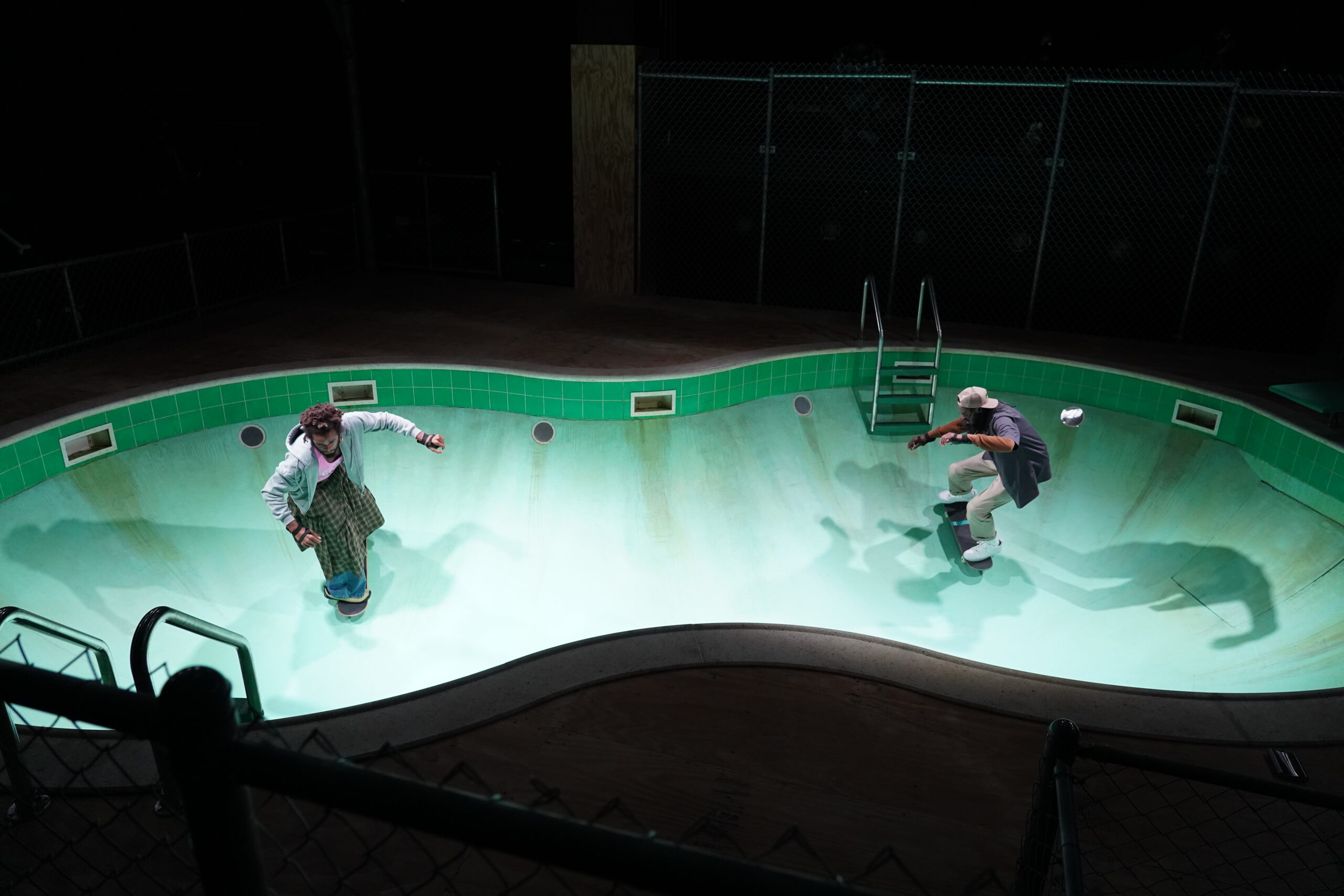
Essence Lotus and Oghenero Gbaje in Bowl EP. Photo: Carol Rosegg
Bowl EP is a multidimensional spectacle, as much a concert, a sporting event, and a trippy fantasia of the psychic underbelly as it is a play in any traditional sense–which makes sense, given that playwright and director Nazareth Hassan is also a dramaturg, sound designer, performance artist, musician, and visual artist. There’s no immersive-theater-esque audience participation, but the experience is also more expansive and strange than your average sit-in-the-audience-and-watch-a-show play; it nudges at boundaries in all directions, anchored in a complete physical transformation of the Vineyard Theatre’s space, an occasional sense of real physical danger (for the performers more than the audience, though the unpredictability quotient is high enough that you never know for sure), and an over-the-top (in the best possible way) performance by Felicia Curry as a demon/spirit of the digital world/ghost of past, present, and future named Lemon Pepper Wings. Bowl EP is explosively kinetic–two of its three characters spend much of the play on skateboards and the third feels like an perpetual motion machine–but grounds that high energy with a deadpan sense of humor and an unresolved but genuinely sweet relationship between its two skaters, who are trying to pick a name for the rap group they might be forming, or maybe they’re just falling in love in a way neither of them quite knows how to handle.
Adam Rigg and Anton Volovsek’s set upends your memory of the Vineyard’s normally traditional space. In its place is an empty swimming pool surrounded by chainlink; we sit on bleacher-like seats outside the fence and above the pool deck, with Kate McGee’s lighting capturing both the blaring sunlight reflecting off the concrete and the tinnier artificial light of night. When Quentavius da Quitter (Oghenero Gbaje) and Kelly K Klarkson (Essence Lotus; yes, the initials are intentional) appear, they’re on skateboards, circling the pool and then dropping in to use it as a skate bowl. If you are short like me, you will miss some of the action that occurs below the pool’s rim, but you will feel both the precarity and the confidence with which Quentavius and Kelly tip over the edge every single time. Faheem Allan is credited as a skateboarding consultant, but Gbaje and Lotus clearly bring both the comfort of experience and fearlessness to the table and Hassan as a director makes expert use of both performers’ lanky grace and well-matched physicality. They may be emotionally awkward with each other, but they’re smooth in motion.
The space is labeled “a bowl on the edge of an urban wasteland somewhere in the galaxy,” though it will later be revealed to be (also) an abandoned swimming pool in some never-named suburbia. Similarly, Quentavius and Kelly are aspiring rap stars putting together a mixtape but they’re also early-twenties Black suburbanites waiting for their adult lives to begin (Quentavius’s real name is “Quinn”–he wanted to “Black it up a bit” and Kelly added the “K Klarkson” for effect). For the first 40 minutes or so, the tempo is languid, as the piece skips through short scenes mixing flirtation, at first via offerings of food and then getting more physically intimate; skating while imbibing various substances, with the drugs getting harder as we go; riffing out rap songs; and trying to come up with names for their rap group—names that are simultaneously high concept and ridiculous. The structural conceit is that each scene represents a track on their theoretical mixtape/EP–titles appear on the side of the pool in increasingly elaborate projections by Zavier Augustus Lee Taylor–but the sequence takes on a rhythm of its own.
Quentavius and Kelly loop each other on skateboards, edging closer and spiraling away, neither of them able to put into words their nascent emotions or attraction. We will later learn that Quinn is already in a “situationship” with another woman, but the reticence has as much to do with an inability to articulate or maybe even to acknowledge their desires: Quentavius is cis and Kelly trans; Quentavius is still wrangling (quite literally, as we’ll see) with his demons and Kelly has worked to exorcise hers; Kelly seems drawn to a little violence in her sex and Quentavius hasn’t entirely come to terms with this. But even as weed gives way to drinking gives way to snorting molly, and offering a piece of fruit becomes erotic choking, the pacing and rhythm still move in tight loops: the circles they skate around and around the pool, the repetitions of the song choruses, the two drawing just a little closer with every iteration. There’s just this one little flicker of something…else, one moment where Quentavius alludes to his demon.
Who, of course, then bursts out of a tunnel in the side of the space, and upends the whole proceeding. And when Curry appears, costumed by DeShon Elem as an aggressively cute manga-coded Energizer bunny (Hassan’s character breakdown labels her “THE most enthusiastic Black anime cosplay girl you’ve ever met, times ten), expertly channeling the manic energy of the repressed, the dark id of the internet, anarchic violence, and kawaii all at once, Bowl EP explodes into a deconstruction of its own narrative—its backstory, its mythology, its present, and its future. We get a quick set from the never-actually named band; we also get cartoonishly bloody murder, a more bourgeois and boring version of the vaguely post-apocalyptic urban-wasteland narrative of Black youth we perhaps thought we were watching–and in the end a surprisingly wistful journey to a possible future. Lemon Pepper Wings careers from saccharine emoji-filled cuteness to rage to unadorned storytelling in a bravura monologue that’s an extraordinary journey in tonal control on the part of both Curry as a performer and Hassan as writer and director.
The play falters a little when Hassan needs to reel it back, to stuff Lemon Pepper Wings back inside Quentavius and return to reality: the physical transition back to the real is much less elegant than the burst that got us into Lemon Pepper Wings’s control, and once you’ve unleashed brilliant chaos, it’s hard to go back to the more downbeat, languorous rhythms of the play’s “real” world. It’s important that Hassan does this, though, even if imperfectly–we need to see Quentavius and Kelly in that one shining moment when it might have all worked out for them. We may know exactly how it didn’t, but the poignancy of that knowledge makes the connection between Lotus and Gbaje feel all the realer as we end.