
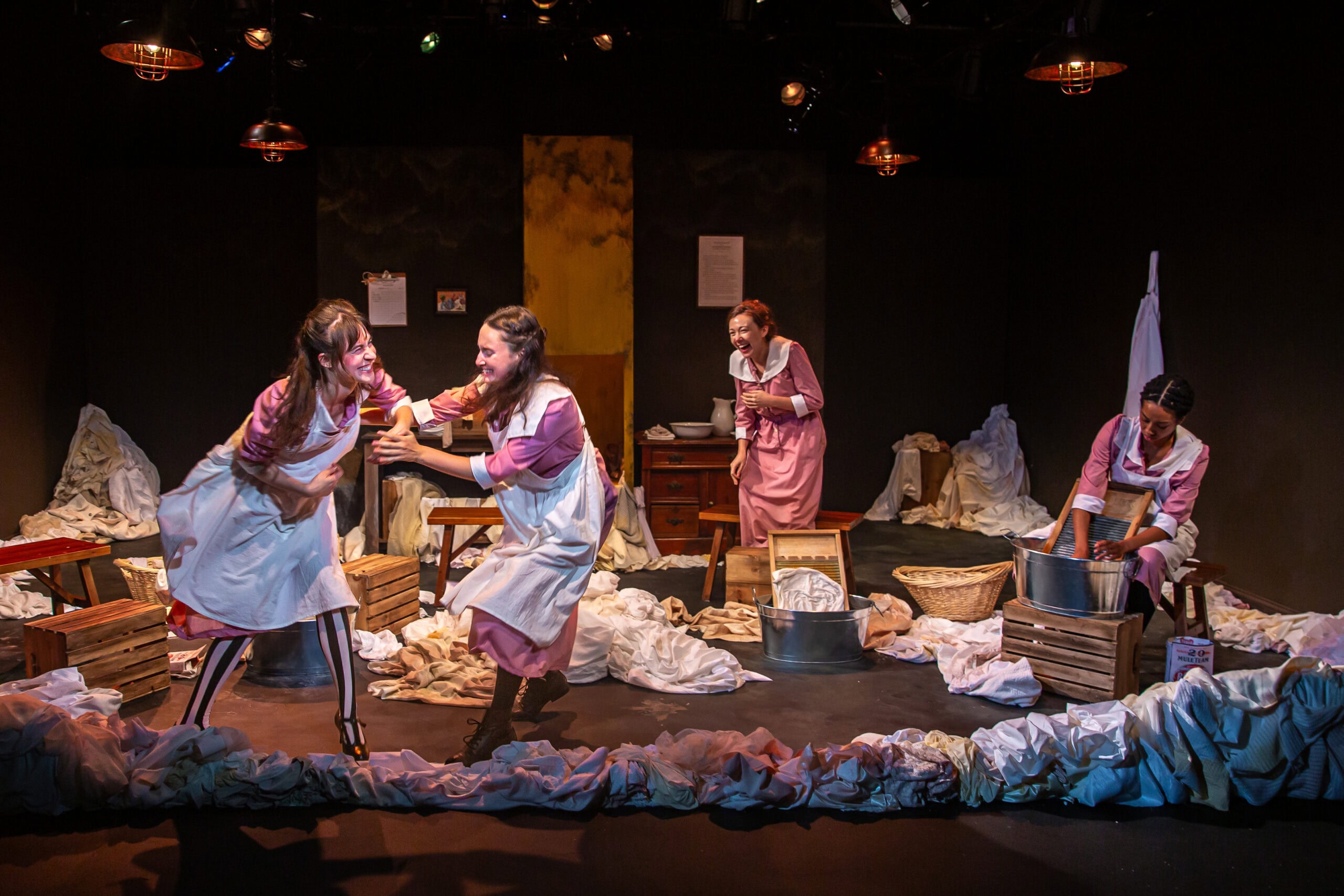
Chani Reese, Rachel Ravel, Livvy Marcus, and Mia Fowler in benevolent. Photo: Nina Goodheart
There’s no looking away from the darkness in benevolent, the new play by the exciting writer/director team of Sophie McIntosh and Nina Goodheart, who produce as Good Apples Collective–but there’s also a surprising amount of humor, affection, and joy both in McIntosh’s script and Goodheart’s rich, nuanced direction. Set in 1917 in a New York “women’s charitable institution”–the titular Benevolent Home, part prison, part social safety net—it features a cast of four young women more sinned against than sinning. (The play wears its history fairly lightly, but the home seems to be closely modeled on the Asylum for the New York Magdalen Benevolent Society in location and even details of some of the inmates.) Most of them are victims of sexual assault; most of them are estranged from or cast out by their families; all of them are serving a six-month sentence in the home’s laundries as penance for their tenuous affronts to the social order. This week, they’re all on extra punishment duty: the night shift in the basement “soiled” room, a never-ending slog of whites with recalcitrant biological stains, to be scrubbed with borax by hand against a washboard. (Junran “Charlotte” Shi’s set and Sean Frank’s props effectively convey the monotonous eternity of this task; the space is practically knee-deep in dingy linen with more arriving periodically down the upstage laundry chute, and the use of real water in the washtubs and the occasional thwack of a wet garment being tossed augment Max Van’s sound design.)
McIntosh’s character breakdown labels the “girls” (who range in age from a very sheltered seventeen to a hard-fought twenty-six) with adjectives as simple as fairy-tale characters: one good, one incorrigible, one ruined, and one just plain wicked. “Wicked” and “ruined”–Margaret (Chani Reese) and Emma (Mia Fowler)–are prostitutes, one catering to a wealthy clientele and one to the working class. “Incorrigible” is an aspiring singer, Sarah (Rachel Ravel), who was busted for “panhandling” as she sang for donations on the Coney Island boardwalk. And “good” is Abby (Livvy Marcus), the teenaged daughter of a patrician NYC family who was caught alone with her beau and has been packed away for a six-month stay in lieu of being grounded. Where the other three are well aware that they could easily have wound up in even worse circumstances–and may yet, once their term at the home ends–Abby has every expectation of returning to her pampered life at the end of her sojourn. She’s learning “how the other half lives” in expectation of chairing the Benevolent Society someday, where for the other three, stays at the home are woven into the fabric of their lives. Emma, in fact, eager to escape her life in a brothel, is angling for a permanent staff position here.
Still, for Abby as much as (perhaps more than, given how naive she is) the others, the play never lets us lose sight of the physical dangers of existing while female: a topic that is often engraved in McIntosh’s subtext. Margaret’s descriptions of her professional encounters with men are all the more brutal for their wryness–and for their contrast with the surprised joy Reese shows when Margaret experiences genuine sexual pleasure. Likewise, Abby’s slow realization of the ways she was abused by her suitor from the best of good families has all the can’t-look-away tension of a horror film, and Marcus gives crystalline clarity to all the levels of naivete and privilege that shatter one by one for Abby during this scene.
The other, enormous and unavoidable, danger that all four grapple with is pregnancy–fearing it, avoiding it, ending it. In the first scene, we hear the groans and screams of a fellow inmate in labor somewhere upstairs, a labor from which she will not recover. Margaret and Emma are both experts in how to end an unwanted pregnancy–from personal experience and because Emma’s father was a pharmacist and she learned a thing or two. Likewise, Sarah’s mother, after bearing six children, had to “[take] matters into her own hands” to keep from having more. All three seem pragmatically resigned to the multiple ways pregnancy can end in disaster, but for Abby, who lost her mother in childbirth, the very thought brings true terror. And so of course, after early clues point to Margaret’s unwanted pregnancy, it’s Abby who’s caught by it–completely unaware, and willing to do anything to get out of it.
At its most exposition-heavy, the care taken to establish the women’s differences can feel a little effortful, but that effort surprisingly pays off in a completely different direction: to me, benevolent also often recalled an ensemble comedy like The Breakfast Club. A group of strangers from disparate backgrounds and walks of life find themselves thrown together, and both genuine comedy and genuine relationships ensue.* They’re all wearing the same dull-pink uniform dress, but Saawan Tiwari’s costumes use small details of accessory and hairstyle to hint at their differences: The louche, world-weary Margaret, a white high-end prostitute with daringly striped stockings, elegant heels, free-flowing hair, and a penchant for sneaking out to the gatehouse to canoodle with the stable boy. Sarah, in dark stockings and boots, hair pulled a little back from her face from a big family (strongly implied, but never stated, to be Jewish); she’s eager to pretend to experience she doesn’t have, but prideful enough of her talent not to lend her beautiful singing voice to the home’s patriotic pageant. Abby, a sheltered child who can’t help wearing her privilege on her sleeve and is utterly oblivious to most of what’s going on; her white ballet flats, white tights, and neatly pinned-up ringlets mark her as younger than the rest. And Emma, the straight man (woman)/management spy, her hair and shoes models of propriety, a Black woman from a middle class background who’s forced into prostitution after a series of unfortunate events–but she has secrets of her own.
As with last season’s Road Kills, director Goodheart’s deftness with tonal complexity is a key component of the play’s effectiveness; she adds both brightness and tartness where these characters could easily get mired in tragedy, without ever undercutting the genuine emotions between these women. Even Abby’s Pollyanna-ish optimism comes off as true to the character. But that lightness, that nod to buddy comedy, also works to lull us into a falsely complacent understanding of how this might end, of the sincerity of the bonds being formed. Even as Margaret–who’s been down this road before–tries to gently shatter Sarah’s illusion that their relationship will outlast their release, a deeper rupture is bubbling away underneath. It comes as a gut punch–but an utterly unsurprising one, in both the world McIntosh has drawn and our own: when their own well-being is at stake, the privileged reflexively default to their own naked self-interest, no matter who else gets hurt.
* Benevolent also fits decisively into this spring’s canon of ensemble plays focused on young women.