
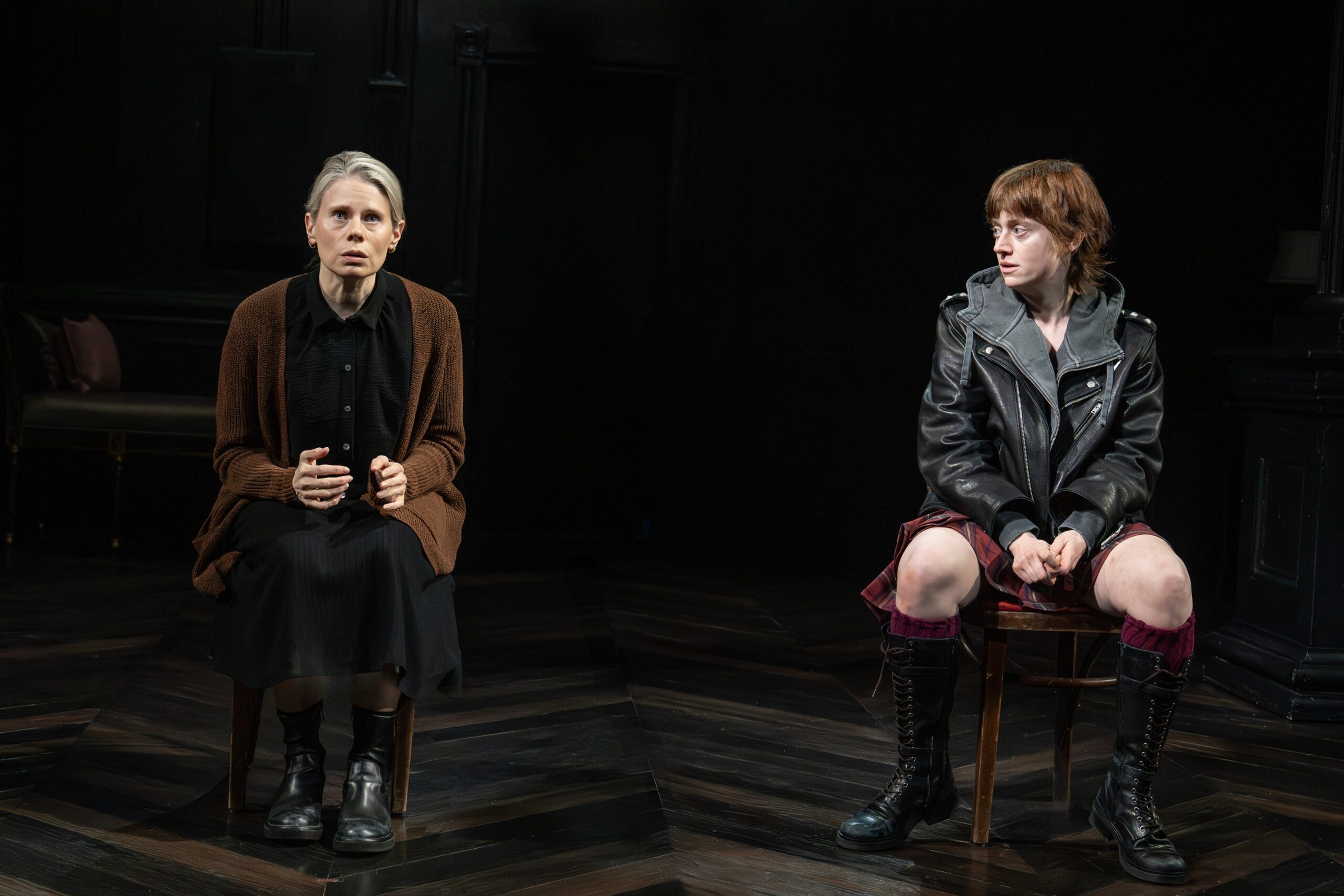
Celia Keenan-Bolger and Susannah Perkins in Antigone (This Play I Read in High School). Photo: Joan Marcus
There are two key transformations of Sophocles’ Antigone at the heart of Anna Ziegler’s Antigone (This Play I Read in High School). One of them is an effective jolt to the heart of the story’s core ethical dilemma, finding a striking contemporary approach to the ancient question of how we frame our moral imperative in the face of an unjust law. The other, to me, is more puzzling—Ziegler turns the Greek chorus into an emotionally invested narrator whose own story is meant to resonate with Antigone’s, a woman who finds the character of Antigone a touchstone throughout her life. But if the first intervention gives us a new lens on the stakes, the second blunts and muddies them, turning Antigone’s searing and tragic outcome into a gentler, almost hopeful story about coming to terms with motherhood and motherlessness.
So, as Ziegler’s Chorus (Celia Keenan-Bolger) says, let’s start with a little Antigone 101. Antigone was the daughter of Oedipus and Jocasta, and the play that bears her name is the final piece (chronologically) in Sophocles’ trilogy of Oedipus play. We all know how Oedipus’s marriage turned out; in the wake of her mother’s death, her father’s exile, and the Theban civil war that arose out of the fraternal battle over the throne, both of Antigone’s brothers have died, and her uncle Creon has become king. In his attempt to consolidate power, he forbids Antigone from burying her brother Polynices, who died a traitor. Antigone refuses to obey this unjust edict, speaking her mind and following her conscience even though it will lead to her death.
In the Chorus’s framing here, she (Dicey) is a forty-year-old woman who’s found Antigone a touchstone throughout her life: where she has often felt voiceless, Antigone speaks up; where she has often felt rudderless, Antigone has a fierce moral compass. But then she sees a young woman (Susannah Perkins) reading the play on a plane, and that girl is unimpressed. To her eyes, the play isn’t really about Antigone anyway–it’s “all about her brother’s body. A man’s body.”
A jolt strikes the narrator, and as she looks back into her own past, the play slips into a fiercely contemporary Antigone–but one that centers the stakes directly on Antigone’s body. In changing the law that Antigone is defying from the societal obligation to honor the dead into the most personal question of bodily autonomy, Ziegler taps into an issue that’s both deeply morally complex and pressingly contemporary: abortion. This Antigone (Perkins), a punk-rock free spirit in a leather jacket and a Catholic-schoolgirl plaid miniskirt (costumes by Enver Chakartash), had sex with her fiance, Haemon (Calvin Leon Smith)–Creon’s son– and has become pregnant. The wedding is nigh; the king her uncle (Tony Shalhoub) would be delighted with a grandchild/heir if they just moved the date up a tiny bit. And, as Antigone’s sister, Ismene (Haley Wong), reminds her, it doesn’t matter what she wants anyway: abortion became firmly and nonnegotiably illegal upon Creon’s recent coronation.
Ziegler’s language hits the right notes to make the dialogue and the emotional landscape feel recognizably contemporary without the lacquer of archness that these “out-of-time” plays sometimes fall prey to, and director Tyne Rafaeli finds the sharp humor within the tragedy. Antigone and Ismene sometimes overexplain the philosophical underpinnings of their actions, as does Creon (though Shalhoub brings a silky pomposity to it that makes it oddly enjoyable when he does it), but we keenly feel the horns of her dilemma with a gut-punch that a dishonored corpse wouldn’t bring to a twenty-first century crowd. For Antigone, the integrity of her identity is on the line: her freedom and her autonomy hang in the balance. For the careful, porcelain-pretty Ismene, control and constraint are her watchwords, but Antigone is willing to risk her life to retain her liberty. True, working for liberation rather than obligation may be the most modern choice Ziegler can make, but it does make the nature of the conflict different. For Sophocles’s Antigone, the moral conflict rests between what we owe to other individuals and what we owe to the (arbitrary) rules of society; for Ziegler’s, it’s between self-determination and obedience.
It’s rich, complex stuff, and Ziegler and director Tyne Rafaeli have the great good fortune to have not just Shalhoub but Susannah Perkins at the heart of it. Perkins is a live wire, and as we watch Antigone morph from a young woman acting out her trauma in reckless behavior into a person with a steely ethical core walking clear-eyed into mortal danger, we see her every thought flit across Perkins’s composed face. They also find the joy in Antigone’s defiance; the play may be a tragedy, but in Antigone’s relationships with her sister and her fiance, or even with a waiter she hooks up with the night of the coronation, we see her fierce intelligence and her playfulness. But we finally see them strip away all of Antigone’s defenses and bravado–literally stripping down and demanding that her uncle view her body and tell her to her face that he has more power over it than she does.
But the play doesn’t quite know what to do with Dicey, the Chorus. Celia Keenan-Bolger brings her usual clarity to the role, but partly because of her forthrightness and partly because she is in fact the narrator of the piece, it’s hard to buy that her journey is toward finding her own voice. And twinning her unasked-for but possibly welcomed pregnancy with Antigone’s desperate need to maintain sanity by terminating hers feels like a false equivalency that rewrites the cost of Antigone’s choices into a lesson in self-fulfillment. Antigone refuses to compromise and dies for it; Dicey stands up for herself in much smaller ways and forces a happy ending.
The venue, the Public’s Barbaralee (formerly the Anspacher) doesn’t help in keeping the Chorus integral, either. It’s the obvious choice for a Greek adaptation in many ways; it’s styled like a classical amphitheater from its voms to its thrust, floor-level stage with big doors upstage mirroring the arches of the classic. But it’s also a space that drains intimacy, and some of Keenan-Bolger’s conversational tone disappears into the ether. (Jen Schriever’s lighting design brings the house lights up for the longer Chorus monologues, which helps in some ways and harms in others.) Rafaeli does strong work with all of the performers, Keenan-Bolger included, but neither she nor Ziegler seems quite sure how to physically keep the Chorus in the play. She keeps hovering around its outskirts, witnessing Antigone’s story: she may be finding her voice, but she hasn’t found a place within the play’s complex web of human obligations, hubris, and mistakes. And in the face of Antigone’s and Haemon’s deaths, Creon’s and Ismene’s grief; in the face of a surveillance society and laws that continue to police women’s bodies, I was not particularly convinced by the miracle of birth that concludes Dicey’s story. Maybe I wasn’t supposed to be.