
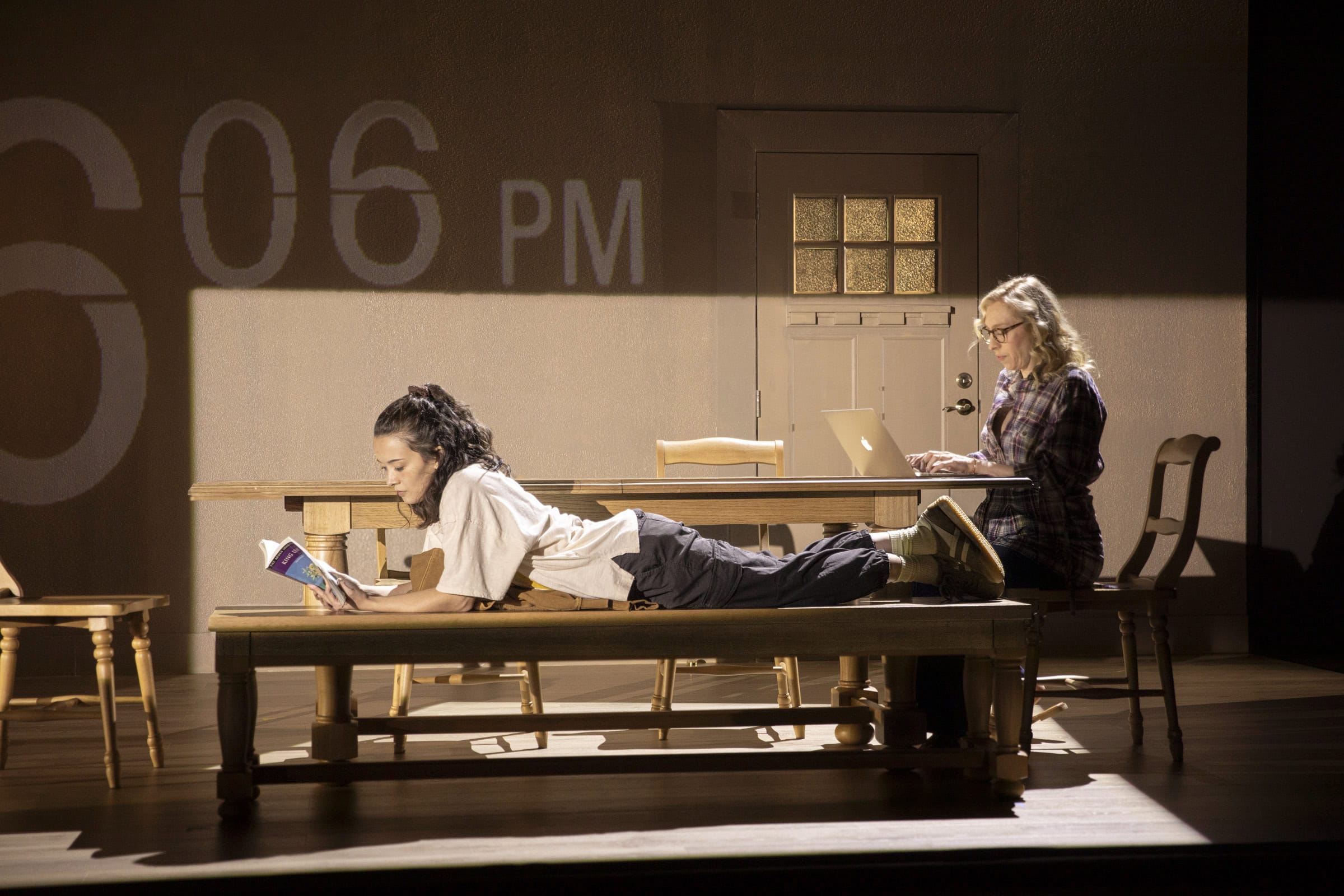
Izabel Mar and Crystal Finn in ANON. Photo: Monique Carboni
“In a soliloquy,” says Delia (Izabel Mar), in ANON, Anne Washburn’s new play, “words take the place of swords.” It’s where the arguments we have with ourselves get shaped and polished into final form–but also, a way of turning private thoughts into public actions. Delia, a teenager in suburban San Antonio in September 2024, is working on an assignment for English class to write a soliloquy for a character in either Richard III or King Lear who doesn’t already have one. (She chooses Goneril, FWIW.) But for Washburn here, all of social media acts as soliloquy after soliloquy: private thoughts going out to an infinite public: “We need someone to hear them and then we understand what we think.”
Delia has a role model close to home on this: her mother, Jeanie (Crystal Finn), a “digital warrior” who’s monologuing QAnon content on TikTok to an audience much smaller than she knows her message deserves. A stay-at-home mom who lost 100K Twitter followers when she was banned over vaccine misinformation, Jeanie is trying to build back her platform, to spread the truth about “one of the most astonishing moments in human history.” The problem, she thinks, with her self-appointed mission is that no one is listening. The problem, her new neighbors think, with her self-appointed mission is that she’s targeting them.
Specifically, she’s targeting the “indoctrination” inherent in the pride flag hung on the porch of those new neighbors, Adam (Jeff Biehl) and Will (Jeremy Shamos), a gay couple who’ve just moved from Philadelphia. Adam, who works remotely, seems to be as terminally online as Jean is, though she is engaged in a pitched battle for the soul of America, and he’s mostly procrastinating. The flag was a housewarming gift, one Will actually feels deeply ambivalent about–until Jeanie starts mentioning it in her TikToks, at which point he becomes both protective of it and anxious about what she’ll do next. And when they start to feel genuinely threatened, they’ll descend into paranoia of their own.
Washburn sets ANON very precisely in a particular September week in 2024: the election upcoming, “Biden’s America” drawing to a close. Jeanie is increasingly determined to see her message break through, even as her husband, Michael (Andrew Garman) starts to ask her whether it’s time to accept that it’s not going to. Jeanie also starts crossing lines that even Delia and Michael–who are otherwise uncritical and allied with her views enough to accept her crusade as her “thing” as long as she doesn’t post about them–find problematic. And it’s a week where Adam and Will shift from seeing Jean as an amusing kook—they might watch her posts more religiously than anyone who agrees with her—to a genuine threat. Jared Mezzocchi’s fluid projections give us date and time stamps ticking down scene by scene, enveloping dots’s generically middle-class kitchen set and giving the audience the occasional glimpse inside the characters’ digital worlds. The same physical space serves as both homes: same farmhouse table, same Mac laptop with its little glowing apple logo, same cabinets vaguely glimpsed stage left. There is of course a practical functionality to this, as well as the relevant reminder that these people literally are neighbors, occupying the same physical space and needing to engage–but it does also feel like a dramaturgical means to flatten the differences between them.
But those differences remain real. Adam and Will actually are being targeted. No, their address isn’t exactly visible in the video, and as Adam says, “if anyone really really has it in their heart to go stomp on gay people hoisting a pride flag like no one has to go to the trouble of ‘zooming in’ and enhancing,” but seeing this play in a moment where certain sectors of the internet are on a crusade to dox the Jane Doe at the heart of the Cornell rape case, it’s hard to think Will’s fears are entirely irrational. Jeanie, for all her talk about shadow-banning, is not being threatened. Her isolation is a consequence of her own actions. (Maybe that’s why King Lear casts a long shadow over this play.)
It’s absurd that satirizing the way we interacted with the internet in 2024—”no one needs the real world we’re all alone together” making TikToks—already feels so toothless. That our digital civic sphere has degraded markedly further, markedly faster, than seemed possible even two years ago. But Washburn’s intervention into this dialogue—crisply directed, as ever, by Anne Kauffman, cast with off-Broadway stalwarts, and brittlely funny—can’t keep up with the new paradigms and dangers. Jeanie’s sense of being beleaguered and shadow-banned, censored for her “truth-telling”? Purveyors of her “truths” are now running the country and destroying public health around the world. Her concern that Adam (whose last name is Epstein) might be related to Jeffrey? It’s her god emperor who’s continuing to hide those files.
If any actor is going to make you feel the protective, desperate weariness behind Jean’s willed TikTok cheer, it’s Crystal Finn, who brings tender humanity to the most outlandish circumstance (see Cold War Choir Practice). But Jeanie’s sincerity doesn’t outweigh her delusionality or the danger to other people in what she preaches. And neither does the increasing paranoia spiral of Adam and Will—enacted with a careful dose of wry self-awareness by Biehl and particularly Shamos—outweigh the fact that they’re just trying to live their lives.
But even with that, if the play gave us a real sense of why Jeanie believes all of this so fervently, what flipped the switch for her, we might come to understand her better. We know that Michael’s positions originally shifted her from “Commiefornia liberal” to what she is now, but we don’t know exactly how they switched places, how Jeanie burrowed so much deeper into conspiracy than Michael’s stopping point. We see that Delia, too, is on Jeanie’s spectrum–happy to throw out a “libtard” and trash her school’s paper for trying to mimic The New York Times–but she too has a line that Jeanie blithely, enthusiastically crosses. Instead, we see her most elaborate fantasy play out on video, a dream where her entire family has come fully around and she’s being interviewed by Vice President Michael Flynn.
Maybe it’s just me—I felt the same way about Slam Frank, that it was fighting the wrong battles at this perilous moment; that a satire that fails to acknowledge the current balance of power feels completely inadequate to the task at hand. Adam and Will, yes, may be dying on a trivial hill. But there shouldn’t be a hill where they’re standing, and I don’t have a lot of patience right now for the idea that all of us bear equal responsibility for the state in which we find ourselves, that all of us are doing equal damage to the community when we retreat to our soliloquies, to making our thoughts our weapons.
I have recently been reading End Times Fascism, a new book by Naomi Klein and Astra Taylor about the three strands of “end-times” thinking that enable today’s most dangerous power politics, and the ways we could possibly avert any of them destroying all of us who are neither true believers nor tech overlords. And so, with a hat tip toward Klein and Taylor, the two moments in ANON that speak to me, instead, go almost unnoticed. One is the only scene in the play where we see members of the two families interact: Michael knocks on Will and Adam’s door asking if they can save him some boxes when they unpack. He doesn’t say why; we can perhaps guess–but still. It’s a request for an act of neighborliness. An action in the real world.
Then, when Will is thinking about poking the bear that is Jeanie from a VPN-shielded TikTok account–Is it a prank? Is he trying to drive her over the edge?–he stops, for a moment, and types: “Are you okay?”
And then he erases it. He’s probably right to do so–it’s not his job to save Jeanie from herself; she wouldn’t be listening anyway; she’s pretty sure she is, actually, okay. Klein and Taylor would say that these impulses–these moments of people in the real world looking out for each other and their community–are the only hope we have. The problem is, when Michael asks if Will and Adam need to borrow anything, it never even occurs to him that they wouldn’t feel safe crossing the street and knocking on his door. And it would never occur to Jeanie to ask if the neighbors she’s targeting are okay. I’m not sure ANON recognizes that.