
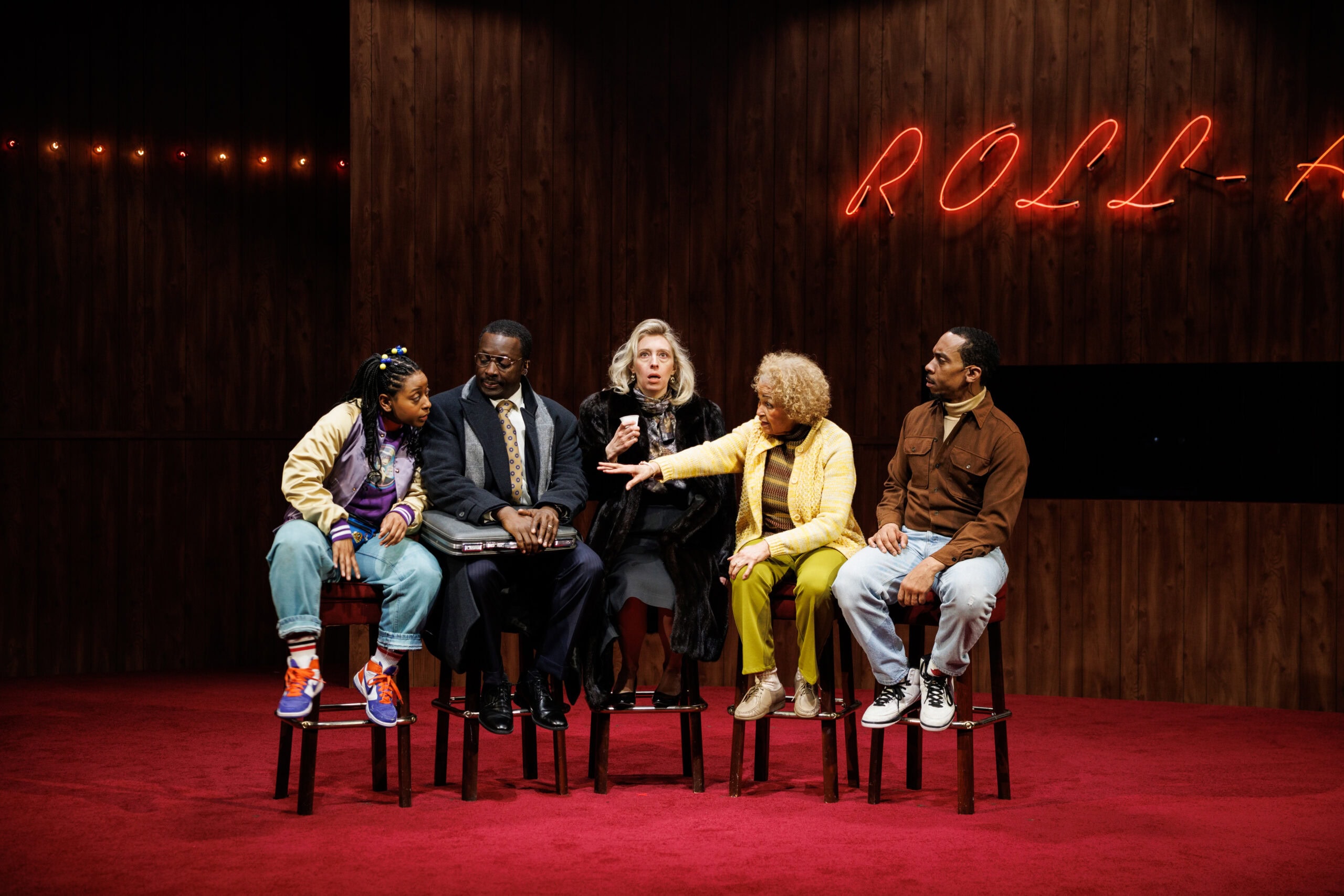
Alana Raquel Bowers, Andy Lucien, Crystal Finn, Lizan Mitchell, and Will Cobbs in Cold War Choir Practice. Photo: Maria Baranova
Playwright Ro Reddick really was in a children’s choir called Peace Child in the 1980s, singing tunes like “Song for a Russian Child,” with an oh-so-American mix of innocent faith in the power of personal connection and nationalistic arrogance at the inevitability of American exceptionalism. The play Reddick has built on the foundation of that experience, Cold War Choir Practice, is a coming-of-age fantasia that embraces a wild array of genres and styles, leading us down a path filled with farce, music, and suspense to some stark truths that ring as true now as they did in the play’s 1987 setting: Institutional power can steamroller over individual choices, every time. Industrial capitalism has its hooks deep into Western power structures. None of us can count on our leaders to save us, and a working-class Black family perhaps least of all. Safety itself might be an illusory promise.
Did I mention it was a really funny comedy?
Aesthetically, there is something for everyone in Cold War Choir Practice, which has been restaged at MCC after a brief run last summer at Clubbed Thumb’s Summerworks festival: 1980s nostalgia, Cold War intrigue, family conflict, roller disco, Christmas carols, slapstick, a few notes of chef’s-kiss-level prop comedy (kudos to director Knud Adams and prop designer Natalie Carney; more on both later), a lonely little girl, an incisive analysis of the failures of Reagan-era capitalism and the politics of Black exceptionalism, Russian pen pals, cults, the fear of nuclear destruction. The “everything and the kitchen sink packed into a tight 90 minutes” is a bit of a Clubbed Thumb signature, and in less skilled hands can lead to undisciplined chaos. But here, while chaos is never far away, that teetering-on-the-brink-of-control energy has a thematic resonance–this is what it feels like to live in a world on the brink of nuclear holocaust, to live in a Black family whose financial precarity creeps into every facet of their lives. (Tonally, I kept being reminded of The Baltimore Waltz—fittingly, as Reddick is this season’s winner of a Paula Vogel Award.) The first time we see the father and daughter Smooch and Meek, she’s putting together a (maximally 1980s) Christmas list, and he’s telling her they can’t afford gifts this year.
And while there are a few spots in the first two thirds of the piece where I might wish the dial was turned down just a notch, so the delirious, hilarious chaos of the ending felt like more of an escalation, that frenetic pacing also serves as a shield, allowing emotional truths to sneak up while you’re diverted by the singing and the Boris-and-Natasha-esque Russian pen pals and the cult leaders and the skating. (There are no real rollerskates, I should say, but the movement work by Baye & Asa makes you feel like there are, and the cleverness of that signature bit of staging helps to anchor the roller rink run by Smooch as the central location on a mostly bare stage.)
Reddick’s script is always doing several things at once–politics with one hand, Christmas carols with the other; nostalgic jokes over here and bitter family feud over there–and director Knud Adams keeps all those balls in the air with an offhand elegance that makes the whole thing seem much easier than it ought to. Adams’s gift for emotional subtlety has been well illustrated, in recent seasons, by Primary Trust and English, but his flair for physical comedy is also on full display here, in ways that elevate the wry humor of Reddick’s script into full-blown Durangian absurdity.
It’s 1987, Syracuse, just before Christmas. Ronald Reagan is president, nuclear war seems a distinct possibility, and it’s sure not helping ten-year-old Meek (Alana Raquel Bowers) that her choir leader (Ellen Winter, also the show’s musical director) keeps concerts at 28 minutes to make sure that even if the Soviet Union happens to launch a missile at the precise moment a concert begins, the young choristers can finish singing and hug their families goodbye. Meek’s dad, Smooch (Will Cobbs), runs his roller rink as part business, part community service in a Black neighborhood in Syracuse–one of the play’s first emotional wrenches is when Meek is told she doesn’t have to worry about the Russians bombing in her part of town “because only Black people live there and they always bomb important people first.” Smooch, who came up in the Black Panthers, on the other hand, is way more concerned about the fact that the FBI recently bombed a Black liberation organization in Philadelphia. They live over the rink with Meek’s grandmother, Puddin–the extraordinary Lizan Mitchell, who is never less than wonderful but may never have been funnier or earthier than she is here.
Meek is in a children’s choir called Seedlings of Peace, and one of the cleverer of Reddick’s structural interventions is to make the ensemble a literal choir of three (Grace McLean, Suzzy Roche, and Nina Ross). Each also plays a plot-essential role in the narrative–as well as other “as-cast” fill-ins and occasionally even a set piece–but primarily they fill the background with songs, written by Reddick, that are both beautifully arranged as Christmas carols and serve as acerbic commentary on the action and the historical moment; both treacly children’s choir pieces and pins popping the inflated balloon of the American ego.
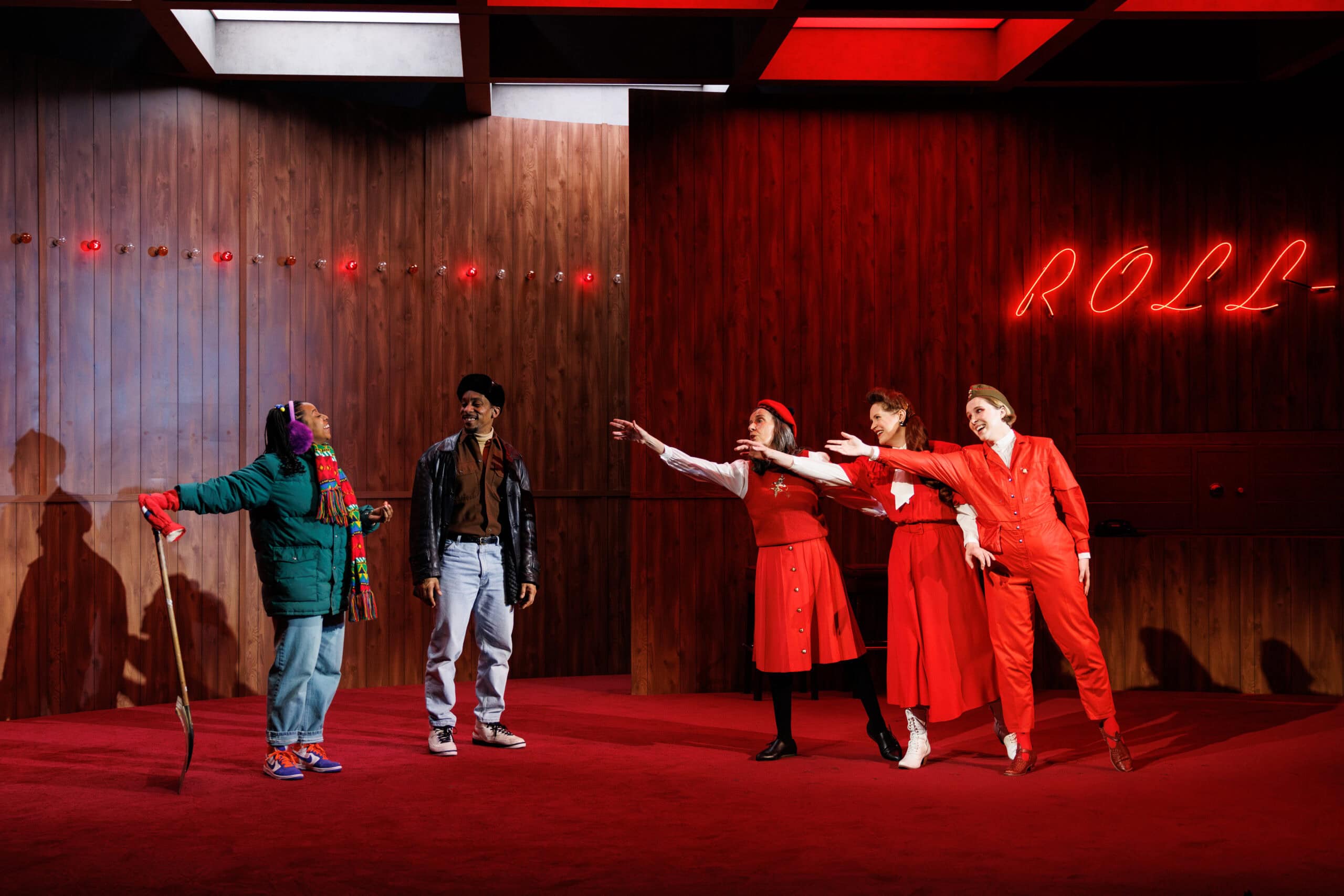
Alana Raquel Bowers, Will Cobbs, Suzzy Roche, Grace McLean, and Nina Ross in Cold War Choir Practice. Photo: Maria Baranova
Meanwhile, Smooch’s brother, Clay (Andy Lucien), is on an entirely different trajectory. He left Syracuse for college, then law school, and is now a high-ranking official in the Reagan administration–a poster child for “bootstraps”–and married to Virgie (Crystal Finn), a neurasthenic white woman who’s recently escaped from a quasi cult under the guise of Wellspring, a “women’s optimization workshop.” (To me, the names Clay and Virgie have a distinct echo of a certain Supreme Court justice and his wife; I can’t say whether that’s intentional, but I was sure thinking it.) Finn is also reaching new heights of physical comedy here; the combination of twitchiness and pained vacancy that she brings to Virgie is sublime. Nuclear talks are heating up and Clay is needed at the highest levels–but he’s afraid to leave the fragile Virgie alone, so he treks from DC to Syracuse to put his wife in the custody of his sympathetic mother and much less sympathetic brother. It’s been a long time since the brothers have been together, and adding a high-strung, terminally dehydrated white woman into the mix isn’t helping things.
When the lonely Meek is approached by her Russian pen pal (via her Speak n Spell; IYKYK, fellow Gen xers) to purloin some documents from her uncle’s briefcase at the same time as Virgie’s cult handler (choir member Grace McLean, silky-smooth but with enough physical abandon to mime slithering under a restroom stall door to get her target) makes the same request, hijinks ensue, culminating in both Meek and Virgie trying to break into Smooch’s safe at the same time, only to be caught by Puddin, and then by the cult’s functionary. The play’s comic and emotional climaxes arrive simultaneously: Mitchell and Finn are bringing the house down with comedy while being held hostage in Smooch’s office. Meanwhile years of philosophical conflict and emotional wounds between Smooch and Clay get wrung out through both a physical scuffle, a heart-to-heart, and a quick but scathing debate about the nature of power and political effectiveness. There’s a gun, there’s a sucker-punch, there’s a daring escape–and the whole thing peaks with a theatrical effect that I won’t spoil except to say that it nails the way the physical elements and the narrative ones have complemented each other so well throughout.
Afsoon Pajoufar’s set is awash in reds that evoke both Russia and Christmas, with the particular flavor of wall paneling, carpet, recliner, TV, and particularly the neon Roll-a-Rama sign screaming 1987. A partitioned upstage space that serves as radio station, roller-rink DJ booth, and Smooch’s office then provides the container for the play’s tensest and funniest scene, which we view through a narrow horizontal window, amping up both its humor and its tension. Natalie Carney’s props play an unusually central role, from a Speak + Spell to Clay’s briefcase to a series of cone-shaped water-cooler paper cups and a two-liter soda bottle that generate laughs to an explosive device that looks straight out of the Acme catalog. Masha Tsimring’s lighting is embedded in a lattice of ceiling panels that evokes old-school fluorescents and a disco floor all at once, but uses color to shift the mood. Beyond the music, Kathy Ruvuna’s sound design uses TV and radio effects, along with actual recorded Reagan speeches, to further refine the sense-memories of time and place. And Brenda Abbandandolo’s costumes reach their apotheosis in the outfits worn by the choir–a little bit Salvation Army, a little bit Sexy Santa, but their solid red means they pull you out, just a little, of every scene they’re in, reminding you of the chorus’s position to supply both commentary and characters.
“I’m tired of…trying to be safe from everything–anything. Ain’t no safe from,” Meek says, near the end of the play. We managed to avoid nuclear war in the 1980s. The Berlin Wall fell. But in a moment where it once again feels like there ain’t no safe from anything, Cold War Choir Practice helps us laugh to keep from crying, though it might also draw a tear–and make us think about the nature of power.