
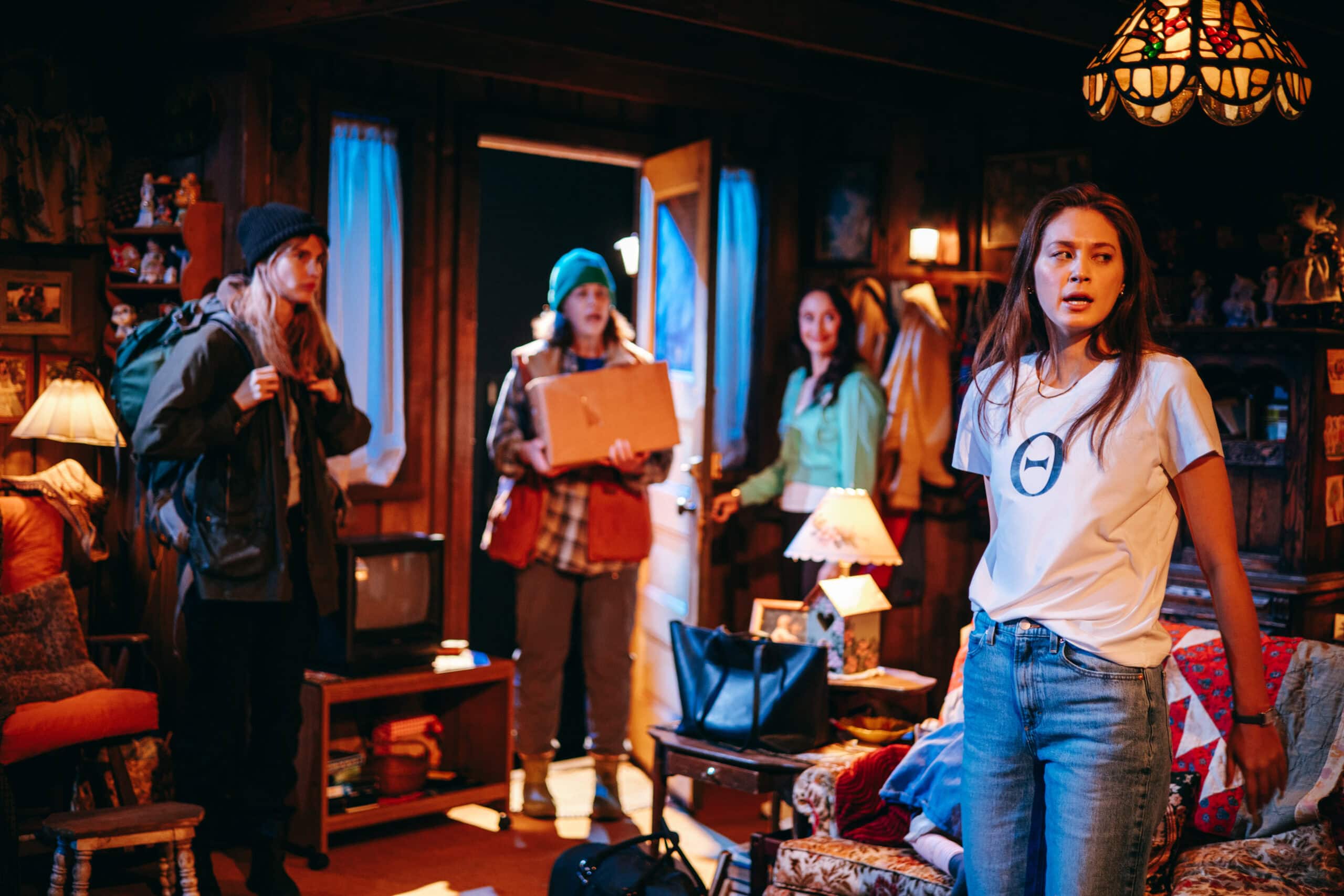
Alexandra Templer, Jennifer Regan, Rachel Ravel, and Emma Kikue in The Morbs. Photo: Geve Penn
The world-building in The Morbs, a new play by Jen Diamond, is a little rickety, as is the timeline of its backstory. It’s now-ish in New England, with two major exceptions. First, cell phones don’t exist (a stipulation I suspect many playwrights would be delighted to make, though in this case the play is set in backwoods New Hampshire and they probably wouldn’t work in this location anyhow.). Second, and more important, America/the world is subject to periodic outbreaks of a disease, also called The Morbs. Its method of transmission is opaque, its consequences dire, and it appears to have quickly warped society around it, creating a lucrative containment industry. The disease has two variants: Hollow is survivable but drains personality and memory out of a person like letting water out of a barrel. Violent turns the infected homicidal and creative; the only way to “contain” a sufferer of the Violent strain is to take them out. (Which is one of the ways the world-building feels thin—less than five years in, ordinary Americans are prepared at the first sign of an outbreak to “give [their] life to protect the others.” Recent actual history makes one very skeptical of that commitment to collective good.)
But while The Morbs is the reason three semi-estranged sorority sisters are holed up at a cabin in the woods–and the reason Harriet (Jennifer Regan), the cabin’s caretaker and the aunt of one of the holed-up, is a shell of a person–the plot is almost incidental to what makes the play enjoyable. Tatum (Emma Kikue), Trish (Rachel Ravel), and Wendy (Alexandra Templer) have gone in drastically different directions in the time since graduation: the perky, neurotic Trish went to business school, got married, and now juggles motherhood of a toddler with a high-powered finance career. Tatum, polished and privileged, has settled into the glamorous life of the visibly idle rich. And Wendy, a college party girl who lost her mom in the first Morbs outbreak, now travels with rope and a stash of canned soup in her weekend bag. Just in case.
Diamond sets the play five years after their graduation; that timeline doesn’t really add up either (apparently I am not capable of turning off my copy editor’s brain when wearing my theater critic’s hat). Not only has Trish applied for and completed an MBA; met, dated, and married her husband; been pregnant for nine months; and raised a child for two years–there was also a major outbreak two years ago, one that directly affected her two best friends (in addition to Tatum’s aunt Harriet surviving the Hollow variant, her uncle died of the Violent strain). It doesn’t seem to have slowed Trish down, though.
But while I did find those logical hiccups distracting, it’s intensely enjoyable to watch Kikue, Ravel, and Templer play off one another: nursing old wounds, sparking old memories, trying to figure out if they’re even the same people they were just five short years ago. The Morbs is a disease that steals memories and takes personality with it–or maybe the other way around; Harriet seems to have perfect recall of the events surrounding her husband’s death and sometimes of Tatum’s childhood, but still, she’s lost affect in a way similar to how psychiatric medications flatten personality. (Regan’s ability to calibrate a warmth of intention even through an impenetrably placid surface is unsettling but also key to the whole effect.) Director Lily Kanter Riopelle has a solid grasp on the vibes buried in each relationship individually and in the group as a whole, controlling the micro-shifts in emotion. There’s also a cabin-in-the-woods horror movie dynamic, and Riopelle controls the anxiety level carefully. Adding to the off-kilter horror effect are the trapped-in-time clutter of Christopher and Justin Swader’s set; I don’t know whether the Swaders or props supervisor Natasha Dell gets credit for the unsettling, child-size rag doll who becomes almost a fifth character–possibly the most liked person in the play–but kudos. (Paige Seber’s lighting design uses a nice mix of practicals and light behind the cabin windows/door to give a sense of both indoor ambience and time passing outside.)
These three women are bonded in treasured memories, but do the people they’ve become even like each other? You see them constantly flickering back and forth from nostalgic affection to present resentment; from analyzing whichever one has left the room to anxiously gauging how they’re being perceived by the other two. (Avery Reed’s costumes give little character tip-offs as well, from Trish’s girly pajamas to Wendy’s sturdy boots.) Each is keeping an iron control on her emotions–anxiety about the outbreak, yes, but also other, darker currents: Templer’s deep sadness and need to exert what little control she can. Kikue’s petulance at the world, for once, not smoothing her glide path, but also a loneliness in her high-end life. Ravel’s Trish readily admits to her own emotional lability, but not till the end do we realize that she’s also been tamping down a seething pool of resentment at not being recognized as the overachieving adult she’s become.
The play, in a sense, is a push and pull in time: the girls they were and the women they are now, their memories clashing with their present. Who are we without our memories–but also, can our memories substitute for our emotions? I didn’t entirely believe the play’s world, but I believed those people.