
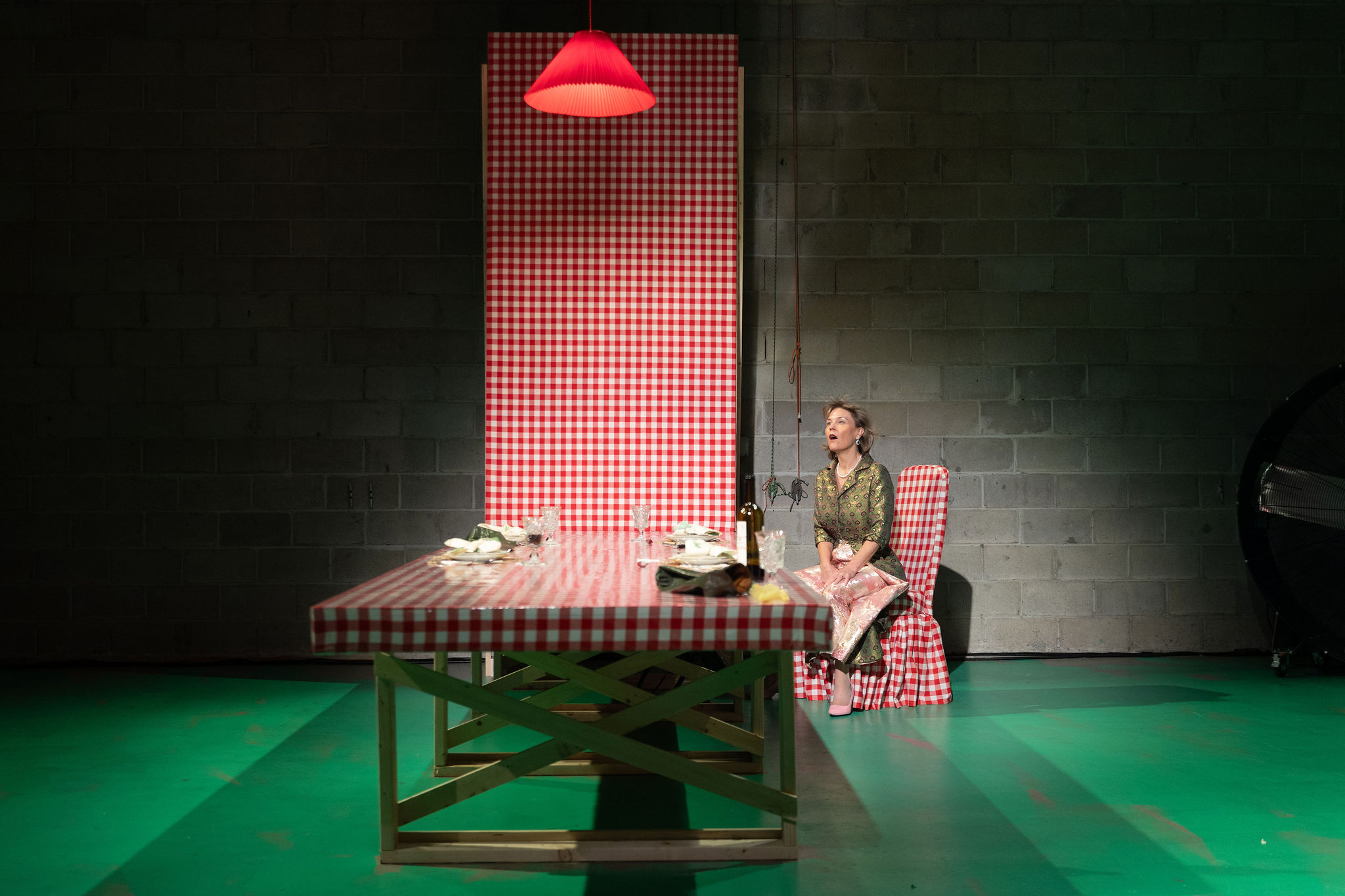
Kelly McAndrew in The Executrix. Photo: Lee Rayment
There is an executrix in The Executrix, the new play by Emma Horwitz, though no one ever actually calls her that (and she’s not very good at the job). Louise (Kelly McAndrew) has been tasked with settling the estate—aka selling All the Art Susan Made in Her Lifetime—of her former lover, Susan (the artist, Susan, you must know her work), who died in a tragic masturbation accident, which we witness in the show’s prologue. Or so Louise tells Ida (Jennifer Ikeda), her newlywed sister-in-law, when Ida shows up early for a little dinner party at Louise’s apartment. (This becomes a little, but only a little, more explicable when you learn that Susan always confused the words “defenestration” and “masturbation.”) But is Louise telling the truth? Susan does mention a complete body transplant on her way toward the ground.
Ida and Louise are “family” but they barely know each other—Louise has been “straight married” to Irene’s brother, Peter, only about a year and Ida and Irene (Molly Bernard) have been together for even less time. Yet Ida seems to know a lot of things she shouldn’t. About Louise. About Peter, who is out acquiring a cake and never makes it back for dinner. About Susan’s art.
Most of the play involves Ida and Louise circling each other like genial panthers, waiting for Peter and Irene to arrive for dinner and each trying to pretend to the other that claws aren’t drawn. Three interruptions punctuate the rising tension: Irene storms in, delivers a brilliantly vitriolic monologue at Ida before dropping off a suitcase of knickknacks, and storms back out. A windblown (literally; Krit Robinson’s set incorporates one giant and one regular-sized fan, deployed to create the necessary wind with the maximum amount of intentional artifice) flashback gives us a glimpse into Louise and Susan’s relationship. And the art collector (T. Ryder Smith) who acquired Susan’s oeuvre arrives to ask for a refund.
The plot hardly matters, though. What The Executrix has got in spades is style, weaving in influences with affectionate abandon: Classic screwball comedy for a suitcase-swap gag and an overall aura of archness (McAndrew’s Louise is an airy patrician with a mean Katharine Hepburn lockjaw and a blithe obliviousness to her own wealth). Vertigo for a fascination with doppelgängers and falls from high places. David Lynch for a kind of calculated repetition in language, and the bright, clashing palettes of Karen Boyer’s costumes and Robinson’s red-gingham-draped set. Soap operas for the whole idea of a complete body transplant. (Speaking of that complete body transplant, the excruciating splat that closes the prologue may be sound designer Johnny Gasper’s greatest contribution here.)
As in Two Sisters Find a Box of Lesbian Erotica in the Woods, Horwitz’s piece with fellow playwright/producing partner/wife Bailey Williams, there’s a fascination with the invisibility of lesbian relationships, with the inherent misperception of two women as undifferentiable rather than a couple: the leap to sisters or friends rather than wives. But here there’s another spin, multiple explicit layers of doubles and doppelgangers: Two red suitcases. Two Susans. Two pairs of gloves on Ida’s hands.
Horwitz isn’t particularly interested in psychology, but more in the concept of what it means to be a person at all. Her characters are polished and opaque, and they operate by move and countermove, interaction and reaction; the way they are perceived and received by others is as definitive to their existence as who they are in the first place. We don’t need to know what they’re thinking to enjoy the witty sparring, but sometimes that sleek inaccessibility also undercuts our ability to differentiate between the artifice of the style and the artifice of a character’s intentional manipulation or lie. Every line needs to be simultaneously taken on faith and doubted on sight until more evidence emerges. It’s another echo of the writer’s fascination with doubles and misinterpretations and replications, but also sometimes an obstacle to understanding.
Horwitz is ideally paired here with director Sarah Blush, who amps her excellent ensemble to truly epic heights. McAndrew, so grounded in a play full of realist emotions, here is brittle and supercilious, dripping luxury from her voice to her brocade ensemble, but perfectly capable of pushing her lover out the window. Ikeda sets Ida’s traps with more subtle scheming, but knows how to put a needle in every line. She makes an entire meal out of peeling off gloves yet barely lets a flicker of untoward emotion into her voice as she channels Peter imitating Susan in one of Louise’s anecdotes. T Ryder Smith’s art collector is basically a plot device, but he still strides the stage in tap shoes and delivers his lines with oily gusto. And Molly Bernard has never been, rocketing in through the venue’s roll up garage door to deliver an exquisitely insulting break-up speech–that is also a hilarious riff on knick knacks– seemingly without taking a breath.
Despite all the devious, polished surfaces and mirror images and micro-power reverses, there’s something yearning and lonely underneath. The press release calls it “a tale about the tragic impossibility of being fully recognized”–but how can you be recognized when you’re standing in a hall of mirrors, wearing a different body, and constantly mistaken for your own sister-in-law?