
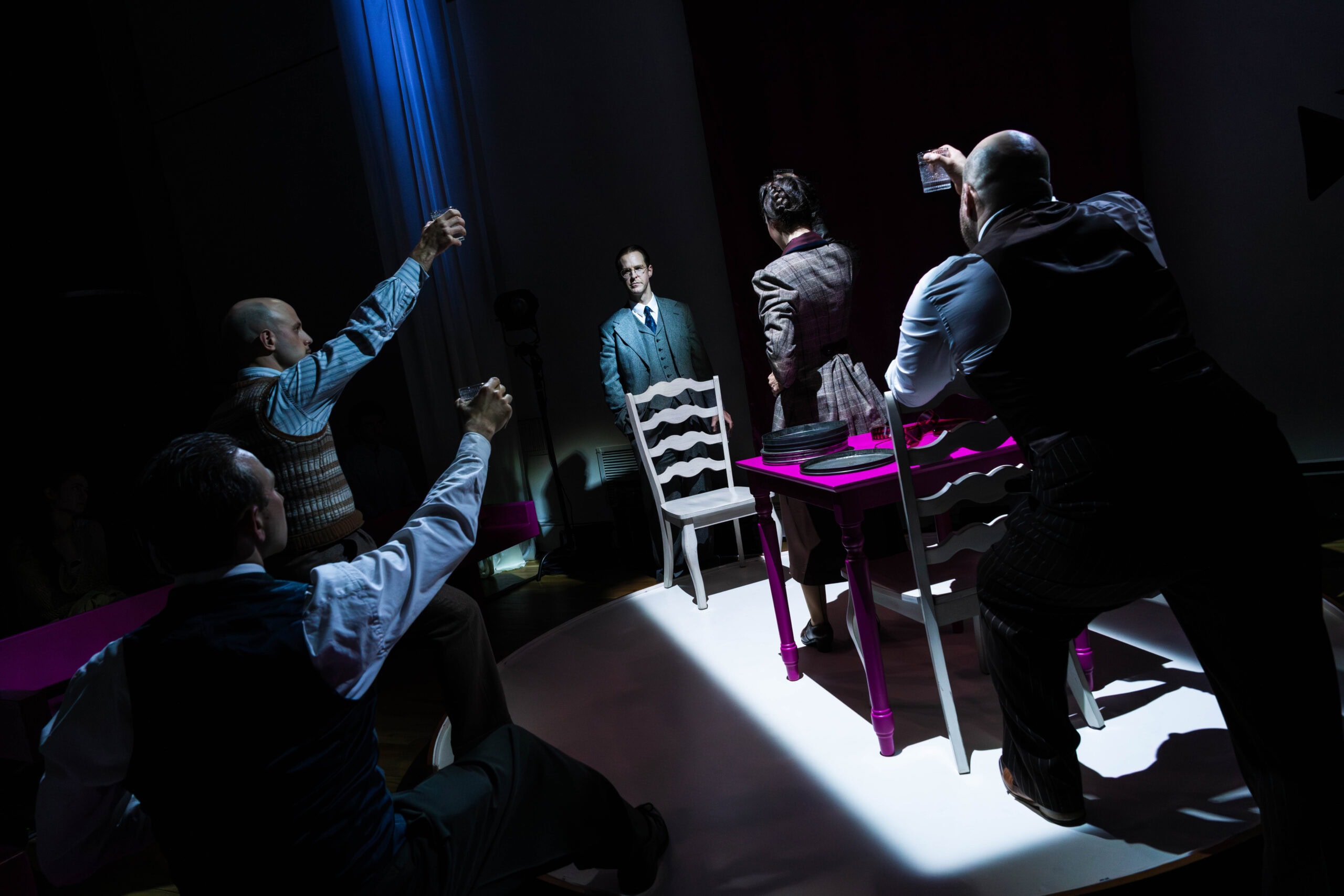
The company of Beauty Freak. Photo: Alexia Haick
As our federal government slowly replaces fascism cosplay with actual fascism, I have found myself thinking about, and increasingly sympathetic to, everyday Germans in the run-up to World War II. The question I used to ask myself, “Did they know what was happening?,” now seems less relevant than “Could they stop what was happening?” Beauty Freak, playing at the Cell Theater through May 17, explores these ideas, except instead of concentrating on workaday Germans, playwright James Clements turns the focus on prodigy filmmaker (or is it propagandist?) Leni Riefenstahl (Baize Buzan).
The action begins a year and a half before Nazi Germany is to host the 1936 Summer Olympics; Riefenstahl, fresh off the success of Triumph of the Will, has been tapped by Hitler to make a film documenting the games. At the start, the feminist filmmaker stands up to infamous propaganda chief Joseph Goebbels (Peter Coleman), defiantly asserting that she will to use the project’s hefty budget to compensate herself generously and to make art—two prospects modern filmmakers might feel a bit of jealousy over. But as the narrative unfolds, Riefenstahl’s artistic integrity is predictably compromised by the Nazi political agenda (and her adoration of Hitler), and she has to choose between speaking truth to power and continuing to work. In contrast, her filmmaking partner, Ernst Jäger (Keith Rubin), has a different choice: Collaborate with Riefenstahl or protect his Jewish wife.
If you come to the play knowing anything about Riefenstahl, it’s probably that she was a not-so-unwitting Nazi propagandist and that Triumph of the Will, her uncritical love letter to Adolph Hitler, was embraced by the Third Reich. So you’re as unlikely to believe her declarations that she is “simply an artist” at the beginning of the play as you are at the end. Thus Riefenstahl’s dilemma over whether or not she should help her pal Hitler is somewhat lacking in dramatic tension.
This hints at the serious difficulty playwright James Clements faces in tackling this story: There’s no mystery who the bad guys are (spoiler alert: it’s the Nazis!). Unlike Richard Nelson’s epic and awesome Two Shakespearean Actors—which also examines the interplay between art and political violence but with a less well-known narrative, more ambiguous causality, and bloviating-yet-still-relatable tragic main characters—Beauty Freak keeps us at a distance. Clements’s Riefenstahl is less sympathetic hero, more increasingly loathsome Nazi apologist. While even mob boss Tony Soprano’s horrible actions are understandable because he, like us, loves his family, there’s nothing relatable about this post-Triumph Riefenstahl. Even being rejected by Hollywood, the show’s dramatic climax and possibly Riefenstahl’s real-life nadir, warrants no more than a shrug.
I suspect the play’s raison d’être is to point out parallels between Nazi Germany and present-day MAGA America. Clements makes that point subtly and effectively, indicting viewers for our failure to do more to oppose the current political repression. But Riefenstahl’s historical prominence foils the analogy; while the cautionary tale should hit home with Tucker Carlson, viewers who haven’t actively championed Donald Trump are kind of let off the hook. Perhaps her bestie, the somewhat sympathetic, Cassandra-like Jäger, who collaborates with Riefenstahl despite his awareness of Nazi evils, might have been the reflection that let us see our shortcomings. But instead, he is used as a dramatic counterpoint, a reminder that there were Germans who did the right thing (because they were married to Jews?).
Director Danilo Gambini makes excellent use of the cell’s postage-stamp-sized stage, creatively overcoming the space’s limitations. What little there is of Suzu Sakai’s set plays the supporting role to Yung-Hung Sung’s lighting, which emphatically defines spaces and heightens dramatic moments. Stephanie Bahniuk has costumed the actors well with what I can only assume is a fraction of a shoestring budget. Liam Bellman-Sharpe’s soundscape starts strong out of the gate, giving the preshow announcement the feel of an old-timey newsreel, and includes plenty of projector noise to good effect, but some cues—like a recurring drumbeat—are distracting and out of place. Given the constraints, kudos all around to the design team.
If only Gambini had as much success with the performances, which feel underrehearsed. The show’s eclectic acting styles are unified only by a lack of subtext. Baize Buzan, who portrays the titular character and remains onstage for every minute of the nearly two-hour-long play, creates a solid enough Riefenstahl but is missing an inner life. Of the three stylistically distinct approaches to portraying the show’s Nazis, I prefer Sam Hood Adrain’s understated Werner Klingenberg, though Slate Holmgren renders a good insane true-believer type-Nazi in Ambassador Dieckhoff. Peter Coleman’s take on Joseph Goebbels, one of history’s most horrifying characters, is quite forgettable. Keith Rubin does a nice turn as the play’s conscience, Ernst Jäger. Late in the evening playwright Clements appears as Walt Disney, but why? Neither character nor actor does much for the show.
Nowadays, when we call someone a prodigy, it’s a compliment. But the word’s original fifteenth-century meaning was closer to its Latin root prodigium: monster. Perhaps early talent and great danger are inextricably linked. Without wisdom and life experience as guides, prodigies are ever in danger of using their gifts in awful ways. Leni Riefenstahl directed, starred in, and edited her first film before she was thirty. She completed Triumph of the Will three years later, one of five propaganda documentaries she helmed before the outbreak of World War II. Despite her considerable skill, success, and pioneering feminism, she is, and probably always will be, a footnote to the dictator she championed, Adolf Hitler. And rightfully so. Intersectionality, as my theater companion pointed out after the show, goes both ways.