
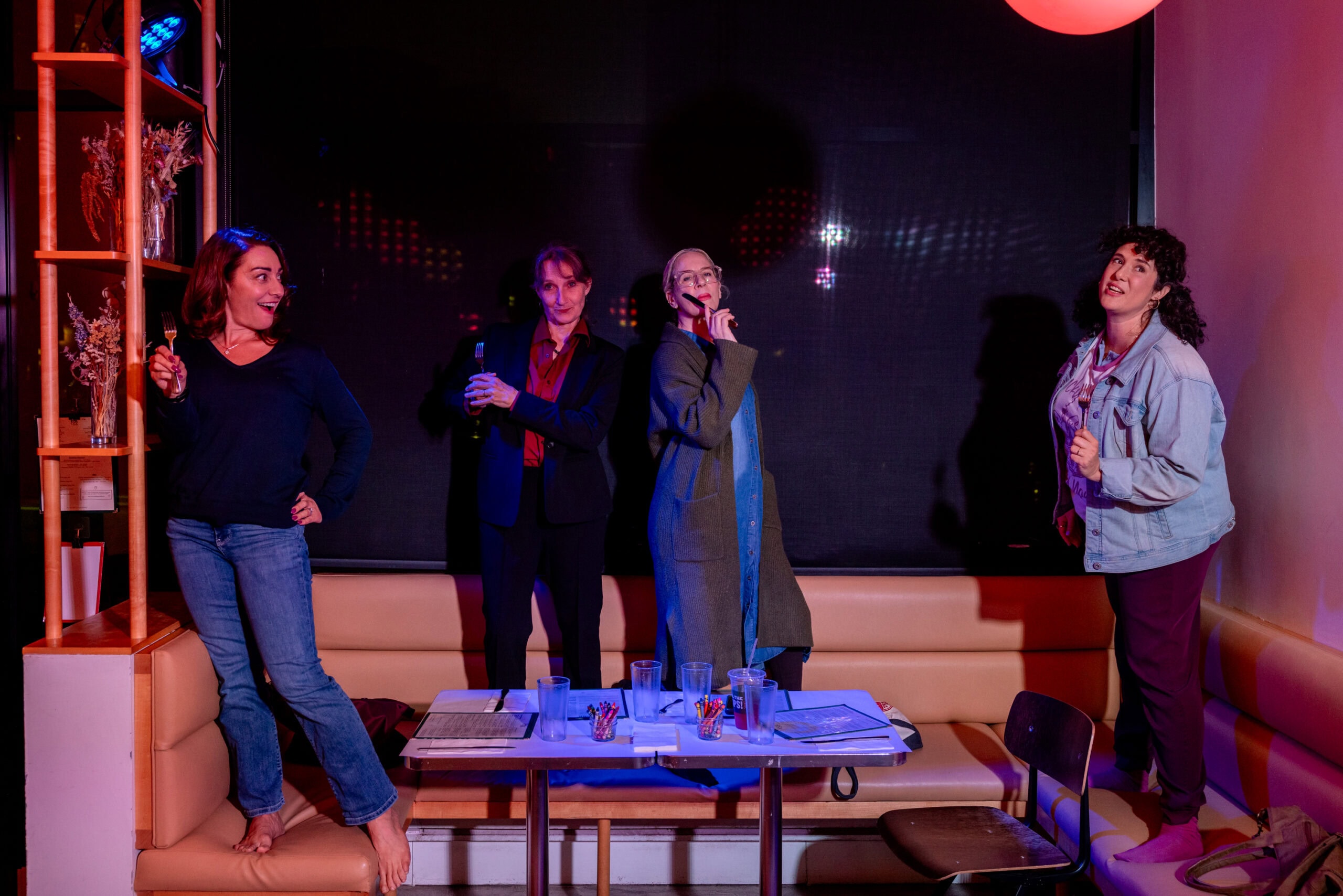
Jamie Ragusa, Dee Pelletier, Mara Stephens, and Maia Karo in Oh, Honey. Photo: Krystal Pagán
If one of your urban pleasures is eavesdropping on the lives of strangers at the next table in restaurants, Oh, Honey (first produced by Ugly Face Theatre in fall 2024) feels at first like a delicious indulgence–and then becomes something more ambiguous and unsettling. Set at a downmarket diner over a series of monthly lunches and staged in an intimate Brooklyn restaurant, Jeana Scotti’s tightly crafted, emotionally suspenseful play drops the audience right into a support group of women whose college-aged sons have been accused of sexual assault. “We meet because we’re not friends,” one of them says. And while one of them—the single, unemployed, and fragile Sarah (Mara Stephens)—craves greater intimacy and tries to cultivate genuine friendships, mostly the women circle one another warily, torn between their need for the catharsis of understanding ear and the competitive urge to rank their individual situations as slightly less bad than the others, either in the criminal courts or in the court of public opinion.
The women originally connect through an online group called FACE: Families Advocating for Campus Equality. Sarah, who seems to have no other support system and whose son doesn’t even seem particularly appreciative of her efforts to protect him, is the first to suggest a face-to-face meet-up with other local members: the polished and poised Bianca (Jamie Ragusa), with a giant diamond on her ring finger and enough money to hire a private investigator to discredit her son’s accuser, and Lu (Dee Pelletier), a terminally cynical private-school principal whose wife is actively choosing not to be involved in FACE’s efforts. Joining them for the first time is Vicki (Maia Karo), a divorced dental hygienist who’s a bit younger and a bit less guarded than the others. She’s the new moderator of FACE and seems to believe its “equality” message in a completely transparent way.
The diner’s Monday waitress, Mari (Carmen Berkeley), functions as a counterpoint to the moms: From inside their own circle, they don’t question their own certainty of being good parents and good people. And yet while they leap to Mari’s defense when they see her being harassed by a male customer, Sarah presumes an intimacy with Mari and Lu an authority over her, neither of which is earned. And all four of the mothers seem oblivious to the ways they behave toward Mari much as they mentally treat the young women who’ve accused their sons: with a casual instrumentality, as someone whose needs and wants are so much less relevant than their own.
If the play were nothing more than these sharp character portraits rife with class dynamics, an exercise putting the audience in the ethically compromised position of mothers whose love for their children curdles into villainizing sexual assault victims, it would be a nuanced exploration of some difficult ground. But it’s got three big additional theatrical strengths going for it as well.
First, the site-specific location of Little Egg, a neighborhood restaurant that serves only breakfast and lunch, is inspired. Yes, Little Egg is less shabby than the diner where the play is set, but its design is neutral and streamlined enough to carry it off. The audience members check in at the hostess stand, and are given programs in the form of menus. Seated at the restaurant’s actual tables, we are served mugs of tomato soup (soup is thematically important to the play, but it also sets the mood for the audience), and Mari takes further orders. The characters enter from the street, Sarah first (of course); she claims the booth and then sits facing the audience, playing with her phone and touching up her makeup. We become claustrophobically intimate with the turmoil churning inside these women. Between scenes, Mari clears the table to reset for next month’s lunch, dropping the dishes into a bus tub. When soup ends up spilled toward the end, we’re close enough to see the bits of noodle clinging to costumes. Most of the piece takes place in that anchor booth, but director Carsen Joenk makes clever use of the rest of the restaurant as well, with key scenes set on and around and behind the lunch counter and in the narrow space between tables.
Second, Scotti, Joenk, and their design team aren’t afraid to go weird. The spine of the play is thoroughly grounded in realism, from the real food served to the women to the character portraits sketched by Iliana Paris’s costumes (the oversized cardigan Sarah wears like armor; the cutesy slogan on Vicki’s T-shirt and her affection for colors not found in nature; Lu’s crisp tailoring and tightly pulled-back hair; Bianca’s luxe neutrals and expensive slip-on shoes). But when Oh, Honey punctures that envelope, it goes all the way to a surreal so stylized it evokes Severance, Real Housewives, and body horror all at once: glowing soup bowls; washes of saturated color in Attilio Rigiotti’s lighting; speaking in a fervent unison that’s part Greek chorus, part hive mind; flights of poetic fancy in the language; strange angles in the body postures.
And finally, the performances are stellar. Having the audience this close allows the cast to do live theater with the subtle reactions of film acting—Carmen Berkeley in particular delivers much of her character in the gap between her polite smile and the expression in her eyes—but none of them is afraid to pull out the stops when the moment demands it: Maia Karo going enraged Mama Bear when the group sees the male customer harassing Mari (a scathingly ironic display of solidarity given everything). The way Mara Stephens shrinks into the sleeves of her cardigan or collapses into tears that are 90 percent genuine and 10 percent performative. Jamie Ragusa’s exasperated disbelief at being ignored by the waitress. And Dee Pelletier, eyes lit up as she stuffs bread into her face in defiance of Lu’s gluten-free diet.
The last twenty minutes throw a lot of plot twists, one piling atop the other in a way that gets a little out of hand–or, perhaps, in a way that really does turn them into reality TV characters: After a conversation with Sarah, Mari posts an Instagram story that reveals how much attention she’s been paying to the women’s situation. Sarah and Bianca’s semi-friendship blows up in a knife fight (okay, a butter knife, but still) and they both end up wearing their soup. There are developments in the proceedings against several of the sons. We learn a secret of Bianca’s that dovetails perhaps too nicely with the play’s themes. And, in the grossest plot twist (one that might have pushed the envelope too far for me), Lu pays the price for her indulgence. And yet despite all that’s stirred up, they have a moment of communion at the end. They’ve exorcised their rage–at Mari, at one another–and are back to the thing that connects them: protecting their sons, who may be sexual predators, boorish assholes, recklessly stupid, or all of the above. We’ll never know.