
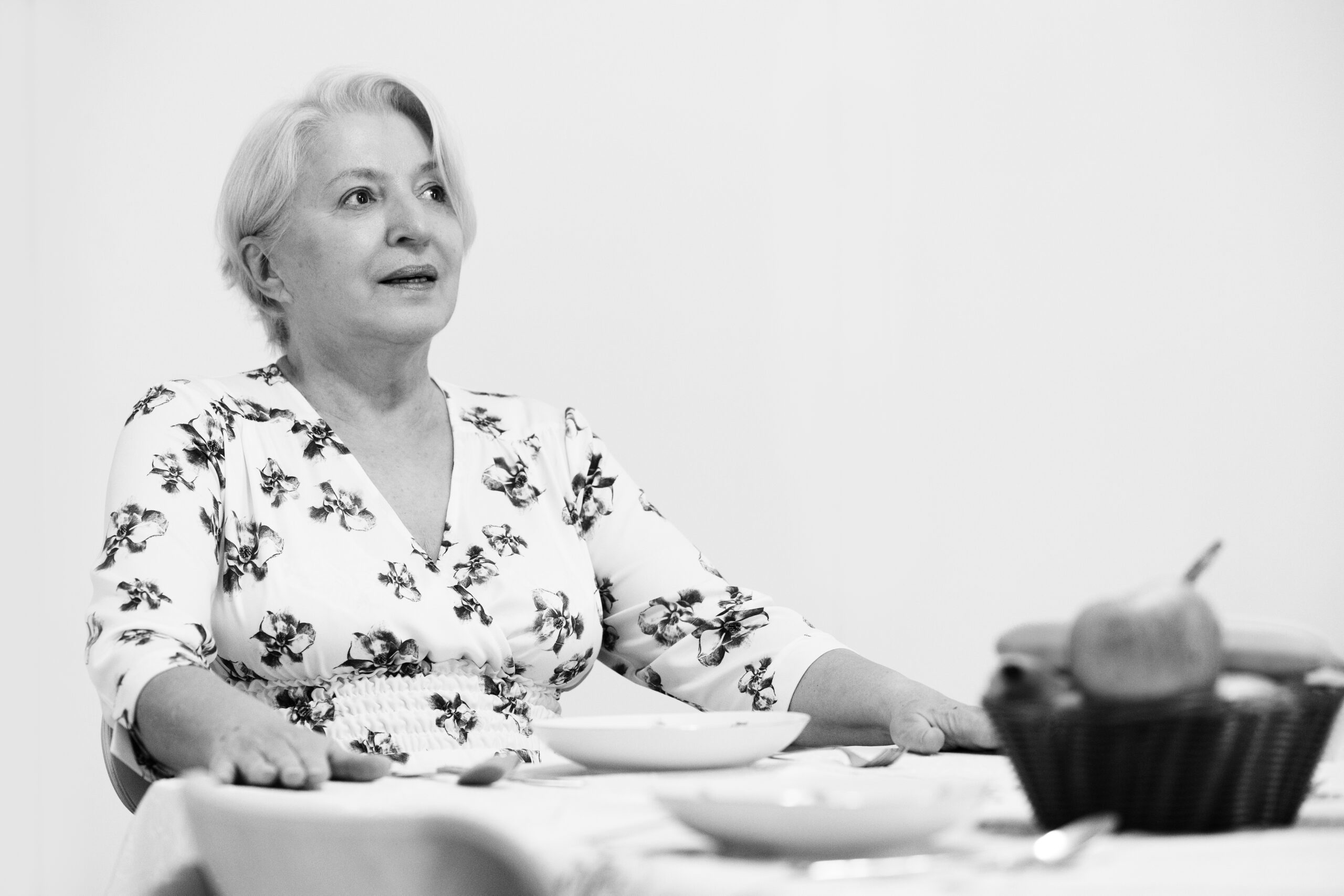
Mirjana Karanović in They Are All Gone. Photo: Patrik Lazić
At the beginning of They Are All Gone, presented at La Mama as part of the Balkan theater showcase From the Other Side, the message is that it’s about to be a lovely day. It’s Sadika’s birthday, her husband is setting up the barbecue, and she’s eagerly awaiting the arrival of her whole family—grown kids, grandchildren—to celebrate. But even in these early moments—even before we hear the word “Srebrenica”–something is off, something doesn’t line up with that surface. Part of this is due to a distancing effect intentionally created by the piece’s use of technology: the entire audience is given chunky wireless headphones, and we’re hearing all of the audio—sound design as well as the actors’ voices—only through the headsets. (The play is performed in Bosnian and Serbian with English supertitles, so we’re listening privately and intimately in one language and reading in another.)
We don’t know, at first, whether the thing that feels off is something inside Sadika (Mirjana Karanović) or something we don’t understand about her world, but there’s a sense of misalignment that builds. She keeps mentioning that she can’t feel anything—she’s bathing in water frigid enough to be painful to the hands of her husband, Azem (Svetozar Cvetković), but she keeps asking for it to be colder; she’s indifferent to shampoo in her eyes. She gets a visit from a care worker, the professionally cheerful Martin (Alban Ukaj), who seems to be Dutch and who doesn’t interact with Azem at all, instead probing Sadika gently about her isolation. She deliberately mixes a few spoonfuls of soil from a plant pot into the water with which she takes her pills. She tells Azem of a nightmare she had about their youngest son; she’s overly anxious about whether he’ll show up for the party.
And as the day and the preparations proceed, that air of disconnection continues to build, in parallel to the arrival of guests and Sadika’s anxiety about whether their youngest son is mad at her. Yet while Sadika is ostensibly welcoming her guests and accepting her gifts, none of these people appear on stage. We hear them only through the headphones. (It’s a remarkable piece of technical theater on the part of director Andrej Nosov and sound designers Nikola Erić and Luka Cvetko, in terms of both the mix between live and recorded audio and the remarkable work the actors, particularly Karanović, are doing, balancing the subtlety and micro-expressions of film acting in the audio with the more broadly accessible physicality of the stage.) For long stretches of the piece, it’s just Sadika alone onstage, celebrating with a family who is not there, who is present only in her memory.
As the title of Doruntina Basha’s play reminds us, they are all gone: the nation of Yugoslavia and the male members of Sadika’s family alike. The play is an act of memory and memorialization for the thirtieth anniversary of the genocide of the Bosnian Muslim population in Srebrenica, Bosnia. Previously performed in both Belgrade and Sarajevo to audiences for whom how to live with the memory and the survivors of such an event is a present and vivid concern, the show arrives in NY stripped of that context. It remains powerful, but the details may not be at all of our fingertips. So let’s lay it out here: “Following the town’s capture, all men of fighting age who fell into Bosnian Serb hands were massacred in a systematically organised series of summary executions.” Sadika had a husband and three sons. The inevitable conclusion is heartbreaking.
For a long stretch in the middle, They Are All Gone plays variations on a single note: the future Sadika has constructed in her mind from the crumbs of her past. But even as this note plays again and again, what it viscerally brings home is the way in which genocidal violence destroys a future as well as a past; never forget is one thing, but never live the life you might have had is another—the son who will never be a professional football player, the great-grandchild who will never be born. Karanović has the difficult job of gradually leading us to see the trauma that underlies Sadika’s fantasy: she’s not hallucinating out of psychosis or lost in dementia, she’s trying to find a way to go on in the world, thirty years after the worst has happened.
I am sure that to a Serbian or Bosnian audience, the truth of the situation is visible much earlier than it landed for me. But that slow eating away at one’s understanding of the piece was devastating in its own way: Watching Sadika open gifts, only to find each of them some talismanic object from her past (the objects are real), until finally revealing a blood-stained football jersey. Listening to the series of excuses different family members present for the delay and then absence of the youngest son. Seeing her receive a mysterious letter from Tuzle, the opening of which she keeps deferring, only to find a “medical report” focusing on Azem’s femur. (At a talkback after the performance I saw, one key audience question unlocked the meaning of that letter, a detail that I had not grasped.)
In that same talkback, director Andrej Nosov talks about the way the play depicts what it’s like to live in the legacy of genocide “in a very practical way”: the day-to-day texture of Sadika’s life as a survivor who winds up living alone in the Netherlands, isolated, numb. The way that each audience member listens to the piece in isolation, lit with the headphones’ chilly blue glow, adds to the effect.
Another detail I wouldn’t necessarily have grasped without hearing the artists talk about it, but one I can’t stop thinking about: The headphones act as a callback to the international tribunal at which the full horrors of Srebrenica were revealed and adjudicated, where headsets provided simultaneous audio translation among the multiple languages spoken by the participants. The International Criminal Tribunal for the former Yugoslavia first indicted Ratko Mladić thirty years ago, but the final sentencing was confirmed in 2021. As William Faulker famously said, “The past is never dead. It’s not even past.”