
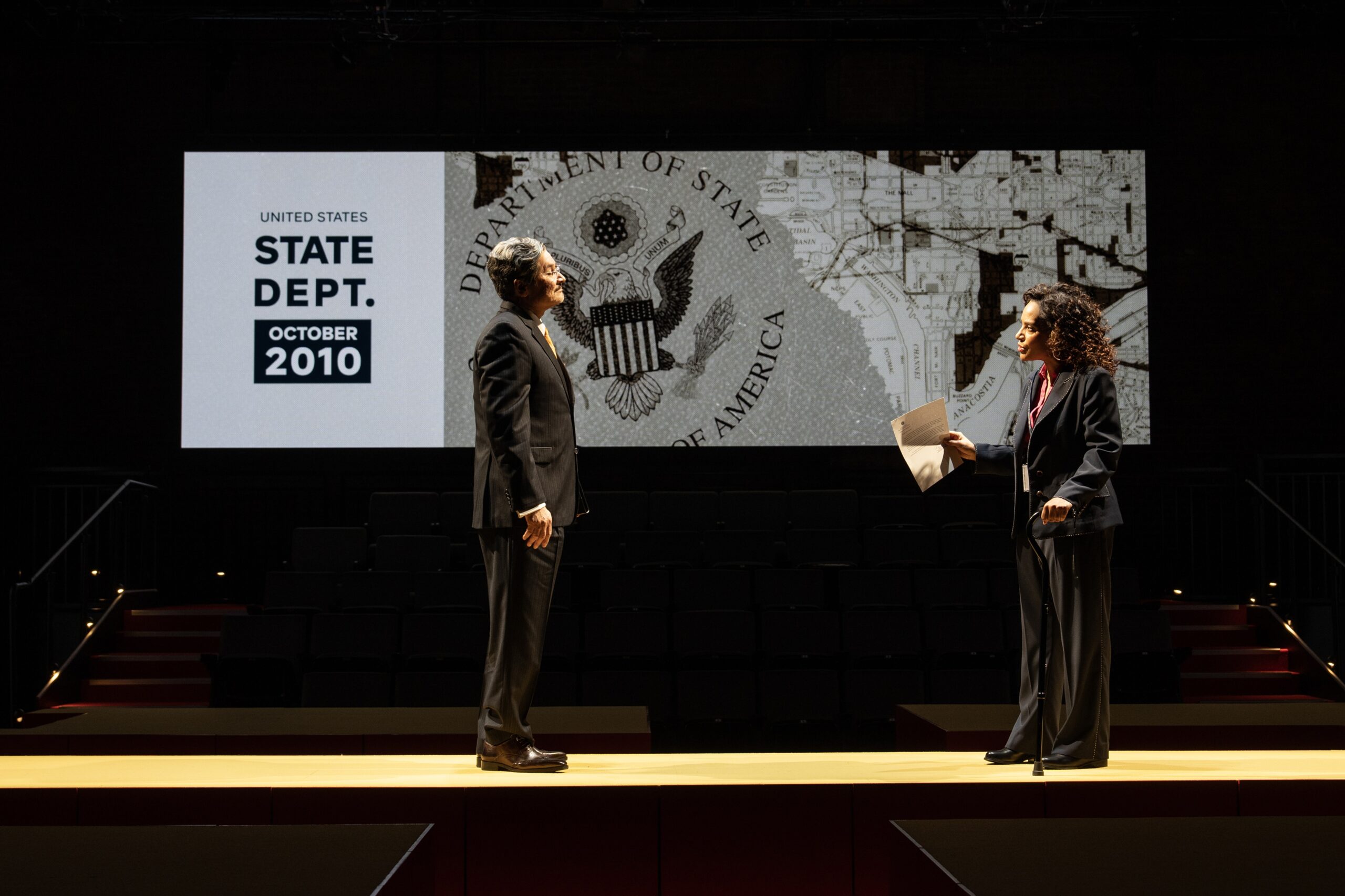
Al Rodrigo and Zabryna Guevara in Public Charge. Photo: Joan Marcus
Lights come up on the State Department’s Truman Cafeteria. Julissa, the Deputy Assistant Secretary for Caribbean Affairs, speaks in a hushed voice to Secretary of State Hillary Clinton’s chief of staff. The two have just successfully smuggled the wives of two imprisoned Cuban spies into the country and out again, armed with the vague hope that the Cuban government will release a US prisoner in exchange. Less than a dozen people know. When other bureaucrats enter, lunch and newspaper in hand, they slide as far down the table as possible.
Diplomacy does not, at first glance, seem like it would translate into the stuff of theater, but Public Charge, now playing at the Public, proves otherwise. Policy disagreements between political appointees of different administrations and the improbable demands of foreign governments are both fully absorbing, especially when they’ve been made so true to life. The play, co-written by former US ambassador/diplomat/real-life protagonist Julissa Reynoso and playwright Michael J. Chepiga, is an autobiographical account of Reynoso’s time in Hillary Clinton’s State Department and the Foreign Service. Under Doug Hughes’s direction, it runs more smoothly than the US government. Public Charge is a gripping look behind the scenes of diplomacy. It reveals that the machine doesn’t always work as automatically as you might think.
The runtime mostly focuses on Reynoso’s Obama-era attempts to reopen diplomatic relations with Cuba (especially as this related to negotiations to return American prisoner Alan Gross). It’s connected, however, to the 2010 earthquake in Haiti and whether or not the Uruguayan government will take in prisoners from Guantanamo Bay. These issues are messy, complex, and interconnected, with no clear correct solution. When Julissa meets with Cuban officials about Gross, our perception of a straightforward situation gets twisted. “We have a long list of grievances from your half century embargo that has caused billions of dollars in damage and the deaths of thousands of Cubans,” the negotiator (Armando Riesco) says. “And you lecture us about human rights violations.”
From its very first scenes, Reynoso and Chepiga present a clear tension between adhering to policy and working for the people. This, simple as it may first appear, guides the show into complicated waters. Julissa, played by a wonderfully likeable Zabryna Guevara, begins as a bright-eyed, bushy-tailed political appointee who doesn’t understand why we can’t talk to others person to person. “Fuck policy,” she cries at one point, frustrated by bureaucratic coldness. By the end, however, she’s become an ambassador of policy, worried about what precedent her actions will set. It would be easy to suggest that the “people” approach is unequivocally the right one, especially in an era that has forgotten what that looks like, but Reynoso and Chepiga rightly veer away from such simplicity.
The set design, on the other hand, uses simplicity to its advantage. The stripped-back layout by Arnulfo Maldonado features something similar to a traverse stage, where audience members sit on either side facing each other. Actors sit and walk on a series of raised platforms that translate the open space into places as diverse as Haiti, the home of the Uruguayan president, and the Bronx. International relations are often said to take place on the world stage, and here, Maldonado has imagined what that might look like.
Amid the diplomatic stress and maneuverings, Public Charge grounds itself in more human scenes set in the Bronx bodega Julissa grew up in. For these flashbacks, as well as the opening memory of her immigration to the United States, the fully grown Zabryna Guevara perplexingly pretends to be a child. We don’t fully delve into these situations or characters—Julissa’s Uncle Chino, for example, or the father unmentioned in the immigration scene—but, even though they’re clearly backstory, they serve a function. This tight script is Public Charge’s biggest strength. A very few awkward or politically simplistic lines are always harkened back to, and the intentionality makes us excuse any surface level skating the text may perform.
Alan Gross’s wife, Judy (Deirdre Madigan), reappears throughout Public Charge even after Julissa has moved on from Cuba. “You’ve given up,” she accuses as Julissa leaves for Uruguay. The United States is the most powerful country in the world. And yet they can’t bring Alan home?
This paradox is at the heart of Public Charge. On the one hand, well-meaning diplomats fight for what they believe in. On the other, they are bound by the complexity of their situation, hands tied by policy and stopped by precedent. When, in the play’s closing moments, Julissa’s colleague Richardo (a standout performance from Dan Domingues) mentions a new memo passed in her wake, it runs the risk of essentializing this central tension. “It’s about the need for contact and interaction at the basic person to person level,” he says. “And how everything else will follow.” People, it seems, have become policy.
It’s a tidy resolution, but Public Charge already had an honest ending. In one of Julissa’s last conversations with Judy, she tells her, confessionally, “I had no idea how hard it would be.” Neither, it turns out, did we.