
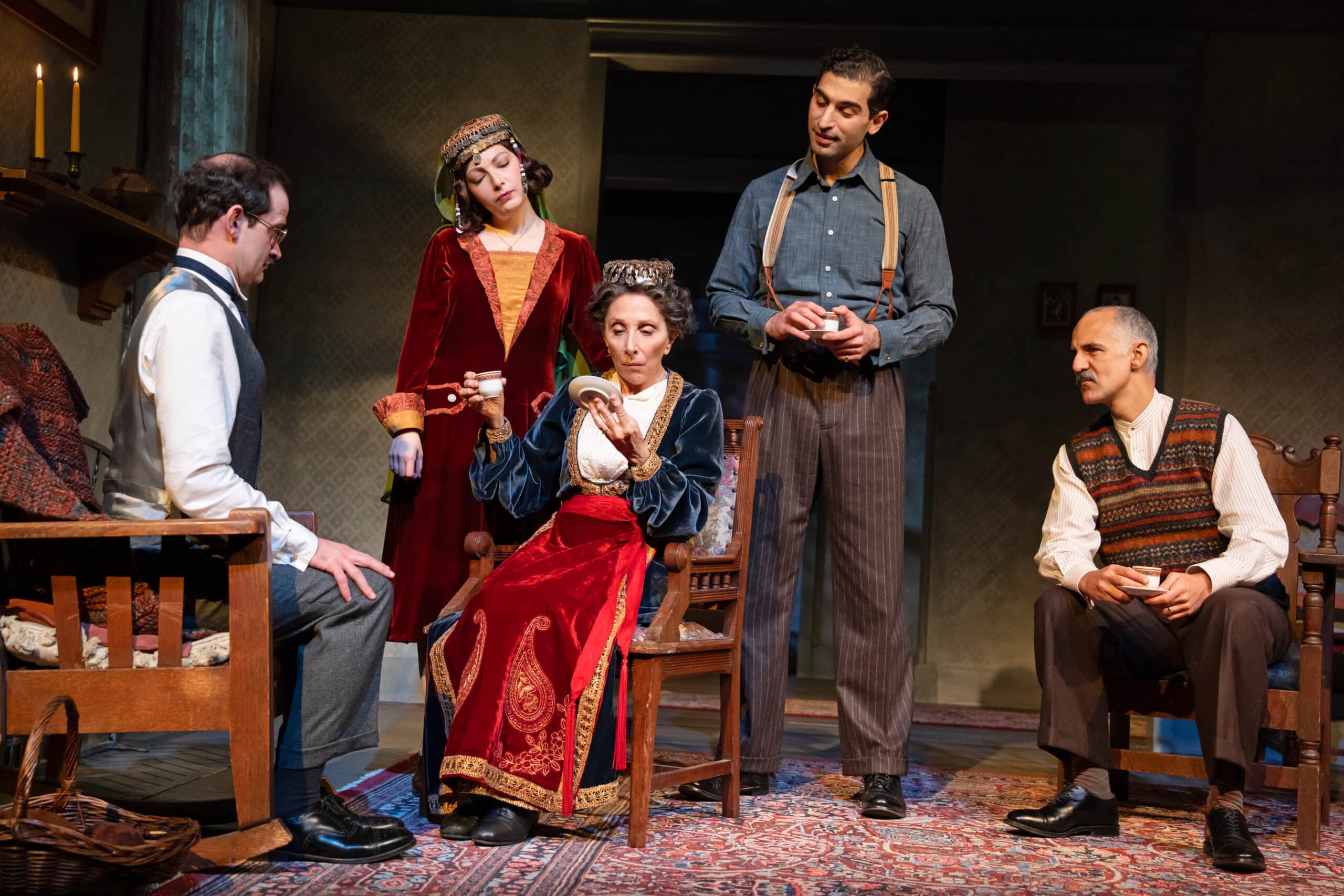
Will Brill, Tamara Sevunts, Andrea Martin, Raffi Barsoumian, and Nael Nacer in Meet the Cartozians. Photo: Julieta Cervantes
It’s funny to say there’s something charmingly retro about a play titled after a reality TV show, but there’s a solidity and a straightforwardness about Meet the Cartozians that does demand that description. There’s a density to the characters, a chewiness in the dialogue. It’s a play of political ideas and carefully limned positions, and while those ideas are nuanced, playwright Talene Monahon takes a straight route to explicating them. Each viewpoint gets a mouthpiece; each act gets us a group of insiders, members of the Armenian American community, trying to explain the complexities of their existence to a designated outsider, the interlocutor through whom their stories will filter out to the larger community. It’s a play that asks big questions about identity, personhood, and nationality, but grounds them thoroughly in character; a play that shows the subtle divisions inside an insular community but also sweeps across a hundred years, looking from two different centuries at what it means to be American, what it means to be white, and what it means to be accountable to a community with its roots in historical trauma.
In the first act, our designated outsider is the lawyer Wallace McCamant (Will Brill, almost unrecognizably buttoned-up and straight-laced if you last saw him in Stereophonic), hired to defend an Armenian immigrant whose citizenship has been revoked on the grounds that he is not a “white person of good character.” (His character is of course just fine, but he’s deemed not acceptably white.) United States v. Cartozian is a real case, argued in federal court in July 1924, following on the heels of two other cases that had determined that men of Japanese and Indian descent were not eligible. It was a decision with extremely high stakes for a community who’d fled a genocide and didn’t have anywhere else to go if not allowed to naturalize here. (This will not be the last time the play’s questions will raise the specter of current wars.) Rug importer Tatos Cartozian (Nael Nacer) has been chosen as the face of the lawsuit, not entirely willingly; this soft-spoken, pragmatic man just wants to run his successful business and become an American. Cartozian may be the mouthpiece, but two of the women in the family, Tatos’s mother, Markrid (Andrea Martin), and daughter, Hazel (Tamara Sevunts), hover anxiously at the edges of the room as McCamant preps with Tatos, seemingly, more invested in the proceedings than Tatos is. Meanwhile, Tatos’s son, Vahan (Raffi Barsoumian), blunders right in, bull-in-a-china-shopping his way through the edifice of decorous Christian propriety McCamant is trying to erect for the court. Boisterous in temperament, lacking in subtlety, and, not least, darker of skin than his family, he’s a threat to the whole enterprise. But then, so is Hazel, who wants to hold fast to certain Armenian traditions–like celebrating Christmas on January 6–even if they mark her family as “different,” Hazel who can’t imagine marrying outside the community.
A hundred years later, the Cartozian descendants have reached a level of success their ancestors could have only dreamed of: Meet the Cartozians is not a reality show that actually aired in 2024, but it wears its adjacency to Keeping Up with the Kardashians on its sleeve. Its never-named Kim Kardashian analogue wants to explore her Armenian heritage in a Very Special Christmas Episode, which, of course, TV being what is is, is filmed in July, at the home of Leslie Malconian (Susan Pourfar), an activist in a campaign to have “Armenian” as a subcategory of identity on the U.S. Census. She’s joined by other prominent members of the local Armenian community: Robert (Nacer), a city councilman in Glendale; Nardek (Barsoumian), a UCLA professor studying Armenian history and displacement; and Rose (Martin), a generation older, the president of the Armenian History Society of Glendale. Here, the outside witness is Alan (Brill), who’s running the set and trying to wrangle an increasingly restive group as the “star” has vanished into hair and makeup and never emerged. As Leslie’s lovingly prepared food dried out under the harsh lights, the four argue over Armenian American history and identity as Alan tries to contour television narrative out of their stories and opinions. The stakes feel substantially lower than they did in act 1–but the poles of argument are also much more complicated.
Monahon’s conceit is to link the two as bookends, or mirrors; in each half of the play, there’s a story the characters are constructing about their place in the world, their place in America, and their access to certain dimensions of success and privilege. In act 1, it’s simple: the success of the Cartozian family hinges on their being able to prove themselves white, and thus eligible for citizenship–but their Armenian identity is never in question. In act 2, it’s more ambiguous; all the characters slip around on the axes of Armenian, American, white, MENA, challenging one another’s perceptions of themselves. The Celebrity (Sevunts, barely seen), famous for being famous and for her self-tanning products, is rich and well-known enough that she owns whiteness by virtue of capitalism, enough so that she can dabble in exoticizing herself, dressing her guests in what almost feels like Armenian holiday drag (costumes by Enver Chakartash). “She’s the most famous Armenian woman in the world and she got that way by flipping between blackness and whiteness like it’s a reversible jacket and selling both sides to the highest bidder,” says Nardek.
For the others, their positionality feels provisional and ambiguous: On the one hand, Nardek was denied tenure because, in his words, they didn’t want to tenure another white man; on the other, he gets detained and questioned all the time at airports. On one hand, Rose blithely describes that the misunderstanding is that TSA thinks he’s Muslim but he’s Christian, so problem solved–in much the same way McCamant, a hundred years earlier, demands constant reassurance that the Cartozians aren’t “Mohamedan”–because Christian = white. On the other, Leslie is seething because she was denied participation in a POC poetry festival.
Meet the Cartozians is a dense text, thick with exposition and intricate political conversations that dig into thorny issues in a way that could easily become didactic. In the hands of director David Cromer, however, it’s impassioned but never self-serious; there’s always a lightness of touch, a sense of humor, and a sureness in character-building that means that we understand where people’s ideas come from even when they (particularly McCamant and Rose) offend others. McCamant is a staunch ally to the Cartozians and also filled with the biases of his time and place; Rose is a pillar of her community and yet tone-deaf to some of the issues the others raise.
The entire ensemble is excellent, particularly Andrea Martin and Will Brill. Martin’s Markrid is an archetype: the immigrant matriarch with her upright posture and her black dress and her insistence on feeding guests. But she’s also the anchor of the family; when she’s not sitting in her rocking chair while the men talk, she’s loitering in the hall eavesdropping, and you feel the way she acts with hidden authority. Brill, as the outsider and “straight man” in both parts, has a lot of expositing to do, but builds two distinct and instantly recognizable characters out of it: McCamant is congenial and efficient, unaware of his own blind spots but committed to the task at hand. Alan is practiced at smoothing ruffled feathers, making himself indispensable and invisible at the same time, coaxing unwise admissions out of strangers.
But as much as things change, certain continuities remain from 1924 to 2024. Even a hundred years aren’t enough to erase the scars of generational trauma. Celebrating a holiday on January 6 is once again problematic, for a whole different reason, in the wake of 2021’s assault on the Capitol. And it seems like the world is still struggling with the same lessons of how to take care of those so thoroughly displaced by genocide and war that they no longer have a home to return to. In the play’s final scene–tonally different enough that I wondered if it might take place in Robert’s imagination–Robert is the only one left on “set” when the Celebrity finally arrives. He is touched that she remembers him from an earlier meeting; he tells her of a trip he took to climb an Armenian mountain that’s now in Turkey (borders are as slippery as anything else, here). He looked from the mountain into Armenia, looking for something identifiable, something eternal. And then he flew “home”–to California. For all their questioning of their place in the world, Monahon’s twenty-first-century Armenian Americans have no home but this one.