
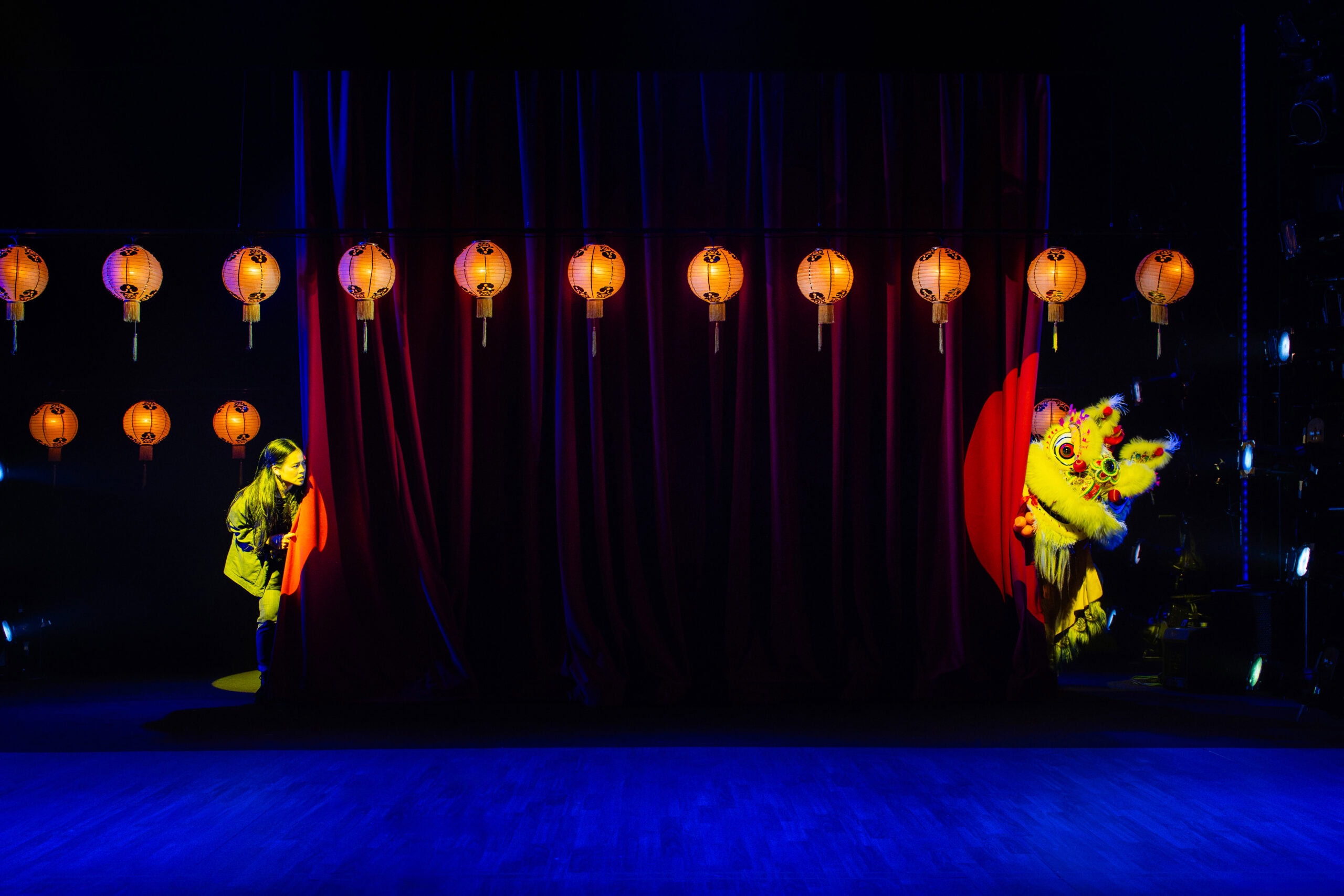
Kelly Marie Tran and Jon Norman Schneider in King of the Yees. Photo: HanJie Chow
In grad school, many years ago, I taught a seminar on realist theater and another one on history plays, but they were both really about the same thing: Not content, but historiographical approach. Not the onstage depiction of real life, but the type of artifice that we’ve decided to label as realistic. In other words: how we choose to deploy the tools of theater–a medium that, by virtue of us physically being in the room with it, is both always obviously fictional and literally real in the present–to tell stories that claim their own extra-theatrical truth, in either style or story. Lauren Yee’s King of the Yees, originally commissioned by Chicago’s Goodman Theater in 2014 and coming to New York for the first time at the end of her pandemic-interrupted Signature Theatre residency, turns that lens on her own personal history. King of the Yees is an act of love for Yee’s father, Larry Yee, and an embrace of the past and present legacies of her family name, but it’s also an interrogation into what it means to bear the weight, to shake off the burden, and to make art–both serious and playful–of inheritance both familial and cultural.
Lauren and Larry are the two main characters in King of the Yees–but the play gives us three of each. There’s the real-life Lauren Yee the playwright, who went on a journey ten-plus years ago to research the Yee Fung Toy family association, a nearly obsolescent society in San Francisco’s Chinatown in which her real-life father, Larry Yee, was an elder. In 2026, she’s in her early forties, a successful playwright finishing up a respected multi-year residency, and the mother of two children.
Then there’s Lauren Yee, the character of the playwright at age thirty (played by Kelly Marie Tran, whose facial expressions alone say everything we need to know about her frustrations with her dad), who has moved across the country from her family and is in town to celebrate her father’s sixtieth birthday. As she grows farther into her adulthood, she’s increasingly aware of a distance from her family of origin on axes geographical, cultural, and emotional: She never really learned Chinese. As a woman, she couldn’t take over the Yee Fung Toy even if she wanted to. She went east for college, and stayed there. She married a white Jewish man. Unbeknownst to her father, she’s thinking of moving even farther away, to Berlin, for her husband’s career. Known but not acknowledged by her father, she’s pretty ambivalent about having kids–who wouldn’t carry on the family name anyway, as she “finally got around to” changing her married name to Zwillinger.
While she’s in San Francisco, she’s also rehearsing, at the Yee Fung Toy headquarters, an autobiographical two-hander (“It’s a play. Plays have two actors.”) about her relationship with her father (the always delightful Francis Jue, bringing cheer so determined it’s hard to tell if it’s also naive).
The third “Lauren Yee” and “Larry Yee” are the characters in Lauren’s play, which we see in rehearsal when the curtain goes up, played by Maureen (Maureen Sebastian) and Dave (David Shih). But Maureen and Dave know more about the play’s “Lauren” and playwright character Lauren than Larry does: He hasn’t seen the script. He doesn’t know about Berlin. And when he shows up–somehow both late and uninvited–and thoroughly derails his daughter’s rehearsal, a series of events begins that force them apart, first in frustration, then in crisis.
First, Larry runs roughshod over the rehearsal with his plans for his birthday event: the erhu player and Lion Dance who are about to show up; the Sichuan face changer who’s parking the car. Then he takes over the overall play that we are watching, inviting questions from the audience–including Danny Ma (Jon Norman Schneider), the only Asian person in the theoretical audience (who turns out to be a sort-of cousin and gets invited to the birthday party) and a woman (Sebastian) who wants to know why Lauren’s play “isn’t confronting San Francisco’s gentrification problems head on.” Then, he sees a news broadcast about the arrest of local politician Leland Yee, for whom Larry has been the most devoted volunteer: Lauren says Leland is using Larry; Larry says being used makes him feel useful. (The real-life Leland Yee, it seems, officiated at Lauren Yee’s wedding, and he was indeed arrested in 2014.) Then Larry disappears, and Lauren must go on a fantastical voyage to rescue him, but what is she rescuing from? From his own misguided allegiances? From her ambivalence about her heritage? From Raymond “Shrimp Boy” Chow, a Chinatown gangster?
The journey that ensues takes us to yet another level, as Lauren must acquire a series of objects before sunset to complete the ritual that will restore her father. She does this traveling through a witty theatrical fantasia that’s part Chinatown stereotype, part fabulosity, part lesson about how her father is woven into his community. Yee the playwright is having a great deal of fun setting up those stereotypes–not only about Chinatown and Chinese American culture, but about Asian American actors and about “serious” theater–only to undercut and complicate them one by one while simultaneously finding something meaningful in the web of underlying relationships. Meanwhile, the actors in Lauren’s workshop, left to their own devices, mull over questions of their own identities and their places in an artistic ecosystem.
Sebastian, Shih, and Schneider form a capacious and versatile ensemble–while actors Maureen and Dave and quasi-cousin Danny remain part of the throughline of the action, the three also dash on and offstage, and into the audience, in the roles of Chinatown elders, practitioners of Chinese medicine, Lion Dances, gangsters, ancestors, and beleaguered immigrant shopkeepers. (Michelle J. Li’s costumes do excellent work in amping up the humor in all of these portrayals.) The staging in act 1 feels static, but we realize the intentional contrast in act 2, when director Joshua Kahan Brody can let loose with a slo-mo gangster kidnapping sequence, a full-on dance montage, the mystical face-changer, and some slapstick acupuncture. (Having said that, I’m not sure Krit Robinson’s set fully fits the bill. While the shallowness of the act 1 space allows the audience interaction to happen in a way that feels organic, the deeper playing space in act 2 leaves individual scenes stranded and atomized. The set pieces get more elaborate, but Li’s costumes often do more to convey the physical world than the set does.)
As exuberantly and delightfully silly as the whole thing gets, though, it’s always teasing out the connection between memory, history, anecdote, and art: If you say something enough times that it’s engraved in others’ memories, doesn’t that make it true? If you embellish all the details and turn it into a story, does the play become more real than what the Yees actually lived? (I can’t say for sure, but I’m betting real life had—mild spoiler alert—fewer thunderclaps when the name “Shrimp Boy” is uttered, Chorus Line numbers performed by Lion Dances, and model ancestors showing off great gams.) If Lauren’s ideas about her family’s, and Chinatown’s, past were wrong all along, then is the play magnifying those mistakes by writing them down? And as real-life Lauren moves farther away in time from the thirty-year-old self who wrote the play, is she reifying a persona for herself that no longer exists?
All of this could easily get dizzying or ponderous, but thanks to the crispness in Yee’s writing, the clarity in Brody’s direction of the ensemble, and the wry double/triple consciousness in all of the performances that it never veers in either direction for longer than a line or two. And yes, King of the Yees does dip toward the sentimental at the end. But it’s so clever, so metatheatrical, and so affectionate throughout that I hardly minded. What better way to honor your complicated family–even as fictional Lauren prepares to move farther away from them–than to write them such a warm and witty tribute? When we get to the end of the play, Yee writes, and Lauren says: “We are…at the end of our play. A play that I thought would be about the past…I was wrong. That’s not what I was writing.” In 2026, the play is now about Yee’s past, but–like all good history plays–is still engaged with vital questions for the present.