
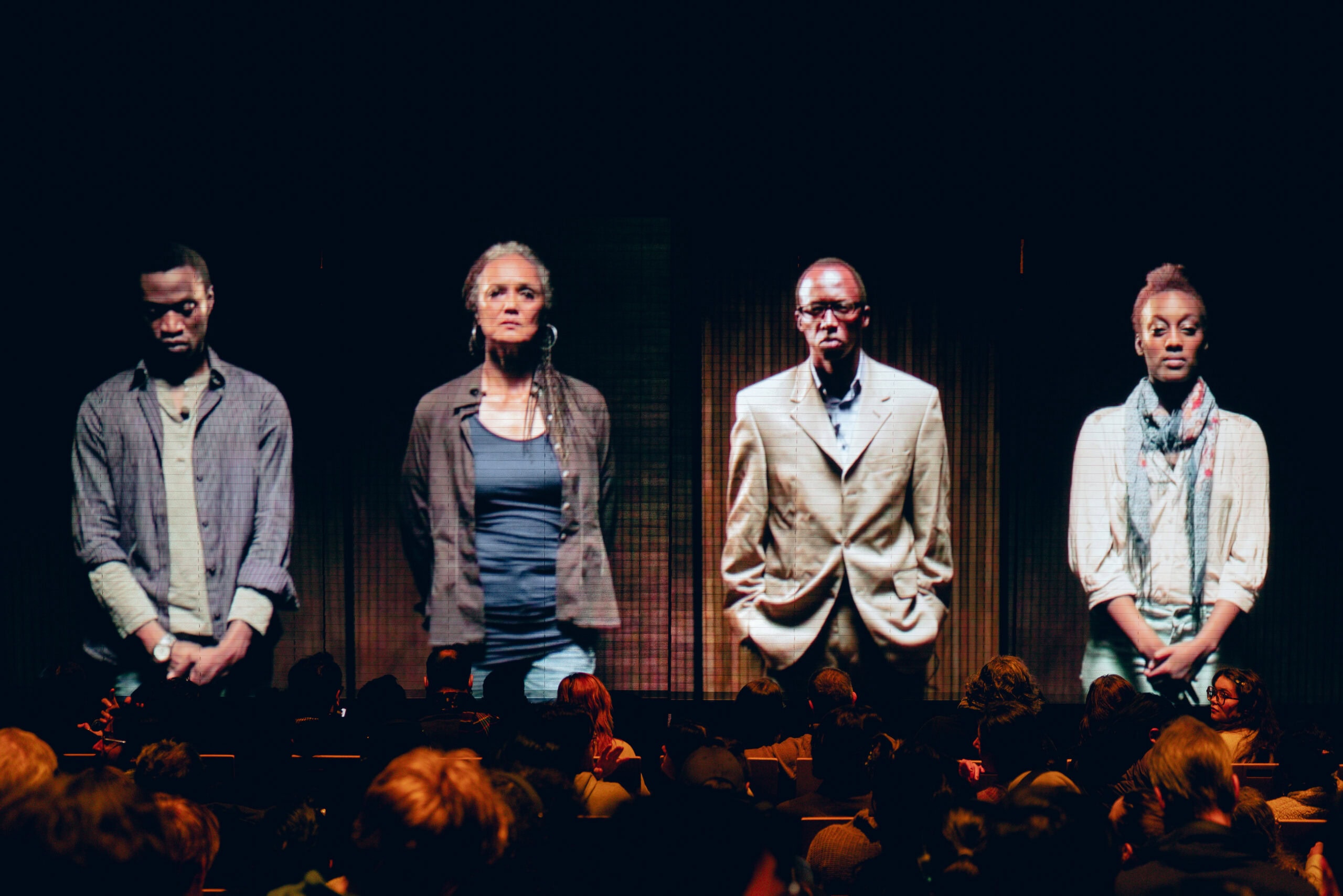
Afazali Dewaele, Estelle Marion, Diogène Ntarindwa, and Nancy Nkusi in Hate Radio. Photo: Amir Hamja
No matter how much you want to, you won’t leave Hate Radio (created by Swiss-German theater auteur/activist Milo Rau in 2011 and having its U.S. premiere in 2026 after playing in 20+ other countries) understanding why the Rwandan genocide happened the way it did; even the victims whose testimonies are presented here still don’t. You’ll perhaps understand a little more viscerally how it happened, although Hate Radio re-presents the effect more than the cause: its main action is set at one evening program of the Kigali radio station Radio-Télévision Libres des Milles-Collines in July 1994, just before the 100 days of genocide against Rwanda’s Tutsi, Twa, and politically moderate Hutus ended.
The piece is bookended by videotaped (fictional/allegorical) testimonies from survivors and journalistic witnesses (Afazali Dewaele, Estelle Marion, and Nancy Nkusi) shown at larger than life size and no less harrowing for the dispassionate, carefully considered tones in which they are presented. Its lengthy central section takes place in the studio of RTLM (the set is by Anton Lukas). The testimonies and introductory supertitles also give us crucial framing exposition: The time period of the genocide (100 days beginning on April 6, 1994, when the plane of the Rwandan president was shot down over Kigali), and the recently signed Arusha Peace Accord ending the Rwandan civil war that had begun a few years earlier. The names of some of the main figures at RTLM, and a little background on one of them in particular. The impact of RTLM before the genocide, and its role as the purveyor of all that was cool in music and culture. The scope of the violence perpetrated upon the survivors and victims, and the way RTLM participated not only in instigating massacres and the attitudes that permitted them, but specifically locating Tutsi “cockroaches” in order to send murderous militias after them.
So when the projection surfaces (window blinds) roll up to reveal a glassed-in booth, it’s almost shocking how ordinary it all looks. There’s a DJ (Eric Ngangare) on one side and a table of three talk-show hosts (Sébastien Foucault, Diogène Ntariwinda, and Bwanga Pilipili) on the other, flanked by a security guard (Sylvain Souklaye). The audience listens in on headsets that match the ones worn by the staff; rather than listening over the air, we’re on the mic with the participants. Only the songs are played via loudspeaker; the music is actually muted rather than amplified by the headsets. (The sound design, mission-critical to the experience, is by Jens Baudisch.) The mics are always live, and the whole thing is presented for public consumption; there may be the occasional facial expression that’s a private communication between the participants, but most of this is their public face. We don’t know what they’re thinking, only what they’re doing.
There are three hosts, all of them real people who were later tried for their participation in the genocide: Valérie Bemeriki, Kantano Habimana, and Georges Ruggiu. Habimana and Bemeriki were the two most prominent presenters, together comprising about 50 percent of the station’s airtime; Ruggiu, Belgian by birth, was the “token white” brought on to appeal to the educated French-speaking population (Bemeriki and Habimana both broadcast in a mixture of French and Kinyarwanda–the show is presented with supertitles–and Ruggiu only in French).
For almost two hours, we see the hosts giving news bulletins, bantering and joking–and frequently, casually, cheerfully reminding their listeners of their duty to exterminate cockroaches. It’s squirm inducing, mesmerizing in its shamelessness, maddening in the self righteousness of the speakers, and creepy when it behaves like regular radio. We know, from the framing device, that the “cockroaches” are their human enemies, instantly dehumanized by this term. Even more than the famed banality of evil, Hate Radio represents evil as jocular, witty, even gleeful. These aren’t frenzied speeches designed to whip up hate; they’re communiques in perfectly ordinary tones: the measured cadence as Ruggiu (Foucault) reads the news; the chipper schoolteacher vibe as Bemeriki (Pilipili) gives out quiz questions; the “shock jock” request by Habimana (Ntariwinda, who in his youth fought with the forces that overthrew the genocidal regime) to “bring us large quantities of grass so we can provide better resistance.” Perhaps the most dissonant and shocking is DJ Joseph, popping in to play contemporary pop songs by Nirvana and Reel to Real, as the talk show hosts dance along. The familiarity and immediacy of the music is very intentional, as Rau says in an interview with The New York Times, this was the “first genocide that happened with the music I listened to.”
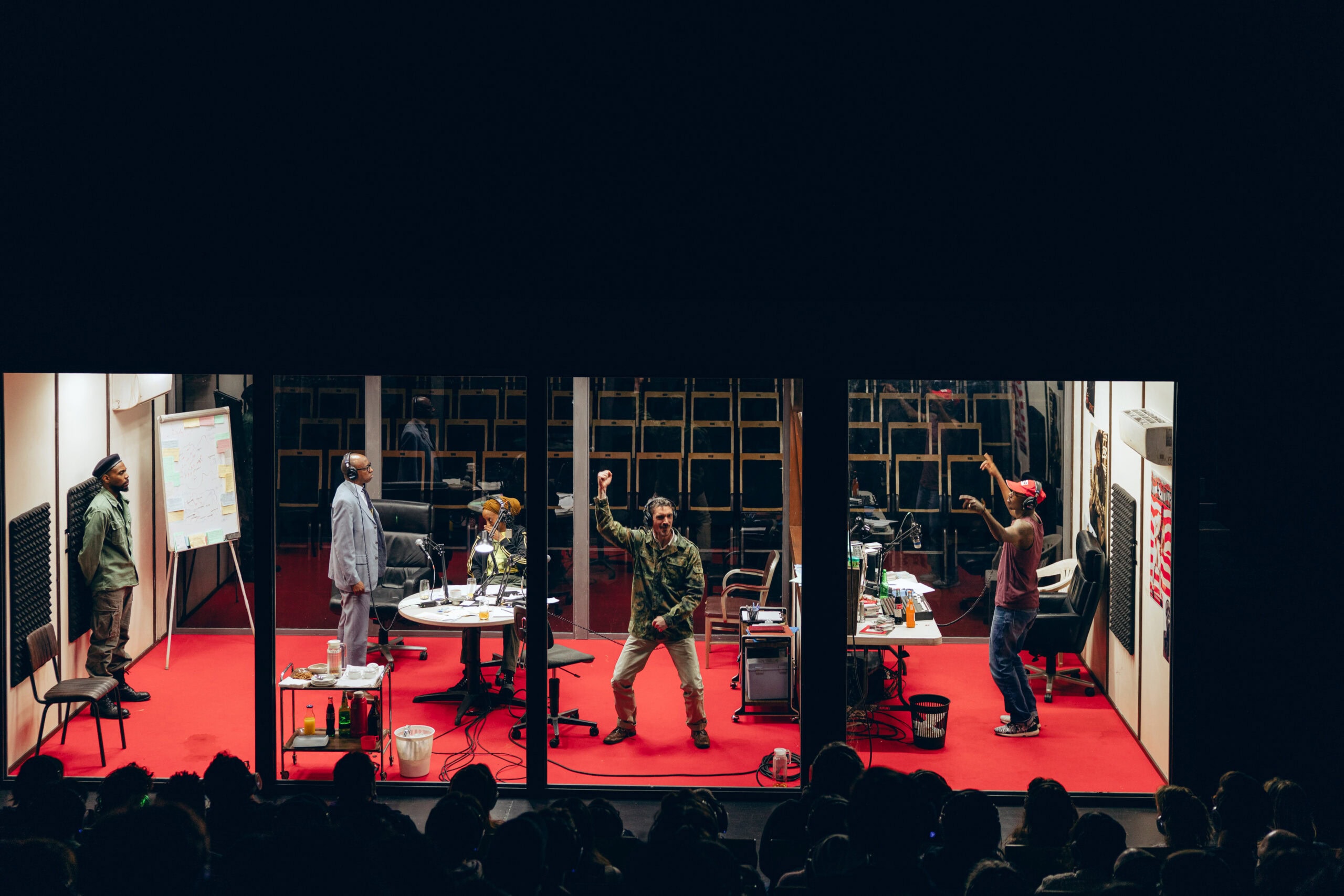
Sylvain Souklaye, Diogène Ntarindwa, Sébastien Foucault, Bwanga Pilipili, and Eric Ngangare in Hate Radio at St. Ann’s Warehouse. Photo: Amir Hamja
“Rape Me,” in particular, becomes all at once a horribly ironic counterpoint to the survivor testimonies, which feature brutal rape; a reflection of the unique place RTLM held at the interface of Rwandan and world popular culture; and a key to the aesthetic choices Rau has made in creating the piece. In a program statement, he acknowledges that Hate Radio is not documentary theater in the verbatim sense. It’s a “reconstruction of this station in today’s world,” an attempt to capture atmosphere and effect. It’s flashier than the thing it seems to replicate: “The true presenters at RTLM, perhaps with the exception of Kantano Habimana, were very serious journalists, professional and focused. To our sensibilities today, they were pedantic, stuffy employees of the genocide.”
The piece cleverly negotiates a dynamic of immediacy and distance. The headsets align us with the broadcasters, but also isolate us from the other audience members. We’re denied even the small comfort of hearing the audience’s shared reactions. And yet within that intimacy, we’re still being held at a distance from the presenters, too, as we take in the audio in one language and read the surtitles in another. (While much of the show is in French, portions are in Kinyarwanda, a language spoken primarily in Rwanda and Uganda, so presumably most presentations of the show outside of Rwanda itself–and perhaps even there; we know Ruggiu, for example, did not speak Kinyarwanda–will be partially if not entirely surtitled.) As we learn from the journalist’s opening frame, this dynamic of immediacy and distance was part of how RTLM gained its effectiveness: Rwandans were used to hearing the radio as a voice of authority, and now they were being invited to participate in the conversation by calling in. They were used to a staid, prudish public demeanor, and now they were getting irreverence and crude jokes.
Hate Radio’s lesson in the mechanism of propaganda is as relevant as ever. The algorithmic YouTube radicalization loop may operate on a different mechanism than what we see here, but the principle is the same: grab your audience with entertainment value, make their existing biases and opinions seem cool and mainstream, and then amp them up. But when we reach the frame narrative at the other end, there’s still an opacity at the heart of the question of how people, even in the midst of a civil war, were so easily persuaded to take machetes to their neighbors–let alone of how people became so eager to persuade their neighbors to do so. “None of this could be made up for,” says an exile who returns to Rwanda only in 1998. “If there was one genocide, then there will be many more,” says one of the survivors. And perhaps the most terrifying thing of all is that now, it’s not only “people” doing the persuading, but TikTok.