
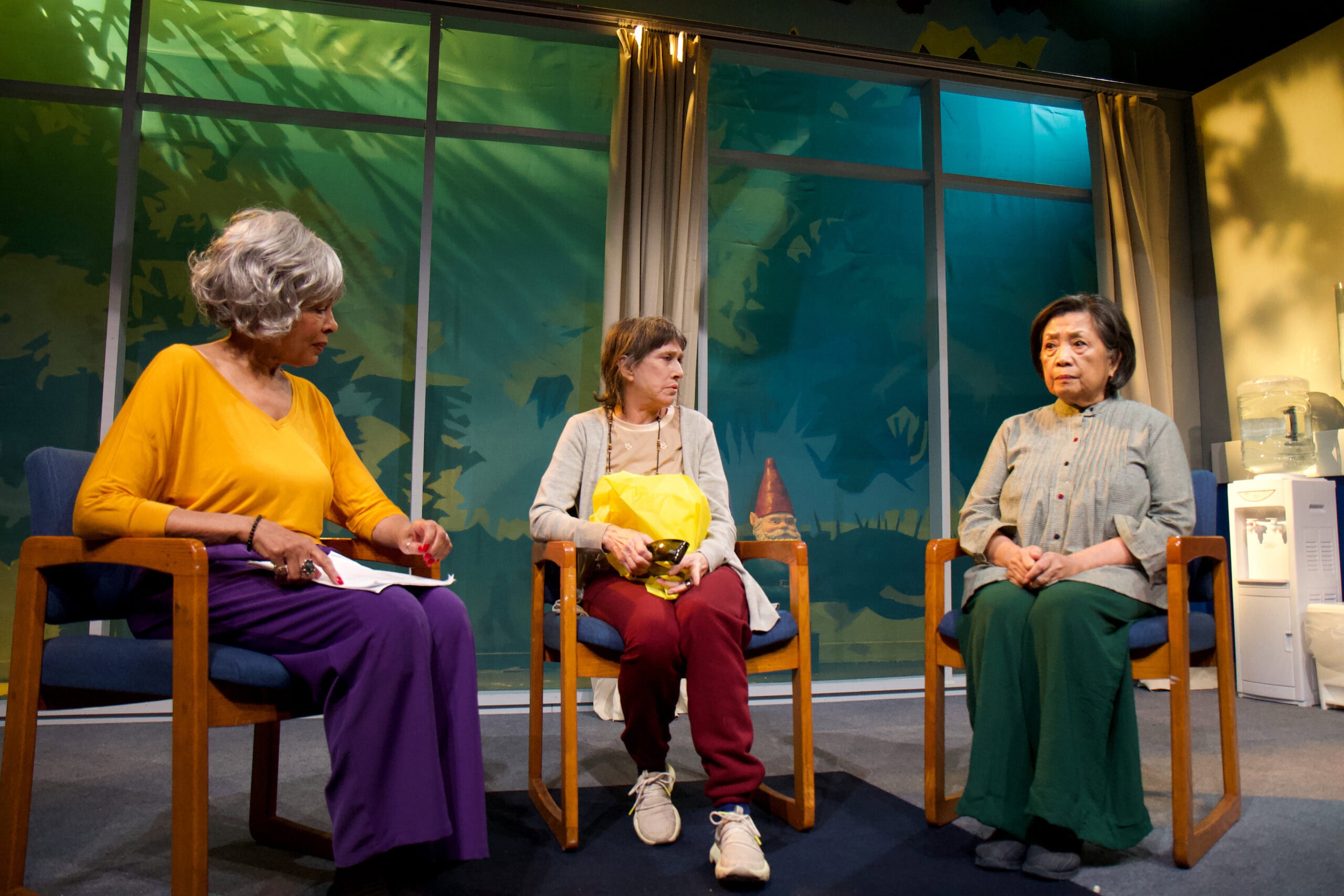
Petronia Paley, Jan Leslie Harding, and Mia Katigbak in Everything Is Here. Photo: Mari Eimas-Dietrich
Peggy Stafford’s Everything Is Here is one of those pieces of theater where I can’t quite put my finger on how it works; it’s intricate and simple at once, and the more I try to describe down its components to write this review, the less it sounds like those pieces come together to produce a whole. But director Meghan Finn and her company of actors have complete command of the tricky tone–suspended like a soap bubble at the intersection of wistful, wry, bleak, and tender–so it mostly does work. Its dramaturgical style flickers in and out of realism, with elliptical movement sequences and direct-address monologues and Tennessee Williams’s A Streetcar Named Desire and an oddly scaled lawn gnome poking at counterintuitive angles out of its basically emotionally realist envelope. But beneath its stylistic flourishes, the play ticks through a journey from one loss to the next–a friend, a dream, a beloved possession, a tree–balanced by just enough moments of respite and grace to stop us from losing hope entirely.
“There was some discussion about the title of this play,” says a program note from Finn. “I like the idea of you making what you make of it. For me it’s become a little secret I whisper to myself.” To me, it feels like a paradox, simultaneously grandiose and insular. “Everything Is Here”: like a description of a luxury resort, and therefore you have everything you could ever want; why would you ever want to leave? “Everything Is Here”: like a remote and isolated outpost; there’s nowhere else to go even if you do want to. And yet, in different ways and for different reasons, two of the characters will leave “here” by the end of Stafford’s script, which even in a brisk eighty minutes still gives those characters chances to root and unfold–and to display achingly lonely hearts.
“Here” is the activity room of a senior residence that, in Richard Hoover’s soothingly colored set, is exquisitely precise in its neutrality. The abstract landscape paintings on the wall mirror the abstract painted shapes we see of the grounds outside the big windows. The three armchairs are supportive but not plush. There are amenities–a fishtank and a piano and a water cooler–but there’s also announcements over the PA warning the residents to alert the front desk if they intend to go outside and a nurse who comes around to check vital signs and dispense medication on the regular. The main detail that protrudes is that lawn gnome, overly large and slightly menacing, staring in the picture windows at us. (Shane Rettig’s sound design, full of noises that sound like they come from a marina–ocean and creaking boats–is also puzzlingly discordant.)
The play cues us in to its thematic of loss right at the beginning: we open in the dark, as Grant (Pete Simpson) runs a theater activity for three older women, who lie in corpse pose as he takes them through an imaginative exercise of walking down a path in the woods and suddenly realizing that “Something is gone that should be there…somethng…essential.” For Bev (Jan Leslie Harding), Janice (Mia Katigbak), and Bonnie (Petronia Paley), their world has narrowed to this institution–and Bev is about to lose even that. Bonnie and Janice are widowed or divorced, and though Bonnie mentions a daughter, she only does so once. Bev seems even more alone in the world, and her “essential” loss in that exercise is all her money. She will soon have to move for financial reasons. (In a piece with a lot of bleak undertones and a death, Bev’s descriptions of the room she’ll be renting instead, whose best feature is a dresser that might be mahogany, may be the saddest thing Stafford writes.) The women’s favorite medical assistant, Nikki (Suzannah Millonzi), and Grant do have outside lives, but those, too, seem full of disappointments: Nikki lost her mom when she was a very young child; Grant, at nearly fifty, is back living with his mother and watching his dream of becoming an actor dwindle away before his eyes, his life shrinking and contracting in a different way than those of the older women.
His last stab at that dream is auditioning to play Mitch in a community theater production of Streetcar–and if any one detail conveys how deluded that dream is, it’s his insistence that the title of the play is The Streetcar Named Desire, even when Janice tries to correct him. As he leads the group, particularly Bonnie, to run lines with him and act out scenes, I was struck by how Stafford’s use of Williams highlights Streetcar, too, as a play about devastating loneliness and the terror of aging and losing one’s place in the world.
And yet, glimmers of hope poke out: a fledging relationship between Nikki and Grant; an act of generosity from Janice to Bev; Bev’s determination to face her fate with cheer–and, finally, with simple acceptance.
The writing and the construction have a fragility that means the play requires actors grounded to their core to anchor it, and Finn does wonderful work with a rock-solid ensemble. Jan-Leslie Harding’s Bev is querulous and seems flighty, but always in perfect touch with the reality of her circumstances. Mia Katigbak is often cast as the stoic truth-teller, but here she also allows Janice to express more vulnerability and even (occasionally) tenderness as she soldiers through, the play’s constant. Petronia Paley uses beautiful diction to give Bonnie’s every utterance a nostalgia for a lost elegance; you see immediately why Grant casts her as his Blanche. Pete Simpson’s Grant covers his painful awareness of his own failures–his unsuccessful theater career, his uncontrolled anger issues–with effusive gentlemanliness. Simpson is as ever fascinatingly complex to watch; the clarity with which he contrasts undertone and surface is striking–though it sometimes feels like Stafford’s having so much fun writing Grant that he takes up more airtime than he needs to (as does Streetcar, which, no matter how thematically relevant, feels disproportionately central to a rather short play). The contrast is especially evident with Nikki, whose inner life I wanted to see more of. To counteract the imbalance, Finn has smartly given Nikki the most vivid of Lisa Fagan’s movement sequences, near the end, which gives Suzannah Millonzi the chance to display a freedom we don’t see elsewhere from Nikki.
All the bonds in this play feel tenuous and fragile, none more so than the tentative relationship between Nikki and Grant; it’s the bodies of Janice and Bev and Bonnie that are teetering along, but for Nikki and Grant, it’s their hearts (though ironically, it’s Grant who breaks an ankle before the end). “It’s all about balance,” says Janice. “Staying upright.” Sometimes hobbling along is the best we can all do–which is both terribly sad and oddly comforting. And Everything Is Here is indeed both.