
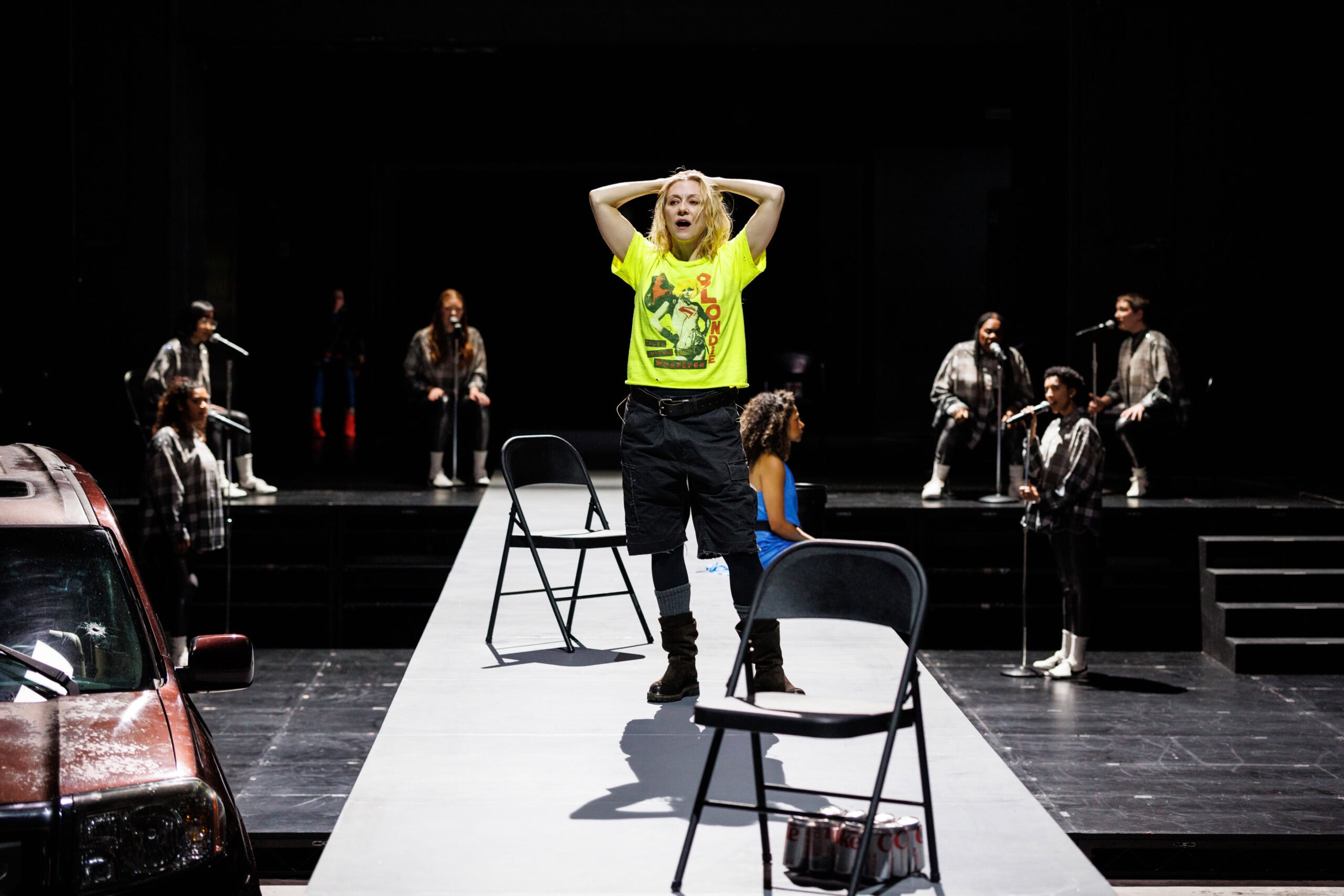
Tina Benko in Elektra. Photo: Maria Baranova
There’s an uncompromising starkness and stasis to Daniel Fish’s production of Sophokles’s Elektra, translated by newly minted Nobel Prize winner Anne Carson—as there is to Elektra’s moral universe: Harsh white lights (by Scott Zielinski) give the air of a particularly inhospitable warehouse. The set (by Jim Findlay, Josh Higgason, and Amy C. Rubin) is a simple elevated catwalk, on and alongside which Elektra (Tina Benko) paces in rangy loops; the rest of the cast never goes farther offstage than an alcove all the way at the back of the long space. The ensemble delivers Carson’s sharp-edged, propulsive verse with an unadorned clarity. For years, Elektra has honed her grief and whetted her anger, waiting for her brother, Orestes, to return and join her in avenging their father’s murder. Everything else in her character, her home, her community has been whittled away; she is fixed monomaniacally on this singular goal, this single emotional state.
Benko, standing straight as a spear, wants to make herself a weapon of righteous fury. Her father was murdered by her mother, Clytemnestra (Sally Wingert), and Clytemnestra’s lover Aegisthus (Michael Rudko). (She spits every time Aegisthus’s name is spoken.) Her sister Iphigenia was sacrificed to the gods by her father. (One does understand where Freud’s Electra complex came from, seeing the family dynamic here.) Her surviving sister, Chrysothemis (Rebecca Naomi Jones) is trapped in a different way, resigned to ensuring her own safety by keeping her head down and being sensible. “Our father, I know, forgives us for this.” She warns Elektra that if she doesn’t tone down her very public grief and calls for vengeance, their mother will have her locked in an underground room. “There are times when justice is too big a risk,” she says. This also enrages Elektra. Orestes (Cricket Brown), who’s been away for years, is supposed to return to instigate their revenge, but instead a messenger brings word of his death. That death frees Clytemnestra from fear; her son will not murder her.
Without Orestes, Elektra feels even more powerless. She says, “Alone, the whole poised force of my life is nothing against this.” She cannot act to relieve her emotion; she cannot leave the brutal family dynamic. Benko makes her anguish real, but you can also see in the glazed weariness of the other performances how exhausting it must have been to live with this for years. Wingert’s Clytemnestra has been pushed all the way to contempt. Jones’s Chrysothemis can barely look Elektra in the eye. Brown’s Orestes–after he reveals that the news of his death was a fiction–speaks to her in dispassionate, measured tones (perhaps too measured for the bloody deeds he describes); he’s less concerned about the message delivered by his actions than about practical details.
Even the chorus–”women of noble instinct who come to console” Elektra–makes no headway. The six-person vocal ensemble, singing their lines to music by Ted Hearne, tries to moderate Elektra’s stance. (Many of Chrysothemis’s lines are also sung, with harsher, more discordant melodies–if you have Rebecca Naomi Jones in your cast, it would be a shame not to have her sing.) “I speak from concern–as a mother would,” they say. “Do not breed violence out of violence.” Dressed like ghosts of a country music group, in muted plaid with a hint of sparkle (costumes by Doey Lüthi), the chorus are ostensibly Elektra’s friends and confidants, and yet she listens to their guidance about as much as you would a song on the radio.
Everyone is telling Elektra she’s wrong: Chrysothemis thinks she’s impractical; Clytemnestra that in valorizing her father, she’s too willing to forgive the death of her sister; even Orestes worries that her inability to control her emotions will give them away. She will not bend. She will take her quest to its bitter end, even when the stage becomes literally awash in blood.
The combination of Elektra’s certainty, her pain, and her impotence feels strikingly current: She keeps battering against the same psychological and structural obstacles, unable to do anything about the horrors that have passed in her family and her world, unable to take constructive action to change things. And yet Fish can’t trust the play’s dynamics to speak to the present moment by themselves. Instead, he punctures the classical envelope in various ways, yoking the Greeks to our current moment in unnecessarily literal ways. A car to the right of the catwalk, in which Elektra sits for part of the play, is a replica of Renee Good’s SUV–a connection I would not have made without a program note, especially because from where I was sitting, you couldn’t see the bullet hole in the windshield. Clytemnestra delivers text from a New Yorker article about last month’s botched execution of Christa Pike. The chorus sings Beyoncé’s “Daddy Lessons,” about a girl whose gun-toting father “made me fight, it wasn’t always right.”
We don’t need those extra lessons, really, especially when I’m not even sure what the message is meant to be for each. Does Christa Good represent justified vengeance, or the ultimate moral corruption of vengeance? Is Renee Good meant to be a stand-in for Iphigenia, an almost incidental casualty in the pursuit of someone else’s unjust war? Or are we meant to understand Elektra’s impotent, unassuageable grief through these two figures? These interventions feel like pure provocation: poking up through the surface of the play to snag our attention, but ultimately distracting from the whole.
Fish says in an interview, “So much of the conversations in the play are polarized conversations. Conversations where people say, over 30 lines, or 50 lines, ‘My worldview is right, my point of view is right, and I’m incapable or unwilling of listening to yours.’” But we in the audience can see the points of view: can see that Chrysothemis is choosing her own survival and sanity over abstract justice; that Clytemnestra acted at least partly out of her own grief and rage at the loss of a daughter; can see how Elektra could have let the chorus push her in a different direction. It’s all in Carson’s words, and in the performances; it’s all in the haunting music of the chorus. We didn’t need the explicit reminders.