
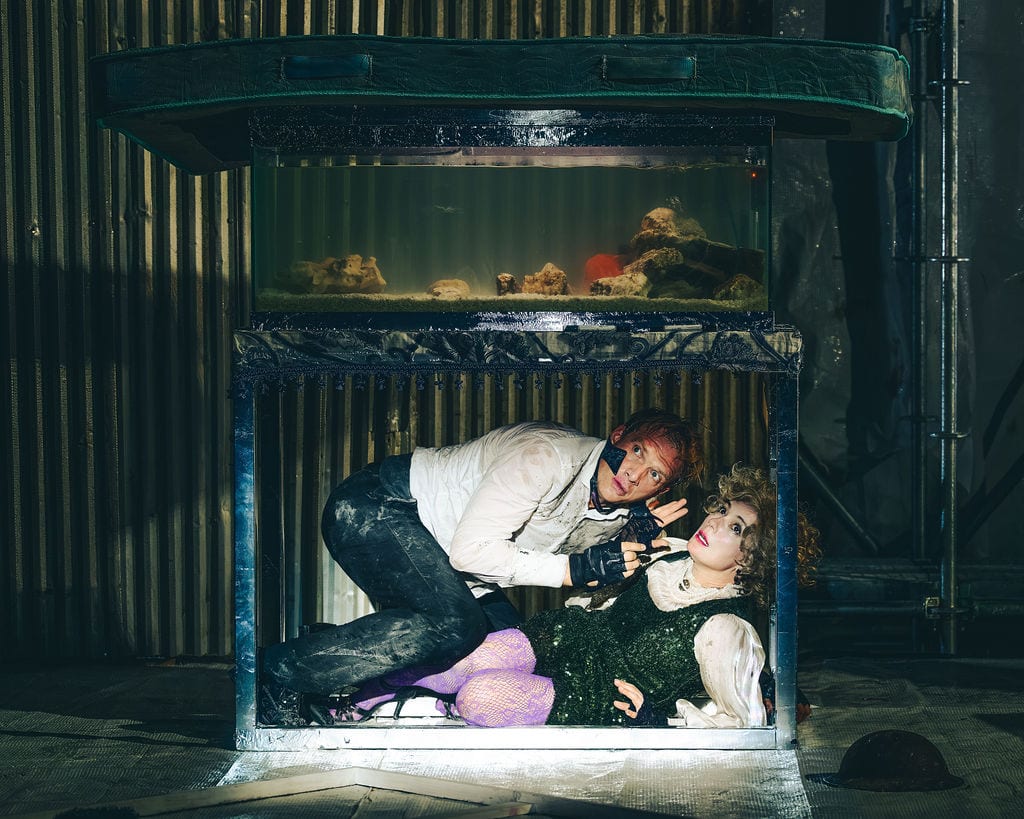
Andrey Burkovskiy and Chulpan Khamatova in Delirium. Photo: Austin Ruffer
If you want to understand absurdist theater, you can’t do much better than Delirium, a new translation/adaptation of Ionesco’s Frenzy for Two, or More by the Ukrainian emigre director Igor Golyak. Absurdism is always slippery to stage: push too far in the direction of zaniness and any social message gets buried; lean too hard on the existentialist or political themes, and you get something ponderous and moody. Golyak and his gifted collaborators sail right down the middle, bringing us something that is two parts slapstick to one part tragedy, seasoned with just enough whimsy and terror to bleed tension off in a laugh with one hand while creating genuine suspense with the other.
The scenario is simple: A bickering couple rehashes familiar arguments as they hide in their apartment in a war zone. She regrets leaving her husband for her lover (seventeen years later); he regrets leaving his wife (they were already divorced). He’s hot; she’s cold. The soldiers entering their apartment building are going to the floor above, or is it the floor below? And, above all, they argue about whether a snail and a turtle are different animals (He) or the same (She). There’s a little Godot in their squabbles, too: should they flee or should they stay? Outside, there are explosions from all directions; inside, there are armed men knocking down doors and dragging away residents. They have no idea whether they are safe–or even how to live anymore when it seems that they are.
Admittedly, it doesn’t sound all that funny–except for the snails and turtles–but Delirium is blessed with two extraordinary performances from Andrey Burkovskiy and Chulpan Khamatova, brilliantly directed by Golyak. Both are exceptional physical comedians, who can constantly surprise with a prop or a splash of water (there’s a fishtank onstage, so plenty of opportunities for water). Burkovskiy is rakish and rangy, with a rubbery Three-Stooges quality and a constant look of mild surprise. Khamatova—a huge star in Russia, exiled by her opposition to the current war—is a compact ball of fierce, fizzing energy, a Lucille Ball type whose facial expressions always go one step farther than you’d think possible.
But both also connect with the fear embedded in the piece. The comedy is fueled by nervous energy. Every time an explosion goes off in the distance, you see the physical and psychological toll. And you fully recognize the way that their squabbles emerge from unbearable tension only in the moments where that tension lifts, and an almost painful, giddy lightness comes to them. In those moments, you can see why they threw away their old lives for each other. In most moments, she clings to her glamour–a wig, pearls, lipstick–in a way that’s both insouciant and feral. He bolsters himself with his “mania for objectivity.” They cling to each other and then push each other away; they make each other laugh and then spur each other to childlike bouts of “up” “down” “up” “down.”
In all its production elements, Delirium is precision-engineered at the highest level. Igor Golyak’s direction makes ingenious, constantly surprising use of the Irondale space, and the actors pop up in the aisles, in the balcony; they climb up the scaffolding that forms most of the set. (Sitting house right, I did miss some of a section that takes place in the house left aisle, but also I am very short.) Most of the action takes place in a single room, centered on that fishtank, whose burbling forms a soothing backdrop to Denis Zabikaya’s spiky, immersive sound design. But the set, by Jan Pappelbaum and Celia Xuetong Feng, is primed to deconstruct. At every explosion, distant or close, a piece of structure springs loose and showers them with dust: corrugated metal panels on the upstage wall, trap doors overhead. It shifts from lightly suspenseful to a kind of sick waiting for the next shoe to drop, culminating in an image of almost unwatchable horror.
Jeff Adelberg’s lighting defines the playing space and shifts the mood, from the starkness of searchlights to the glimmer of distant explosions to the whimsy of a disco ball or a trip into the imagination. Sasha Ageeva’s costumes–a suit graying with dust, a purple flower in the lapel, and a dented military helmet for him; a sequined dress, leopard coat, and purple lace tights for her–have an aura of silent film, a touch of the old world about them.
And above all, Denis Zabikaya drops us into their world, both the war zone and the domestic fantasias they indulge in, through his sound design (with the help of Anna Drubich’s music), which mixes practical effects with recordings (and even the occasional bit of audience participation) so that each sound comes from a defined location. The sonic environment has a realism that lets the surreal and absurd qualities of the piece flare brighter against its backdrop.
The bravura silliness of the slapstick makes the rapid shifts in and out of tragedy all the more poignant and shocking. This couple doesn’t know how to live “normally” anymore, because there is no normal in their world, only catastrophe and brief respites from catastrophe. And so they spark and fight and make up and cower, drawn together by fear as much as by love; pushing each other away from stress as much as from enmity. Like the turtle and the snail over which they argue, they huddle in their tiny home for safety, never quick enough to escape, never sure of what they’d do if they could. There is a certain comfort–even if it’s comfort tinged with hysteria–in the familiar, even if it’s terrible. What more absurdist insight could there be?