
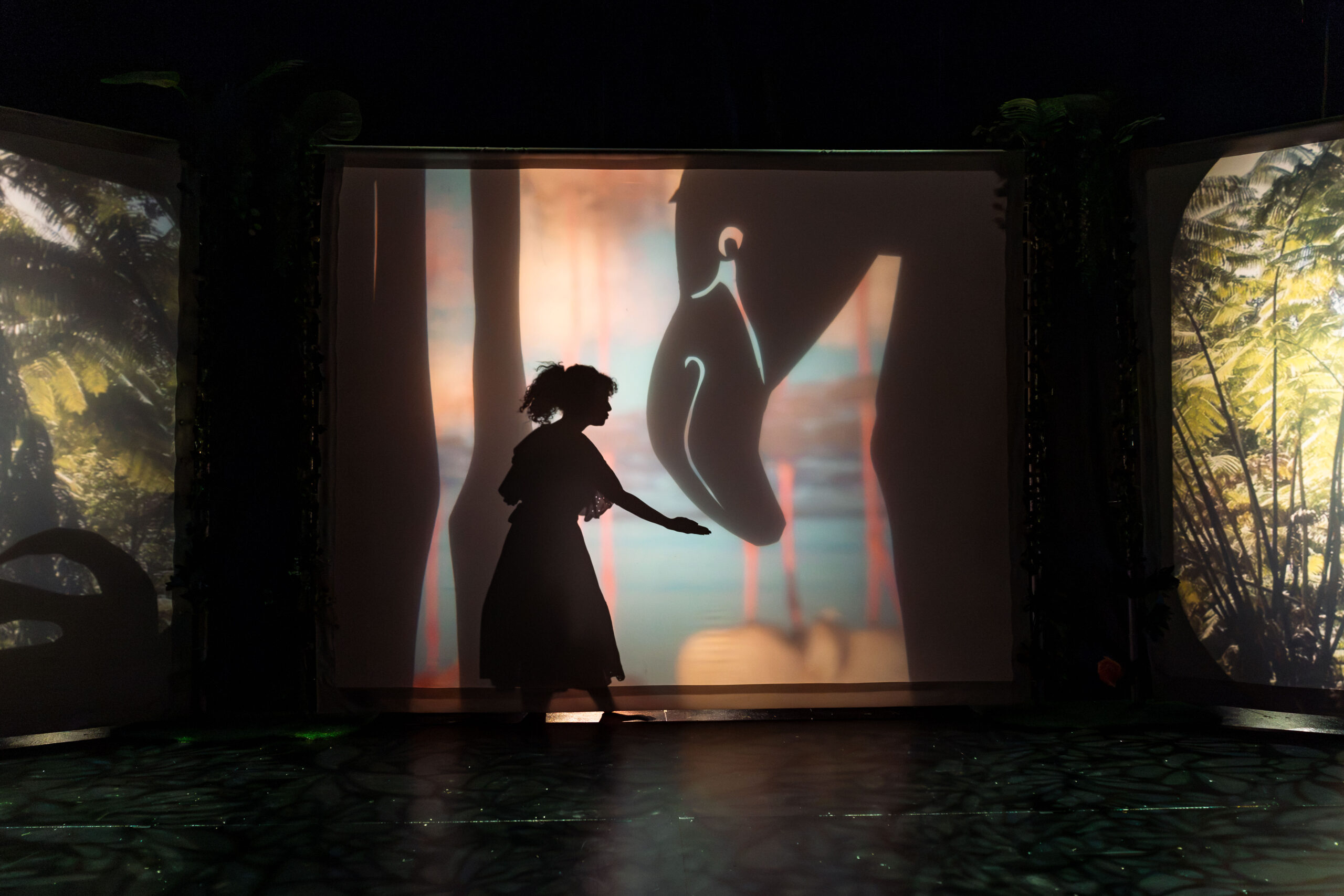
The puppet and shadow work of Isla. Photo: Rebecca Michelson
Isla–a “bilingual shadow puppetry play with music”–is an act of love and of remembrance, Samantha Blain announces in its introduction. Blain’s mother and two aunts left Cuba together in 1969 on a small boat to forge new lives in America, and now she and her fellow co-artistic directors at the company Hit the Lights! have together created this piece, based on her family’s stories. Blain performs (as one of her aunts) and co-composed the music with Claron Hayden, who also scores the piece as a live accompanist; Casey Scott Leach designed the puppets; and Mikayla Stanley co-directs (with Roman Sanchez). Visually, Isla is creative and engaging, with a handmade charm that echoes the scrappy resourcefulness the sisters would have needed to sustain their life. But narratively, the piece’s collective act of creation leaves it feeling rudderless and generic; lacking a book writer or lyricist, it also winds up lacking a viewpoint–a vision to bring clarity and specificity to its storytelling, character development, and even songwriting.
We feel the mutual affection among the three sisters, but we never get a sense of the reality of their lives, in Cuba or in the United States. Blain plays us recordings of the real women’s voices, but they’re snippets and snapshots–I wanted the staged piece to build on those foundations, but it feels more like what we see onstage is the background texture, and that foreground never comes into focus. Those recordings give us names—Carmen (Daniela Delahuerta), Alina (Tiffany Iris), and Lulu (Blain)—birth order, and some descriptive adjectives, but the sisters as they are performed onstage never become more than an undifferentiated tríad. We don’t get a concrete sense of story or their individual identities. They venerate their mother; they play together; they escape together. The music by Blain and Hayden, too, remains stubbornly generic–a lilting tune, a few lines of lyric or even just vocalized syllables as a refrain. The lyrics have the simplicity of children’s songs–but what appeals about children’s songs is how broadly applicable they are.
It’s a shame that the book elements are weak, because there’s a plethora of beauty, charm, and excitement in the visual environment, which combines full-screen projected backdrops with shadow puppets and silhouettes of the live actors to show both landscape and cityscape, crowds of people and a whole menagerie of animals. Puppet designer Leach and puppeteers Erica Knight and Jessie March do remarkable work with shadow puppets of both human figures and animals, making them seem almost animated through their movements. And when the actors in silhouette interact with the shadow puppets, against the projected landscapes, it’s magical. Leach also creates a coterie of three-dimensional animal puppets: chickens, dragonflies, rodents that the script calls solenodons (they look like small capybaras or alarmingly large rats).
Yet as adorable as the chickens and solenodons are, what feels like a third of the running time is devoted to Lulu chasing them around the stage and across the projected landscapes. It’s inventive and fun to watch, but veers into a different piece of theater than the one that narrates through the recordings the tyranny of communist Cuba and the sisters’ escape from the island. Isla has strong components–its magical visual environment and the true lives that inspired it–but they haven’t quite fused into a compelling theatrical whole.