
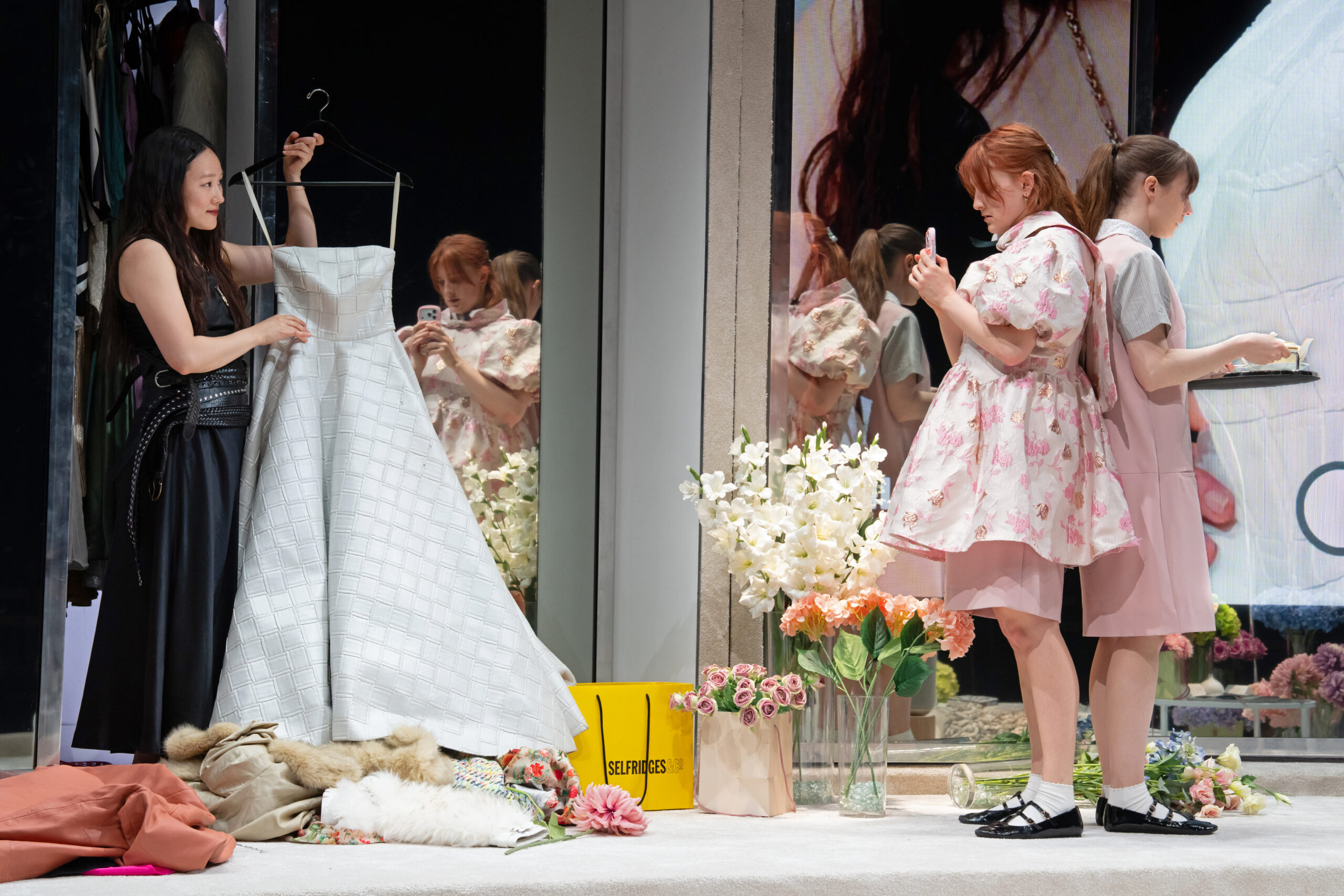
Yerin Ha, Phia Saban, and Lydia Wilson in The Maids. Photo: Julieta Cervantes
Jean Genet–ingenious at blurring the line between reality and fantasy, of the difference between the appearance of power and its wielding–would have had a Lot of Thoughts about the Kardashians, about social media and influencer culture writ large. A provocateur who wielded the tools of theater to create dizzying funhouse mirrors questioning and complicating our notions of identity and power, he built characters, one could argue with tongue only slightly in cheek, whose negotiations with self-presentation presaged the Instagram filter by 60 years. (Why yes, I wrote an undergraduate thesis partly on his work, why do you ask?) So the pairing of his 1947 play The Maids—a tight one-act loosely inspired by a real 1933 murder case, about domestic power and class rage—with digital provocateur Kip Willams (creator of last season’s solo Dorian Gray) makes intuitive sense.
Yes, Williams is drawing from the same bag of technical tricks used for Dorian—the teasing filters that satirize and glamorize the human form at once; the privileging of public image over private self; the use of the digital realm to create an echo chamber that flattens any sense of morality and agency—but here, instead of a camera crew creating the hall of mirrors, the actors turn the lens on themselves. And where all of that technology added a feverish, cloying edge when juxtaposed with the language of Oscar Wilde, it settles more comfortably under the skin of Genet’s women. The addictive appeal of building and believing a fantasy to prop up the unsatisfying aspects of your reality; the inability to disentangle the parasocial from the real; the way a public image becomes an aspiration in itself, so that being seen is more meaningful than action; the way female-coded soft-power battles play out in the domestic sphere—it’s all in the original. Williams has layered the text in a thick coat of zeitgeisty references and slang—the whole thing would probably need a rewrite to restage it as little as three years from now—but he’s changed remarkably little from Genet, not just in terms of structure but in small narrative beats.
Claire (Lydia Wilson) and Solange (Phia Saban) are sisters, who work as maids for the fabulously rich and famous-for-being-famous Madame (Yerin Ha). They spend their days filling Madame’s dressing room with flowers, tending to her wardrobe and her wigs (displayed by Rosanna Vize’s set in two giant mirrored closets whose height dwarfs the actors), tabulating her social media stats, and serving as her companion when no one better is around. Madame alternates between treating them like faceless functionaries whom she can’t reliably differentiate and like pets who get dressed up in her spare gowns to accompany her to events as if they were extra accessories. They adore her, they admire her, they envy her, and they loathe her in equal measure, and they relish any small scrap of power they can wrest back from their subservience to her narcissistic whims–but also any small way they can manipulate the situation to get more time by her side. Which is why Claire made an anonymous tip to the police about the fraudulent activities of Madame’s lover, who has subsequently been arrested, with concomitant hits to Madame’s reputation: her followers, her sponsors, her Vogue cover. Two birds, one stone.
But when Madame is absent from the boudoir in which the play is set, Claire and Solange enact a private ritual: One sister performs as Madame, in her clothes and her hair, and the other performs as the sister she is not. Madame hurls invective at her maid, criticizing her stinking breath and her filthy rubber gloves and her desperation–and then the maid degrades Madame right back, abusing her up to the point of staging her murder. (Tonight, Claire plays Madame and Solange plays Claire, but the implication is that they take turns.) “You act like you’re obsessed with me, but what you really want is to end me,” says Claire-as-Madame. And yet their ritual is at a breaking point—their subterfuge with the police tip will be found out now that the lover is out on bail, and they don’t know whether to flee, murder, or await their fate. Their only hope, or so they think, is to wrest control of their own public image before Madame does it for them: to chase their own virality instead of meekly orbiting Madame’s.
The difference, of course, is that Madame has bottomless resources of actual money and the glamour it buys, where Claire and Solange have only the cast-off couture crumbs from her performative largesse. What can they, in their insipid baby-pink uniform smocks, do to compete with Madame’s endless cycle of consumer novelty? (Between the precision of these uniforms and the lavishness of Madame’s wardrobe–both on the hanger as set dressing and on Madame–Marg Horwell’s costumes are an indelible part of the character portraits.) Something violent, sensational, and rash.
The overall conceit is sharp enough, and the claustrophobic intensity of the pacing and performances compelling enough, that you almost don’t need to see the actual videos and images and bizarre filter distortions as they snap and post and TikTok. But, of course, we do see them; the giant mirrors that front the closet become the playing ground for Zakk Hein’s video design, as the projected images loom far beyond life-size, dwarfing the real humans compared to their digital counterparts. It’s an unsubtle metaphor, to be sure, but the play between the “real” mirror images we see onstage, of the characters reflected as they appear before us, and their grotesque and magnified manipulations, is effective. To me, though, Dan Balfour’s sound design and DJ Walde’s music, whose underscoring dominates the second half of the piece, tip into overwhelming by the end, swamping rather than enhancing Claire and Solange’s frantic retreat into fantasy.
Vize’s set, a sea of white and mirrors punctuated by an overwhelming plethora of flowers–too many “pink fucking hydrangeas”–gives literal hothouse, and the performers deliver. Claire and Solange are, intentionally, characters who fade into each other, but Saban and Wilson give each a distinctive yearning edge and it’s fascinating to watch the locus of control shift back and forth between them. And Yerin Ha’s Madame is a marvel of self-delusion: a narcissist who believes in her own generosity, a tyrant who believes her own justifications, a nepo baby who believes she’s earned everything she has. It feels almost like she doesn’t take a breath in her entire time onstage. The play depends on her being measurably, visibly More than Claire and Solange and Ha delivers.
In the end, for both Williams and Genet, the maids can’t get out of the trap the world has set for them, can neither beat Madame at her game nor wrest their own fates from her. Their final ritual betrays their ultimate impotence in a world where Madame–a billionaire with a billion followers–is queen. But there’s a risk to shifting the terms of the playing field, of course, and it’s a dynamic we see playing out every day in our social-media-poisoned world as well: the flattening of class rage into a battle over follower count. On TikTok, what’s the difference between Claire in Madame’s bedroom, in Madame’s Chanel and Madame herself? The proliferation of screens threatens to overwhelm the real material gulf between the maids’ and Madame’s lives.