
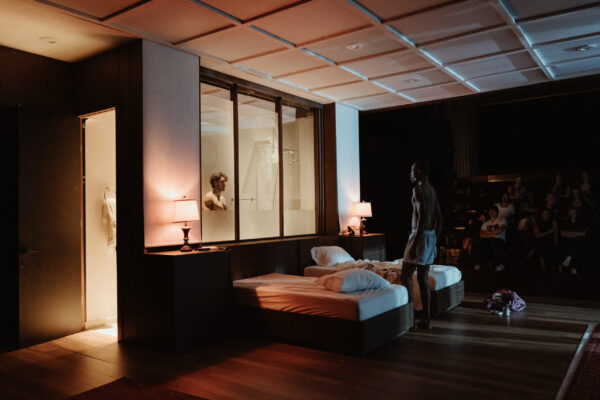
The Pass (Photo: Andy Henderson)
John Donnelly’s The Pass offers a meaty role for an actor who must toe the line between arrogance and abuse, manipulation and self-pity. But director Max Hunter’s new production (the U.S. premiere) does not bring out the nuance in the material. Instead, it ricochets through Donnelly’s trenchant efforts to toy with audience expectations, but the melancholy and anguish it should reveal never quite appear.
This 2014 piece centers on Jason (Matisse Ratron-Neal), a man full of internal conflicts. He inhabits a series of hotel rooms in this play, which stretches from his teen years to his thirties.
The first hotel room is in Bulgaria in 2014. Jason has been training in soccer since he was 8 years old, and this is the night before his life could change. Tomorrow he will play in a Champions League game. If things go well, it could launch his soccer career. But hanging over his head is the fact that someone will also get cut from the team.
Full of unbridled energy and nerves, he and his teammate Ade (Terry Bell) tease each other, swagger like they know anything about the world or themselves, and lean into toxic masculinity, grabbing their dicks, watching their mate’s sex tape, and mocking each other in blackface and whiteface.
Time leaps forward several years to a hotel room in Spain, where the now married and successful Jason meets up with a lap dancer, Lyndsey (Ino Badanjak), and plays a different set of games with her.
The last hotel room we see is upscale and caters to every customer demand because Jason is now a world-famous superstar. He’s mysteriously invited Ade to see him after being out of touch for 12 years. Here, he drags in a hotel employee (Oliver Rowland-Jones) and acts like there are no consequences his PR team cannot erase. A pill-fueled bacchanalia ensues.
The path from Bulgaria onward is paved with Jason’s belief in his superiority, his control over his celebrity image and over other people, and the queasy sense that he is outrunning himself.
Max Hunter’s production does not make clear that these are teenagers at the start (it is also possible that, with the accents, I missed a reference). But their frisky energy in clearly grown bodies skews macho and aggressive rather than reading as some kind of juvenile boundary testing. With the effective traverse staging, there is nowhere for these characters to truly hide. Even a half-glass-walled bathroom does not provide true privacy. Seth Byrum’s apposite set design leaps from a bulky tube TV and chintzy bedspreads in the Bulgarian hotel to sleek flat screens and a Peloton as Jason’s wealth accumulates.
I really liked the use of “hotel staff” to change out the set between scene changes as side chairs, artwork, and carpets seemingly pop in and out of one small cupboard with the space-saving magic of Mary Poppins.
Badanjak, as the girl who says too much, has a delightful stage energy and carries her section of the play. Ratron-Neal revels in Jason’s narcissism and steely control throughout the play. But it can be his only note. His vulnerabilities are far less apparent, and that’s what makes the character really interesting. On the flip side, Bell underplays too much. These two men do not feel inextricably linked or drawn to one another.
The play requires seeing these men try to hide from each other, open themselves up, and then lock it all away again. We need to sense that push and pull. When they get tangled up with each other one final time, we should be beset with sadness and a sense of loss. But in the loud and wild finale, that glimmer of what could have been just gets bowled over.