
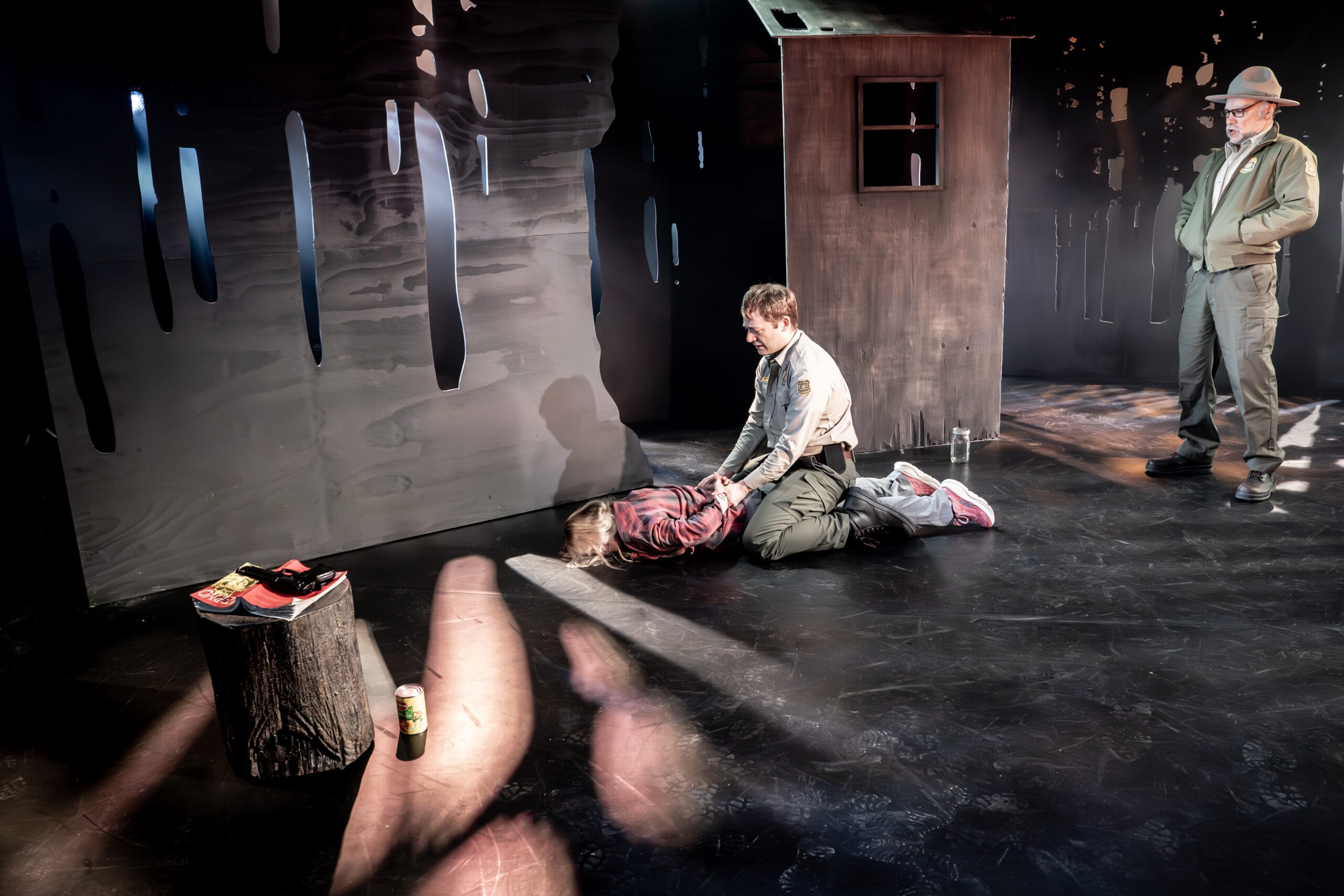
Kellie Overbey, Evan Sibley, and Greg Stuhr in The First Line of Dante’s Inferno. Photo: Marina Levitskaya
“Midway in our life’s journey, I went astray from the straight road and woke to find myself alone in a dark wood, lost.” It’s the titular line of Kirk Lynn’s The First Line of Dante’s Inferno, and clearly the inspiration for the play–as well as a perfectly functional summary of the plot. A woman disappears in a remote state park–and then her sister follows her there. Midlife, astray, alone in a dark wood: check.
Still, Lynn’s script is more elliptical and elusive than that simple description would imply. “As I remember it” is the hallmark line; the play is constantly couching itself as a dialogue between a person and their past, between the thing that happens and the story we tell about it later. Part memory play, part parable, part spiritual journey, and written more in prose than in dialogue, the piece also presents an unusual directorial challenge. As a script note says, one could treat 90 percent of the script as a richly imagined map of stage directions—the iceberg burgeoning beneath the relatively sparse spoken words. One could use a narrator’s overvoice to present the long sections that are third-person prose narrative. But what director Christian Parker has done is embrace all of it, letting each of the play’s three characters own their sections of the tale fully. The technique can make scenes feel a little stagnant or bogged down in exposition, but it also serves to show these characters’ alienation from themselves, and the opacity of their own motivations. It amps up the sense of their loneliness, too; even when they interact, they’re not exactly operating in a shared narrative or with a shared frame of reference. And it creates an odd double vision effect where the description of an action precedes the thing itself, or sometimes outpaces it, which adds to the parable effect: a twice-told tale, as it were.
Carol Espinoza has disappeared in a northeastern state park. (The ambience is beautifully created in La MaMa’s basement space, with Lauren Helpern’s set made of layers of plywood tree shapes receding back toward the upstage wall, and Zack Blane’s lighting creating depth, forest shadows, and a sense of the passage of time. And Bart Fasbender’s sound design is rich and atmospheric, with both recognizable animal sounds and more ambiguous noises.) Carol left her kids with her sister, went to a movie alone (all of this in Florida where they live), and has not been heard from since, though evidence of her presence has been found in the park. We don’t know exactly how long she’s been missing, but long enough that the initial flush of the search has worn away.. Now, her sister, Ann (Kellie Overbey), is determined to replicate Carol’s journey in order to find her. Taking up residence in a dilapidated shack, she defies the woods to harm her, and Carol to save her.
The park rangers have other ideas. When Ann is found by Craig (Evan Sibley), a young ranger who’s fled life as a high school teacher for the solitude of this remote post, his first instinct is to arrest her. But their mutual loneliness and despair speak to each other, and soon they’ve forged an alliance that’s part sexual, part parental, part dare. It’s not healthy, particularly, but it’s filling a need for both of them. It’s all well and good until Craig’s senior ranger, Bill (Greg Stuhr), more experienced and also more feral, shows up. If the scenes between Craig and Ann capture an emotional spectrum that includes suspicion, loneliness, lust, intrigue, affection, and tenderness, Bill adds a wilder, more anarchic streak to the proceedings: a little violence, a little anger, a little real danger (when Bill tries to skeet shoot a tin can with his glasses broken).
Greg Stuhr does steal the show a bit, giving a character portrayal that’s both broader and emotionally freer than either Overbey or Sibley, both of whom are more grounded and subtle. At the same time, it sometimes feels like Bill is in the piece mainly to provide that weirdness, and to add another dimension to the tension between Ann and Craig. Stuhr’s scenes with Sibley are all edgy masculine jockeying for position, which can derail from the fragile momentum of Ann and Craig’s trying to get up the courage to truly reveal themselves.
And as late revelations make clear, Ann’s quest is only partially about Carol: she’s really come more to replicate Carol’s journey than to find her sister. Ann and Craig may find a little tentative happiness together, but the overall tone remains melancholy; none of the three can really let themselves be known, or figure out how to balance the wild and the tame in them. Unlike Carol, Ann has the rangers to put her back on the straight road. Whether that’s a happy ending or a tragic one remains a mystery.