
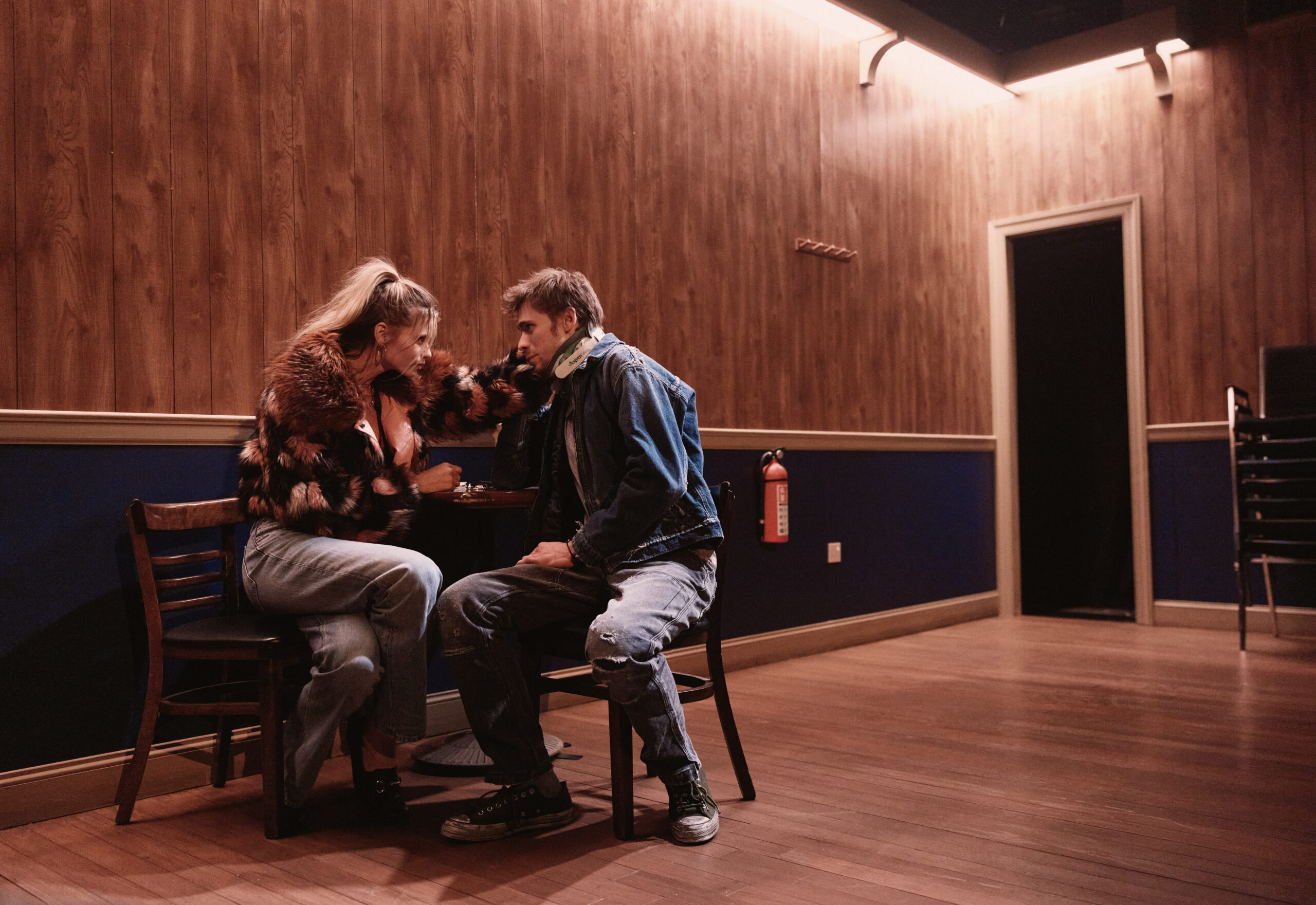
Abbey Lee and Owen Teague in Blackout Songs. Photo: Emilio Madrid
“You’re the most memorable person I’ve ever met,” one character tells the other in Joe White’s purposefully confusing, electric play Blackout Songs, now playing at the Robert C. Wilson MCC Theater Space through the end of February. His declaration, though heartfelt, feels insubstantial; both characters’ perpetual drinking binges have left them with vast swaths of unaccounted-for time. For her, the memory loss is a feature, not a bug; she wishes she could “wipe it all,” forget the past. The other character mourns his lost memories. He’s terrified that he’ll one day look back and find nothing there. The play explores this tension between trying to forget and wanting to remember so deftly that I left the theater with a feeling akin to what a magician’s volunteer might experience upon learning their watch has been stolen off their wrist: thoroughly entertained, but unsure what exactly transpired.
The first time Blackout Songs’ alcoholic lovers, referred to as “Her” (Abbey Lee) and “Him” (Owen Teague) meet, she drags him away from the twelve-step program they are ambivalently attending. It’s the beginning of a years-long romance—or is it? The timeline is obfuscated; we may be skipping around or we may be progressing linearly. Hours or days might pass between lines. Figuring out what is going on is part of the fun of the chaotic, unreliable narrative. White cleverly employs this fragmented and confusing structure to replicate his characters’ uncertainty regarding their past. We aren’t sure in what order the events we are witnessing happened, or even if they really happened at all.
It’s disconcerting, in the best possible sense. The perspective sometimes inexplicably shifts from the present tense to that of a nostalgic future where the characters are observing rather than experiencing, like when Her responds to his admission he is in love with her with, “This is the first time you said it.” Later, in a moment of emotional strain, Him flat-out asks, “Is this real? Did this really happen?” One of my favorite moments occurs when the two now-estranged lovers debate which of them pushed the other away by downplaying their relationship with, “You know, we’re just drinking buddies, don’t you?” Even though I’d seen the line delivered by Him a minute earlier, so thin was my hold on the play’s reality that I found myself questioning if it was really Him who said it. And as much as I enjoyed the vertiginous ride, I could have done with a bit more clarity at the end.
Blackout Songs is a mystery to be solved, though the dizzying pace director Rory McGregor sets doesn’t leave time for much detective work. It’s demanding work for the performers, both of whom throw themselves into their roles—at times literally, flinging themselves around physically during interstitial moments. Abbey Lee’s Her is a distillation of id, compelling and immediate. The character does everything she can to avoid displaying vulnerability; somehow Lee does this while still letting the audience see the depths of her longing and her sadness—and she with great comic timing. Teague, too, gets the funny parts right without undercutting the play’s tone. His physicality is inspiring; he’s acting with his whole body. Both actors are so clearly present in the same playworld, reacting to each other at every moment, fitting together like jigsaw puzzle pieces. Despite the substantial divide separating the two characters on paper, the performers ensure their connection is never in question.
The design elements are outstanding, though understated. Scott Pask’s simple set passes so convincingly for a church basement in the first scene that I was fooled into believing the entire play would take place there. Though the physical enviroment remains static throughout, it supports the action through the play’s many locations. Credit to Stacey Derosier’s lighting, which starts with traditional realism but gradually shifts to reflect the play’s move toward expressionism. I also quite liked Brian Hickey’s original music and sound design, which make the realistic moments more immersive and give color to the abstract ones. And Avery Reed’s costumes are spot on (shout out to Her’s faux fur vest).
Blackout Songs says so much about how we can give up parts of ourselves in relationships for better and worse, about what we get in return, and about how memory informs who we are. By the play’s end, Lee’s Her has undergone a profound shift, wishing for more memories, not fewer. As for me, I still wasn’t completely sure which character said what or what was real, but it turns out maybe that’s not that important; not every question has an answer. Like the magician’s volunteer who gets their stolen watch back, you don’t have to understand the trick to enjoy the show.