
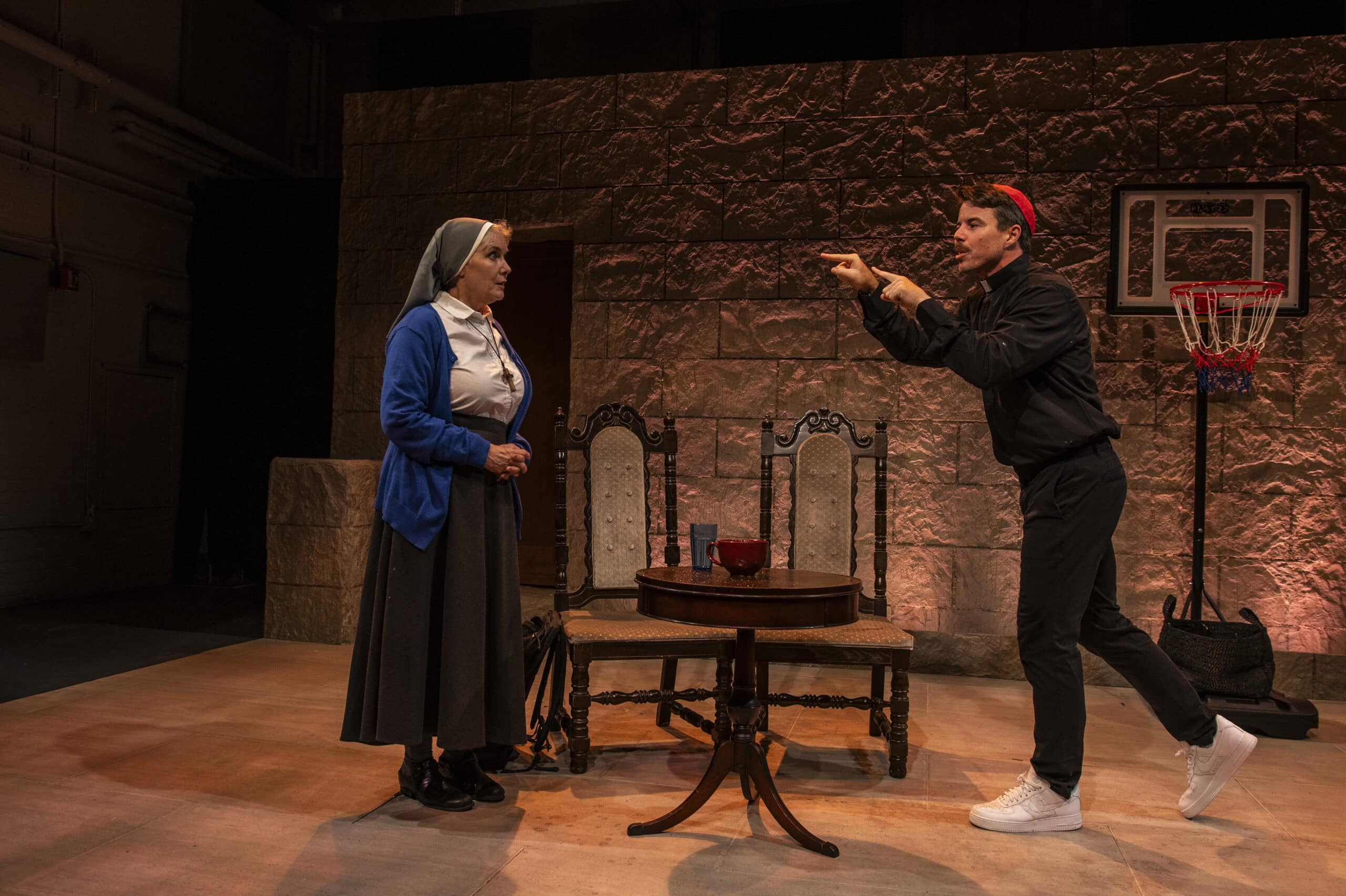
Tracy Sallows and David Hull in The Body of Mary. Photo: Alley Babcock
For an institution that has long held itself up as the world’s moral authority, the Catholic Church has a lot of ethical shortcomings to answer for: Covering up widespread sexual assault of children by clergymen. Collaborating with oppressive regimes. Crusades. Colonialism. And that’s just the Cs. In the biting and funny Body of Mary: A Play in Three Acts (of God), playing at the Gym at Judson, playwright and director Katie Cappiello travels farther down the alphabet to spotlight another shortcoming the Church has had since its inception (or perhaps I should say conception): its oppression of women.
Cappiello’s precision-guided satire stitches together three thematically similar but distinct standalone short plays. In the first (The Virgin), the Angel Gabriel (Ben Cook) informs thirteen-year-old Mary of Nazareth (Annalisa D’Aguilar) that she’s been chosen to give birth to the son of God; teenage Mary would prefer not to. The second act, The Mother, goes contemporary, where the young conservative Cardinal O’Malley (David Hull) spars with Mother Mary Joseph (Tracy Sallows) over his ambitious and controversial plan for her and the other Immaculate Little Sisters of Self-Sacrifice and Martyrdom. The play’s third Mary (Gracie Conn), also a teenager, is alone on stage in act 3 (The Dumpster), as she and her friend Neveah (the offstage voice of D’Aguilar) try and decide what to do about the infant Mary has found in the titular dumpster.
Each act entertains by playing out a simple premise to its logical conclusion. The pacing is fleet, the comedic touch light, and the social commentary discerning. And Cappiello enjoys toying with audience expectations. She creates a delicious, unresolved tension in the first act: Are we to take things at face value and accept what the angel and Mary’s father (David Hull) say, or should we be wearing our skeptical glasses and interrogate these unlikely claims? We experience not only Mary’s uncertainty but that of every Catholic asked to swallow Church doctrine, and are left to wonder what, exactly, they don’t want us to see, and why.
The second act, the show’s longest, a Handmaid’s Tale-esqye allegory quite blunt in its criticism of the Church, is both more satisfying and more frustrating: satisfying because the Cardinal’s insane plan is plausible and the conflict feels quite relevant; frustrating because the characters’ inconsistencies leave me feeling the writer has prioritized message over plot. I don’t believe Mother Mary’s turn, nor do I understand her faith in the Judas-like Father Donato.
The last act, a coda, is less pointed and less dramatic than its sisters, favoring realism over satire and consensus over conflict. Mary and her friend’s complete accord regarding the mother’s culpability keeps focus on the Church’s shortcomings but leaves the scene without much dramatic tension. And not fully interrogating the question denies the audience a chance to understand and relate to the absent mother. You either agree with Mary’s point of view or you don’t.
It’s fun to watch the actors emphatically embracing these larger-than-life characters. Annalisa D’Aguilar captures the first Mary’s innocence and awakening (and produces realistic retching sounds). David Hull plays a fairly disgusting villain in the first act, then outdoes himself in the second when he faces off against Tracy Sallows’s believable, saintly, and grounded Mother Mary. Gracie Conn portrays a grittier modern-day Mary with considerable verve, while Mary Jo Mecca and Ben Cook create strong characters in their respective supporting roles. And Lu Yi Peng graces us with a beautiful interstitial performance of “Ave Maria.”
The creative team does well with a small budget, giving enough of a set (Forest Entsminger) and lighting (Lauren Bremen) to support the action. Jennifer Baumgardner’s costumes help the audience navigate the play’s temporal leaps, though I couldn’t help but want a little more pizzazz and character in places. Florian Staab’s nicely textured sound design provides dimensionality in the Gym’s limited space.
Though never bored, I did find myself wanting The Body of Mary to delve deeper. The first act, in its weaker moments, ventures into sitcom; the final act lacks punch. The second act, clearly the show’s heart, brought to mind the question my playwriting teacher (hell, probably every playwriting teacher) would ask after reading a short: What’s the second act?
Woe to the playwright who writes a great forty-minute play! The writer seeking an audience/commercial success faces the unenviable choice of expanding something too brief to stand alone (in essence destroying the short and using its carcass to create a hopefully still decent full-length), or pairing it with another short/shorts, crossing one’s fingers that they work together. If this was the choice Cappiello faced, she has done well with the latter route, linking this second act with pieces distinct enough to provide variety yet similar enough to feel connected, reinforcing the point that the Church’s demand for obedient and subservient women has been dubious from the start.