
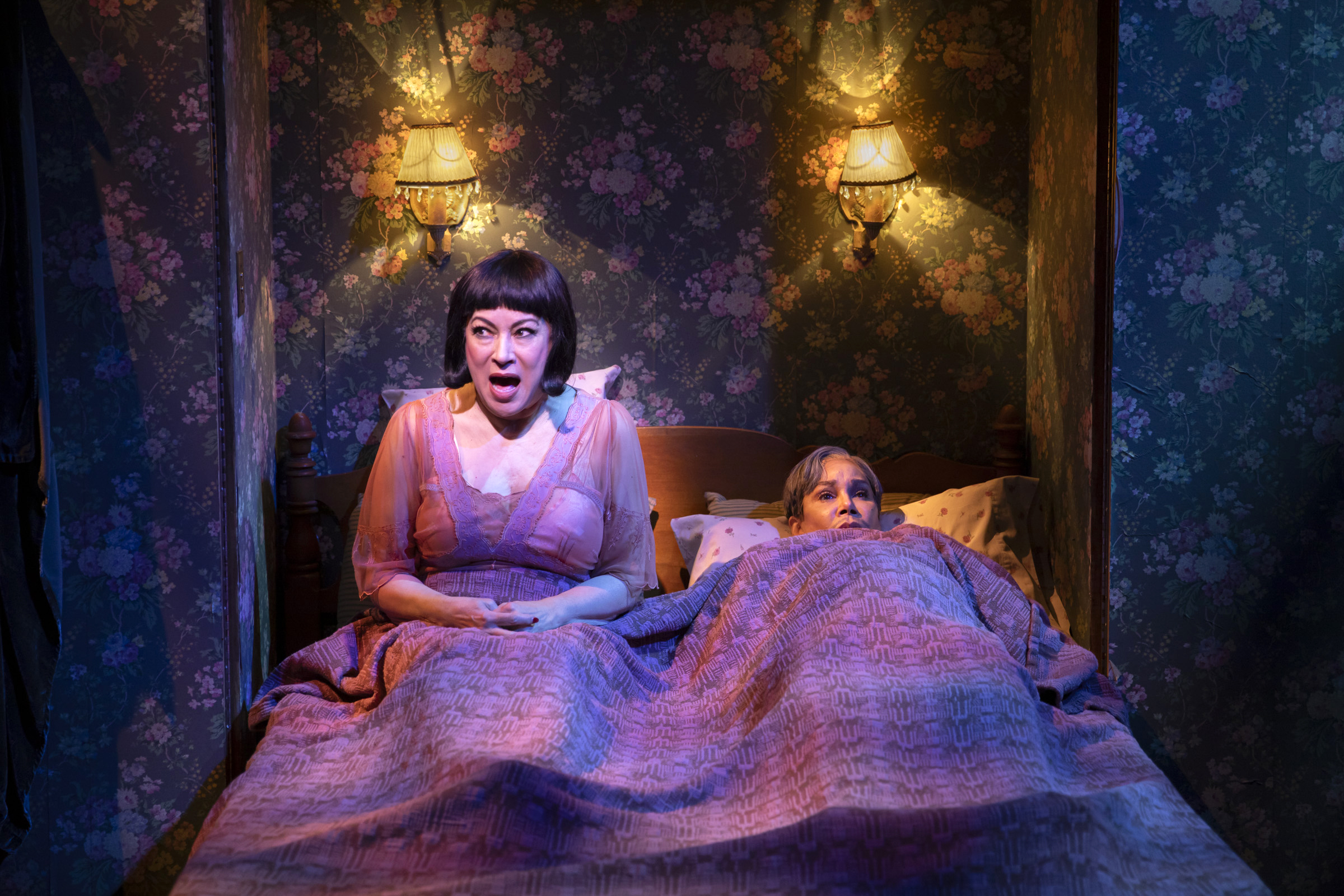
“The Adding Machine” at the Theater at St. Clement’s (Photo: Monique Carboni)
Jennifer Tilly’s tour-de-force monologue at the beginning of The New Group’s revival of The Adding Machine immediately sets the tone for what is one of the most exciting off-Broadway productions in recent memory. Tilly’s daffy persona, on full display these last two seasons of The Real Housewives of Beverly Hills, belies the exacting precision of her acting. She’s been nominated for an Oscar, sure, but her supreme self-assuredness and seemingly immense wealth on reality TV portray her as a woman of leisure – a fun time, but not necessarily someone who, at this stage of her life, is going to get into the trenches.
How surprising – and absolutely delightful – to see that she’s upending those expectations, not returning to the stage in a splashy Broadway revival, but in an off-Broadway church in Hell’s Kitchen. And, even more so, she’s puffing that powdery voice all over a 103-year-old play by Elmer L. Rice (with revisions by Thomas Bradshaw). Tilly treats Rice’s multi-page monologue like a road map and the destination is merely to drive, repeatedly, over the character’s husband, flattening him with his own failures. But with her exceptional timing and well-placed vocal modulations, Tilly turns what could be a hectoring wife into a genuinely dissatisfied partner. It’s not simple to retain the comedy and find the pathos at the same time.
In Scott Elliott’s production, Tilly delivers that monologue in a Murphy bed pulled out of an old wooden filing cabinet. Beside her in that double bed is a pair of eyes floating above the covers. Mrs. Zero’s husband, Mr. Zero, the anti-hero of Rice’s play, gives no indication that he’s even listening to his wife. You get the impression, from just those peepers, that he’s adept at tuning her out. That’s the other major surprise in Elliott’s casting: Zero is played by the inimitable Daphne Rubin-Vega.
Rubin-Vega embodies Mr. Zero with no winking acknowledgment of her actual sex. It’s not even a drag performance, really, because the intention isn’t to elbow you in the side and say, “Look at these gender roles!” Instead, Rubin-Vega plays it with a straightforward intensity, as a man faced with the end of his career and the dead-end of his marriage. He’s stifled by his chattering wife and stymied by his boss’ introduction of the newfangled adding machine that renders him redundant. His only way out is to make a bold move: in this case, with nowhere else to turn, murder.
What intensity Rubin-Vega packs in her small frame! The voice that catapulted her to stardom in Rent is still put to fiery use, even without singing. Her Zero thunders through the play, making noise because he feels unheard. Even in his softer moments, his machismo prevents him from becoming fully relaxed. He’s not built to be comfortable. He’s never had the chance. Costume designer Catherine Zuber’s three-piece suit and Tom Watson’s stringy gray wig help Rubin-Vega disappear into Zero, packaging him into what amounts to a straitjacket.
Derek McLane’s scenic design is marked by wooden filing cabinets that reveal that Murphy bed and every other location through which Zero travels, including, eventually, the afterlife. A large-scale scaffold of desk lamps, fans, typewriters, and other business accoutrement fills the back wall, representing the vast, imposing history of office life. It looms over Zero in both life and death. He’s a man defined by his career – and doomed by it. Jeff Croiter’s lighting design casts that ethereal shadow over him, evoking the dark passage of a storage room where you’d rather not linger.
Sarita Choudhury as Zero’s devoted work-wife and Michael Cyril Creighton as everybody else round out the cast, both delivering fine work. A note from Thomas Bradshaw in the program indicates that he has retained much of Rice’s language, “both the prosaic and odious.” It’s a great decision, as the prescience of Rice’s play (a machine replacing a human then, artificial intelligence replacing us all in the future) could not strike hotter.