
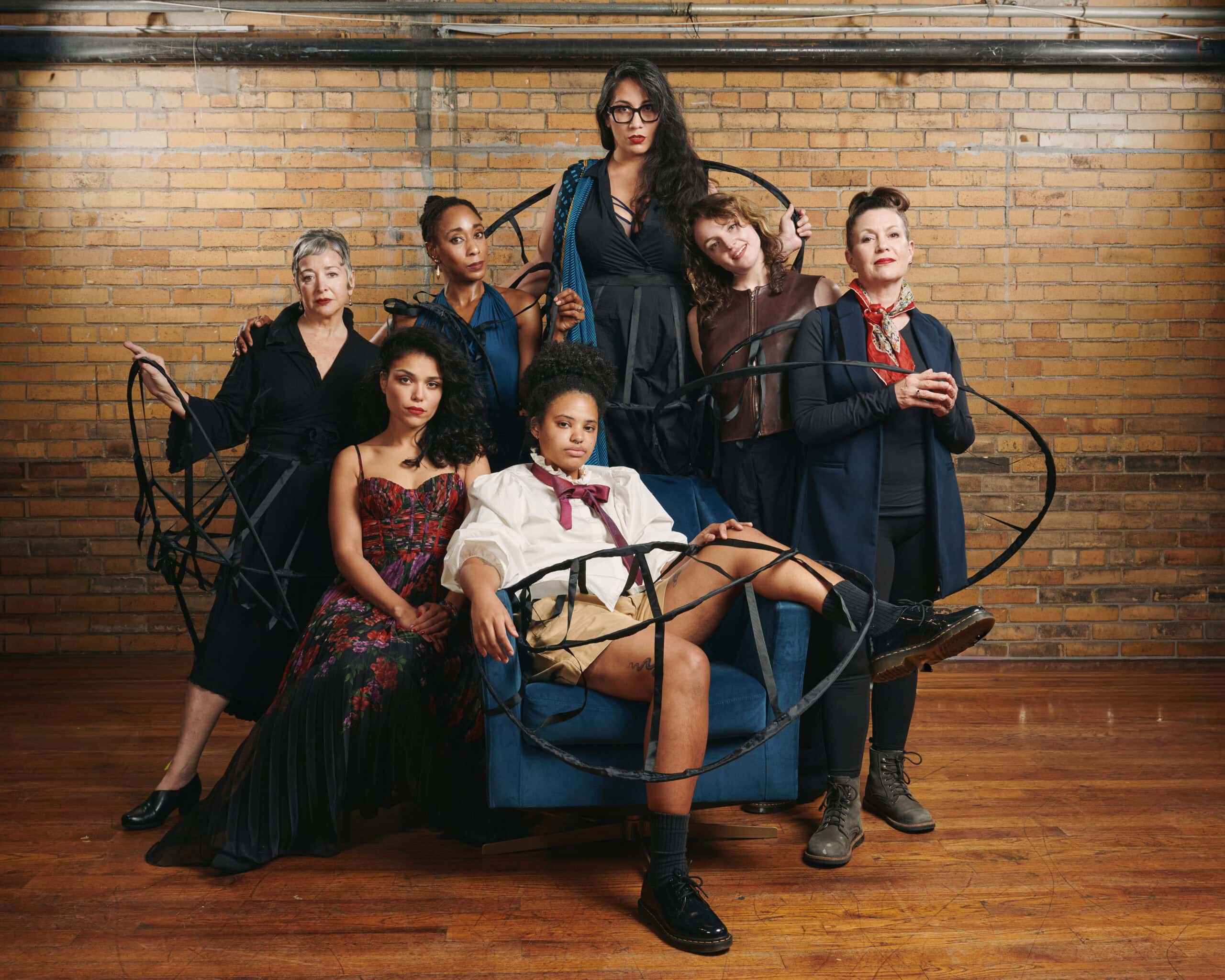
The company of Plan C. Photo: Valerie Terranova
Plan C’s two settings don’t appear to have anything in common. In one, a seventeenth-century Belgian noblewoman uses her postal network to unearth national secrets; in the second, a family-owned hardware store in modern Appalachia is mysteriously ransacked. The stories span almost 400 years and almost 4,000 miles. The pairing, unlikely as it is, sparks questions. How are the two linked? Why have they been put together? But by the end of the evening, the answers haven’t been made much clearer.
Hook and Eye Theater, the company behind Plan C, specializes in these types of “mash-up plays.” The program begins with a note explaining their ethos: to create work out of “seemingly incongruent materials” that “knit together fragments of history with our imagination to juxtapose the past against the present.” Previous productions have interwoven contemporary women with their analogues at a 1930s work camp and Iranian families with New England counterparts. Both of these connections feel tighter than those in Plan C, whose dual timelines are more ambitious than their execution proves feasible. The play, which was devised by the ensemble, is forced to speed past depth of character or plot to accommodate the colossal scope of its gaze.
The ostensible link between the two settings is their connection to the mail. Before the show, audience members are encouraged to write letters, based on a series of prompts, that will be read out by the cast. The scenic design (created cleverly by Anna Grigo, who balances the two wildly different locations required with rotating set pieces) features a series of envelopes hanging from crisscrossing red clotheslines. In Brussels, the reasoning is clear: Alexandrine von Taxis (Elizabeth London) and her company steam open letters to find hidden details of gossip they can profit on, selling intelligence about a duchess’s desire for silk to merchants. In Appalachia, it’s more of a stretch. We know that Charley (Vann Dukes) is receiving mysterious parcels, but we don’t find out what they contain until the last scene.
As a result, the Appalachia story feels out of place, centered around stakes wildly incongruent with the scenes that surround it. In Brussels, the workshop smuggles battle plans under the murderous watch of the Holy Roman Emperor. In 2026, a girl announces she wants to get her teaching degree. This mismatch is, perhaps, to be expected from two such different stories, but then why put them together at all? The final reveal of what’s in Charley’s mysterious packages does retroactively make much of the otherwise inscrutable Appalachia plot make sense, which raises the stakes to a more consequential level. It doesn’t, however, change the disorienting experience of the last 90 minutes.
In order to cover the amount of ground Plan C would like to, conventional wisdom suggests you should keep each story simple, going into thematic depth rather than spreading the plot thin. Hook and Eye seems to reject this notion, featuring a copious amount of minor characters in both timelines. Take, for instance, the workers in Alexandrine von Taxis’s workshop. Each one has an individual name and backstory—there’s Matilde (Nylda Mark), formerly a French governess, and Keiren (Jesse B. Koehler), an Irish stowaway, among the many others speaking in distractingly overdone accents—and they each force their history into awkward expositional dialogue. The group has about three scenes, but are otherwise forgotten for the bulk of the play. The runtime is short, and Plan C has hundreds of years to get through. Why spend so much time on these digressions? The same is true of the Appalachian segments—if there were no other competing plot, it might be nice to flesh out every friend of the family. As it is, it’s impossible to know who to pay attention to.
Plan C shines most in the moments it frees itself from narrative, showcasing a kind of innovative movement too rarely seen in plays. The show opens with an extended physical dance scene in the Brussels workshop, culminating with the company marching in a staggered formation while writing, stamping, and sending letters with beat-perfect precision. This is the first in a handful of compelling choreography sequences by Leslie Galan Guyton, each of which elevates the show into something more ethereal and consequential than the sum of its parts. In the Appalachia scenes, a procession of people all pass a package down the line in harried movements that mimic Charley’s frenetic worries. The meticulous movements of Parnia Ayari lead both of these segments, and she shines in a solo dance near the end.
In moments like these, you get a glimpse of what Hook and Eye was going for. Plan C is, if nothing else, ambitious. It’s just a pity the rest of the show got stuck in transit.